Get Full Government Meeting Transcripts, Videos, & Alerts Forever!
Get email alerts on the Finance Impact Fees topic
No spam. Unsubscribe anytime.
County staff outlines draft transportation impact fees; commission asks for more data before vote
Summary
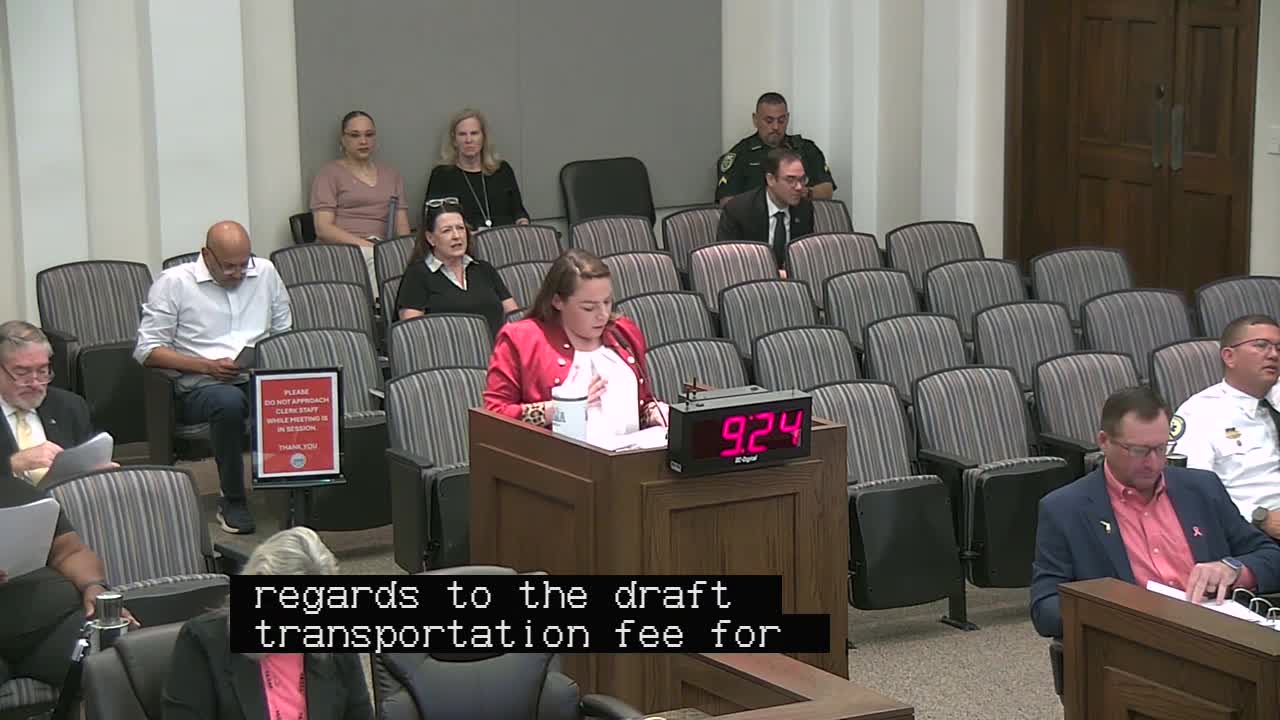
County planning staff on Tuesday presented a revised draft transportation impact‑fee study and asked the Board of County Commissioners to give direction on interest‑rate assumptions and fee adoption percentages.
County planning staff on Tuesday presented a revised draft transportation impact‑fee study and asked the Board of County Commissioners to give direction on two main policy choices: which interest rate to use when annualizing capital costs and what percent of the legally allowable fee the county should adopt.
Jessica, a county planning staff member, told commissioners the study team proposed applying a 6% interest rate to calculate the maximum allowable fee and offered two example adoption scenarios (75% residential/50% nonresidential and 60% residential/40% nonresidential). “We are recommending that the 6% interest rate is applied,” Jessica said, describing 6% as “the maximum allowable impact fee that you can impose without doing another study.”
The presentation compared Okeechobee’s draft fees with surrounding counties and explained methodological choices. Jessica noted some land‑use units in the comparison relied on different editions of the ITE trip generation manual and said the report would include footnotes explaining those exceptions. She also answered questions about developer credits, explaining that credits for infrastructure provided by a developer are handled under Florida statute and typically agreed in a developer agreement on a dollar‑for‑dollar basis at fair market value.
Why it matters: Impact fees are a primary local tool to require new development to pay for transportation capacity needed because of growth. The commission’s selections on interest rate and adoption percentage would determine how much of the calculated fee the county seeks to collect and therefore the immediate cost to new housing and nonresidential development.
Commissioners pressed staff for more evidence behind specific fee numbers and for the consultants to present in person. Commissioner Burrows said the board should have the consultant available so commissioners could ask technical questions directly. “It would be nice when you’re paying for a consultant that you would be able to see their happy face here, and for us to ask the questions personally,” he said. Several commissioners expressed concerns about particular land‑use rates in the comparison table—pharmacies versus coffee shops and hospitals—asking the consultant to explain the trip‑generation assumptions.
Next steps and public process: Staff said the methodology document would be circulated if the board confirmed the interest‑rate assumption. Jessica said the next formal step is a public hearing; she asked whether the board was in consensus on 6% interest and the 60/40 adoption scenario. Several commissioners said they preferred the 60/40 scenario as more in line with nearby counties. The board asked staff to obtain the full technical methodology from the consultant (Kimley‑Horn) ahead of any public hearing and to invite the consultant to attend a joint meeting so commissioners could ask detailed questions.
What was not decided: Commissioners did not adopt fees at Tuesday’s meeting. No ordinance or resolution was introduced; staff only sought direction to proceed to public hearing with a specific interest rate and adoption scenario.
Quotes
“We are recommending that the 6% interest rate is applied because… that’s the maximum allowable impact fee that you can impose without doing another study,” Jessica, county planning staff member, said.
“If we’re going to do this, they may charge us reasonable dollars to come here and have a person stand where she’s at. Let’s do that,” Commissioner Burrows said, urging the consultant to appear in person.
Ending
Staff will circulate the full methodology to commissioners and schedule public hearings. The board directed staff to ask the consultant to present the methodology in person before any final adoption vote.