
Commission discusses law‑enforcement federalism: 287(g), deputization, forest‑service rule and use of National Guard
Get AI-powered insights, summaries, and transcripts
Subscribe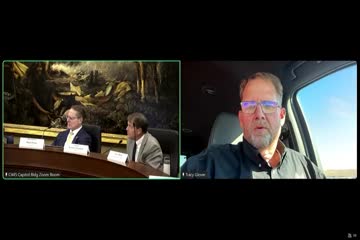
Summary
The Federalism Commission focused on law‑enforcement issues: 287(g) and other deputization models, a Forest Service criminal‑prohibitions rule, and recent federal uses of the National Guard and emergency powers.
The commission devoted the remainder of its meeting to law‑enforcement issues that intersect with federalism, including local participation in immigration enforcement, deputization of federal rangers, federal criminal prohibitions on public lands, and the federal government’s recent domestic use of military and emergency powers.
Sheriff Tracy Glover (Kane County) described local and regional sheriff concerns about federal rulemaking that affects how sheriffs perform duties such as search and rescue and property‑crime enforcement on federal land. Glover said sheriffs and western law‑enforcement associations joined the commission to comment on an OSHA rule that would have affected search‑and‑rescue work; the rulemaking has been shelved for now. He also described a December Forest Service rule that expanded criminal prohibitions on national‑forest lands; sheriffs said that historically local law enforcement took the lead on many property crimes and that the Forest Service change blurred enforcement lines. Representative Malloy (federal) is pursuing a Congressional Review Act motion to revisit that rule, Glover said.
Sheriff Michael Smith (Utah County) described two MOA models local sheriffs use for immigration work — a warrant‑officer model (to check identities on booking and hold people when appropriate) and a task‑force model (to share investigative resources). Smith said deputization and task forces can give local sheriffs tools to identify suspects and request holds while preserving local priorities. Smith noted that each sheriff is an independently elected official and that participation varies by county.
Commissioner Weston and others requested more detail about how the 287(g) agreements are implemented in practice and whether ICE efforts include significant financial recruitment incentives for deputies; commissioners asked staff to gather specifics from sheriffs and police chiefs and return with a focused briefing.
Ilya Somin, a constitutional scholar from George Mason University and a Cato Institute fellow, gave a legal overview of the constitutional principles at stake. He summarized the nineteenth‑ and twentieth‑century expansion of federal power (commerce, spending, and immigration precedents) and reviewed recent jurisprudence that limits federal commandeering of state governments. Somin discussed emergency powers and the National Emergencies Act, the International Emergency Economic Powers Act (IEEPA), the Alien Enemies Act and statutes that permit federalization of National Guard forces (10 U.S.C. § 12406, and the Insurrection Act). He said courts should not simply defer to presidential declarations of emergencies and that domestic military deployments for routine law enforcement threaten the rule of law unless limited to true, demonstrable invasions, rebellions or mass breakdowns of civil order.
The commission did not adopt policy at the meeting but asked Professor Somin to remain available and asked staff to form a working group to collect specific questions from commissioners and to convene a follow‑up session focused on: (1) practical deputization and 287(g) experience in Utah counties; (2) the Forest Service criminal‑prohibitions rule and the CRA action; and (3) the statutory standards that govern domestic federal military deployments. Sheriff Glover and Sheriff Smith agreed to provide operational details to staff for the follow‑up.