Get Full Government Meeting Transcripts, Videos, & Alerts Forever!
Get email alerts on the Transportation Planning topic
No spam. Unsubscribe anytime.
UDOT presents mobility and environmental analysis of Salt Lake City highway-reduction projects; city to present mobility plan next month
Summary
The Utah Department of Transportation presented a mobility and environmental analysis of lane-reduction projects in Salt Lake City, finding mostly minimal cumulative mobility impacts across a large study area but mixed, localized effects and stakeholder concerns about construction and access.
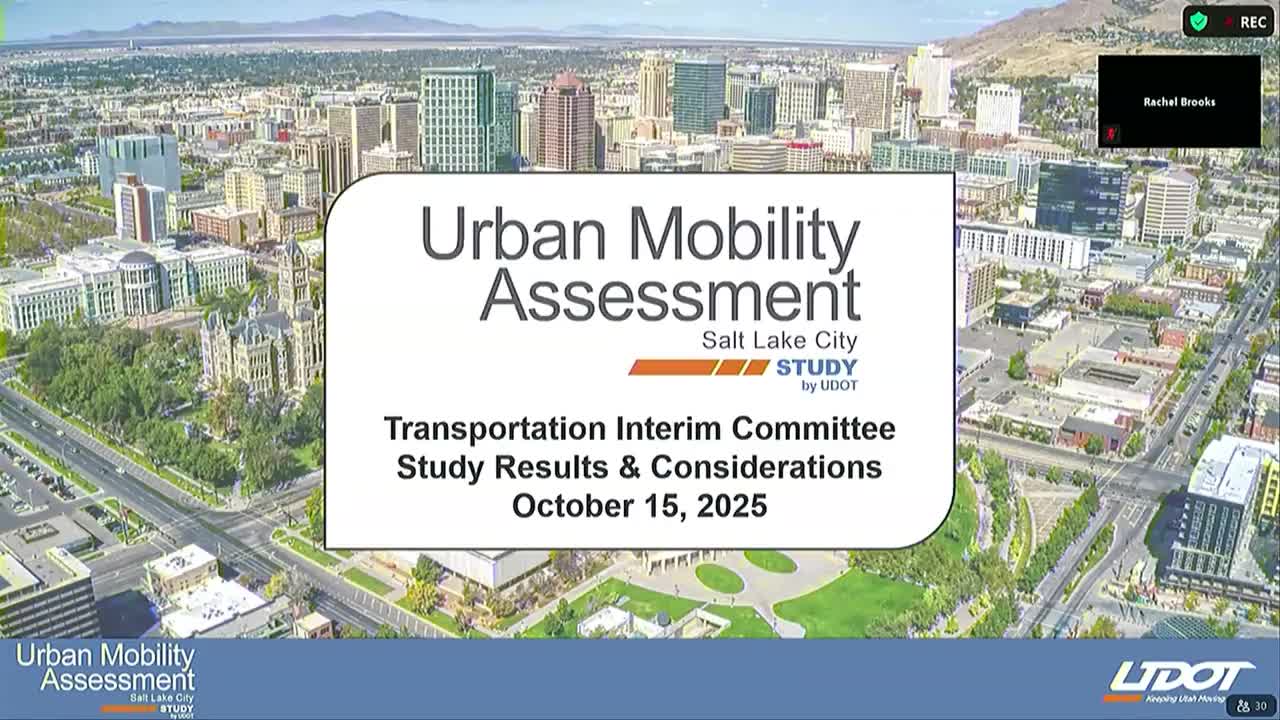
Carlos Pereira of the Utah Department of Transportation summarized an analysis required by Senate Bill 195 that assessed mobility and environmental impacts of Salt Lake City’s completed and proposed highway-reduction strategies (HRS). Pereira said the study draws on large datasets — traffic-signal detection, continuous counters and private-sector trip data — and used travel-demand models plus micro-simulations to isolate HRS impacts from other drivers such as COVID-era travel changes and construction.
UDOT said the study covered a study area bounded roughly by 2100 South on the south, Interstate 15 on the west, Foothill Boulevard on the east and North Temple on the north. The department identified 13 completed HRS projects and 15 anticipated projects within that area and reported lane-mile changes and parking impacts for the study area.
Pereira said speeds and volumes changed during the study period, with COVID reductions and then subsequent recovery complicating simple before/after comparisons. He reported the study found mostly “minimal” changes in vehicle mobility across the study area, with localized worse or better results depending on corridor. Transit and active-transportation impacts varied: some corridors showed increased transit ridership and improved active-transportation facilities, while parking shifts occurred in different neighborhoods.
UDOT reported negligible cumulative environmental impacts across the study area but noted specific localized effects. The department said stakeholders — businesses, emergency service providers, institutions and residents — reported mixed experiences: construction disruptions, freight and delivery challenges, but also improved bicycle and pedestrian facilities in places. Emergency response impacts were raised anecdotally by ambulance providers; UDOT said the claim could not be independently verified from the study data.
As considerations, UDOT recommended identifying and preserving a tier of vehicle-capacity routes, improving signal operations, and strengthening engagement and construction mitigation practices. UDOT said Salt Lake City will present its formal mobility plan to the committee at the November 19 interim meeting; Pereira and Mayor Erin Mendenhall said the city will also address curb management and parking as part of its mobility plan.
Committee members asked technical and data questions, and UDOT said certain short-term data anomalies may be attributable to data quality issues in private-sector datasets. Mayor Mendenhall said Salt Lake City agreed with the presentation and will return with its plan. No committee action was taken at the session.