Get Full Government Meeting Transcripts, Videos, & Alerts Forever!
Get email alerts on the Behavioral Health Funding topic
No spam. Unsubscribe anytime.
Audit maps Utah behavioral health funding and recommends interim oversight to reduce fragmentation
Summary
Legislative auditors produced an interactive mapping of the state behavioral health system’s funding flows, finding fragmented funding streams, limited program-level performance measurement and a need for a central interim authority to improve coordination. The Health and Human Services Interim Committee and the Social Services Appropriations Sub
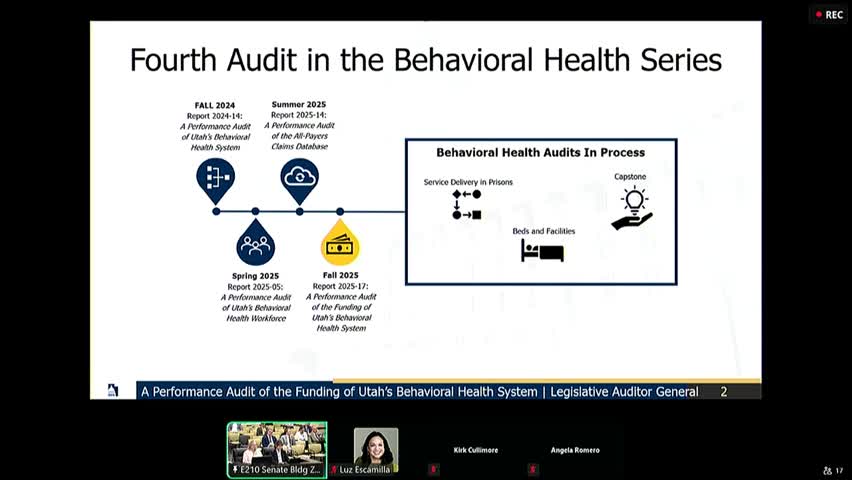
Legislative auditors presented a statewide review of how Utah funds behavioral health services on 2025-09-25, publishing an interactive map of funders, programs and recipient entities and concluding the system has fragmented funding streams, limited program-level performance measurement and insufficient cross‑agency coordination. The committee voted to refer the audit to the Health and Human Services Interim Committee (lead) and the Social Services Appropriations Subcommittee (review).
What auditors reviewed
Auditors compiled a large, interactive visual that links federal, state and local funding streams to programs across departments including the Department of Health and Human Services (DHHS), the Department of Corrections (UDC), the Utah State Board of Education and others. Auditors said the system is larger and more complex than commonly presented and that most programs do not perform routine, outcome-based evaluations or collect sufficient client feedback to demonstrate impact.
Key findings
- Fragmented funding and duplicated responsibilities: Auditors identified cases where closely related services — for example, behavioral health care and substance-use treatment in prisons — are funded and administered by different agencies, which complicates service delivery and performance oversight.
- Limited program evaluation: Most programs examined lacked consistent performance measures, cost‑benefit analysis or routine client feedback collection, leaving the Legislature and executive branch with insufficient evidence to judge program effectiveness and prioritize funding.
- Governance and oversight gap: Auditors recommended that the Legislature consider creating a central authority to map, coordinate and evaluate behavioral health funding and services. As an interim step, auditors suggested designating an entity (for example, DHHS or an interim authority) to perform coordination and basic oversight while the Legislature decides a long-term governance model.
Responses and next steps
The governor’s Office of Strategic Finance and the Division of Planning and Budget (GOPB) told the committee it supports strategic planning facilitation, training on performance measures and integrating program-level actors into existing state planning networks. DHHS signaled openness to playing a larger coordination role. Auditors and GOPB officials described existing GOPB tools — agency strategic planning support and a performance measures playbook — as resources that can be applied to behavioral health programs.
Action taken
The committee voted to refer the performance audit of the funding of Utah’s behavioral health system to the Health and Human Services Interim Committee as lead and the Social Services Appropriations Subcommittee as review committee; the motion passed by voice vote.
What’s next
Auditors recommended the Legislature consider an interim coordination authority while it studies structural governance options and urged improved program-level evaluation and financial tracking so future funding decisions can be based on outcome data rather than fragmented budget line items.