Get Full Government Meeting Transcripts, Videos, & Alerts Forever!
Get email alerts on the Department Alcoholic Beverage Services topic
No spam. Unsubscribe anytime.
Auditors find inventory, oversight failures at Utah Department of Alcoholic Beverage Services
Summary
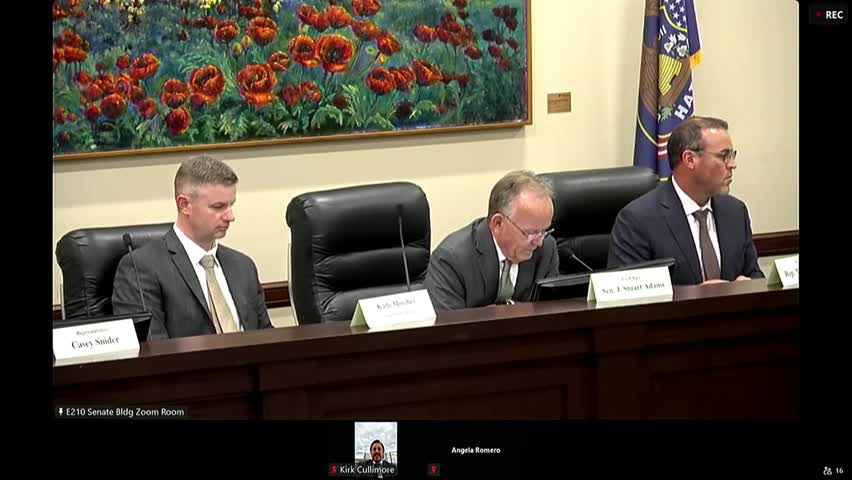
Legislative auditors told the Legislative Audit Committee on 2025-09-25 that a systematic performance audit of the Department of Alcoholic Beverage Services (DABS) revealed persistent inventory variances, gaps in financial controls and a “culture of noncompliance,” and the committee voted unanimously to refer the audit to the Economic and Community Development Appropriations Subcommittee as lead and the Business and Labor Interim Committee as the review committee.
Legislative auditors told the Legislative Audit Committee on 2025-09-25 that a systematic performance audit of the Department of Alcoholic Beverage Services (DABS) revealed persistent inventory variances, gaps in financial controls and a “culture of noncompliance” in operations, and the committee voted unanimously to refer the audit to the Economic and Community Development Appropriations Subcommittee as lead and the Business and Labor Interim Committee as the review committee.
The auditors said they reviewed the whole agency, then focused on operational risk areas including retail stores, the statewide warehouse and the department’s enterprise inventory system. Deputy Auditor General Brian Dean said their report shows repeated findings since 2010 and problems with inventory controls, IT systems and oversight that management has not fully corrected. Auditor Rusty Foster and team member Abby Maccabee joined the presentation.
Why it matters: DABS operates a retail enterprise that auditors said generated approximately $500 million in annual sales and returns large sums to the state general fund. Weak inventory controls and incomplete financial reporting, auditors told the committee, risk public resources and can distort planning decisions such as the need for a larger warehouse.
Audit findings and examples
- Inventory variances: Auditors found multiple stores and the warehouse with inventory counts that diverged from the department’s records. The office reported stores with repeated, unexplained variances and said store- and regional-level investigations were not performed consistently.
- Delayed internal audit and incomplete reviews: An internal audit of DABS’s primary inventory and financial system, prioritized after the system launch in October 2022, was delayed and completed about 18 months after prioritization. Auditors said that review focused on contracts rather than the control failures that auditors and the state auditor previously identified.
- Incomplete data used in legislative requests: Auditors flagged one example in which material excluded from DABS’s warehouse turn calculations — inventory held as bailment (owned by producers, not DABS) — was omitted from a presentation to the Legislature. Because bailment made up roughly 60% of total inventory in the auditors’ example, the omission made warehouse turns look more efficient and could have affected legislative evaluation of a warehouse expansion request.
DABS response and management actions
Erica Evans, the executive director of DABS, acknowledged the audit findings and told the committee the department has substantially changed executive leadership and is implementing an action plan. Evans said the department is tightening inventory controls, has revamped store audit checklists, is increasing cycle counts and is evaluating an annual third-party inventory count. She said finance and budget approval processes have been reset and a new deputy director of finance and administration is in place.
Steve Handy, chair of the Alcoholic Beverage Services Commission, told the committee he and the commission pledge active involvement and oversight and said the commission supports the action plan.
Legislators’ questions and concerns
Committee members pressed auditors and DABS leaders on specific problems including a cluster of about $400,000 in unexplained losses at a non‑public retail store between fiscal years 2000 and 2024 (the audit text identifies inventory losses concentrated where stores serve licensees rather than the general public). Senator Escamilla and Representative Romero asked whether statutory changes are needed to increase accountability for an enterprise-style state operation; auditors emphasized management and control improvements while acknowledging the Legislature may consider statutory remedies.
Action taken
The committee voted unanimously to refer the systematic performance audit of the Department of Alcoholic Beverage Services to the Economic and Community Development Appropriations Subcommittee as lead and to the Business and Labor Interim Committee as the review committee. The referral was recorded as a unanimous voice vote.
What’s next
The audit report includes recommendations for strengthening inventory controls, improving risk assessment and coordinating internal audit work with the commission. DABS officials and the commission said they will implement the department’s action plan and work with the referring committees as they review the audit and the department’s proposed responses.