
Seattle Public Schools presents 2025–26 highly capable plan; narrows universal screening and pilots single‑domain identification
Get AI-powered insights, summaries, and transcripts
Subscribe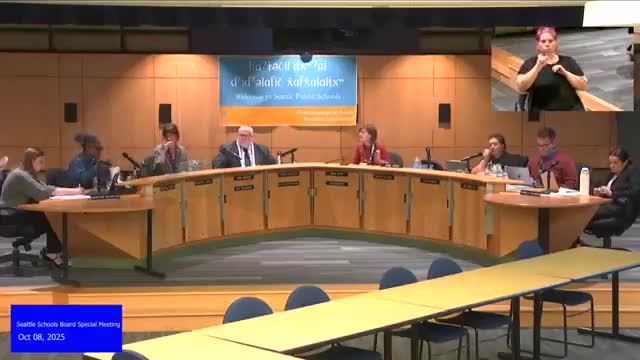
Summary
District staff presented a draft 2025–26 highly capable (HC) plan that narrows universal screening to grades 1 and 4, adds single‑domain identification (math or literacy) beginning in 2026, and emphasizes teacher training and site‑based supports. Final recommendations are due in February 2026.
Seattle Public Schools staff on Oct. 8 presented a draft 2025–26 Highly Capable (HC) plan that tightens identification steps, increases teacher supports and pilots single‑domain identification for students who show advanced learning in math or literacy.
Assistant Superintendent Kurt Buttleman introduced the item and Dr. Paula Montgomery, director of Highly Capable Services, described changes the department is implementing this year. The district said it will use universal screening in first and fourth grades, keep family and educator referrals open at other grade levels, and roll out single‑domain eligibility (math or literacy) with services beginning in 2026.
Dr. Montgomery said the department reduced the scope of universal screening to better align resources behind instruction and teacher support. She told the board that about 12% of Seattle Public Schools students currently hold a highly capable designation and that the department’s priorities this year include professional development for teachers, work on a new “new to Seattle” evaluation pathway for students who have been educated outside the district, and targeted math acceleration pilots.
"We are committed to listening to our communities," Montgomery said, noting several remaining engagement sessions and a commitment to return to the board in February 2026 with recommended changes and a tighter plan before open enrollment.
Key changes and programs noted by staff: - Universal screening limited to grades 1 and 4, with family and educator referrals accepted at other grades; communications to families will be provided in the district’s top languages. - Single‑domain identification (math or literacy) will be implemented for 2026 services, so students may qualify in one subject without qualifying in both. - A revised teacher referral tool (demonstrated performance instrument) has been vetted with Seattle elementary teachers and is scheduled for broader release to better capture students who do not appear on test scores alone. - Site‑based support: three teachers on special assignment will spend time in schools to assist teachers with classroom strategies aligned to universal design for learning and gifted standards. - A summer math acceleration pilot for rising fifth graders to compact sixth‑grade material, and a 4–5 math materials project across five elementary schools to provide deeper learning and accelerated standards alignment. - A planned pathway to assess students who are new to Seattle without requiring a full year of district enrollment before eligibility review.
Board members asked for clarification about whether summer acceleration will become a permanent route into cohort programs; staff said that will be part of the work before the district returns with final recommendations in February. Director Mizrahi asked whether the summer accelerated math program was intended as a long‑term replacement for cohort placement; staff said the February follow‑up will outline options and the district’s preferred approach.
Why it matters: The HC plan directs how the district identifies and serves students who need accelerated instruction. Narrowing universal screening aims to balance identification with capacity for follow‑up services and to target teacher supports that would benefit both identified students and others who are ready for more advanced work.
Next steps: Staff will continue community engagement sessions, refine tools and return to the board with recommended policy and implementation details in February 2026, ahead of open enrollment for 2026‑27 services.