Get Full Government Meeting Transcripts, Videos, & Alerts Forever!
Get email alerts on the School Safety Police topic
No spam. Unsubscribe anytime.
School board rejects amended policy to allow Garfield student‑engagement officer pilot after hours of testimony
Summary
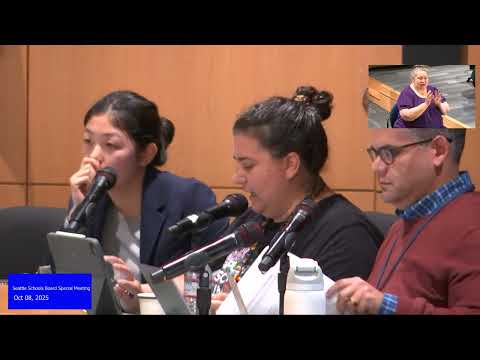
The Seattle School Board on Oct. 8 voted 5–2 against adopting an amended version of Board Policy 4311 that would have authorized a one‑year pilot placing a Seattle Police Department student engagement officer (SEO) at Garfield High School.
The Seattle School Board on Oct. 8 voted 5–2 against adopting an amended version of Board Policy 4311 that would have authorized a one‑year pilot placing a Seattle Police Department student engagement officer (SEO) at Garfield High School.
The board voted first to adopt an amendment from Director Michelle Mizrahi that narrowed the SEO role, required a school‑level complaint process, and directed the superintendent to provide a plan and timeline by Dec. 31, 2025, to collect data and assess the pilot. That amendment passed unanimously. After extended public testimony and board debate the full motion to adopt the revised policy failed, with Directors Clark and Mizrahi voting yes and five directors voting no.
The amendment approved by the board would have limited an SEO’s role to responding to external threats and providing liaison services, stated the SEO must not act as an enforcement arm of school administration, required a school‑site complaint process in addition to Office of Police Accountability (OPA) pathways, and asked staff to present program data and budget implications before any expansion beyond Garfield.
The proposal prompted hours of public comment, largely from Garfield students, families, teachers and community groups. Speakers opposing police inside classrooms said the district should invest in alternatives and community control; speakers supporting the pilot said Garfield needs additional, consistent public‑safety resources near campus. Student board member Sabi Yoon described plans for student engagement sessions to inform a pilot; community advocates and teachers urged stronger student oversight and independent complaint channels.
Demetrius Wheeler, a student family advocate at Interagency, said in public testimony that staff who advocated to keep a West Seattle site open were being investigated and asked the district to stop what he called “baseless investigation[s].”
McKenna Gaudient, a special‑education teacher who worked at Garfield, opposed bringing armed officers into classrooms and said the SEO in the draft would not have required training in nonviolent physical intervention or restorative justice. "Guns do not belong at school, plain and simple," she said.
Community groups including the Seattle Alliance Against Racist and Political Repression urged what speakers called “community control” — student, staff and family authority over officer selection, training standards, performance evaluation and complaint review. Jonathan Toledo, a member of that alliance, said the proposal did not yet give students, faculty and parents control over officer selection or termination.
Board debate reflected deep divisions. Director Mizrahi said his amendment responded to community concerns by clarifying limits, complaint procedures and measurement criteria. Director Rankin, who spoke in support of a measured approach, said the decision should follow building leaders’ requests for additional safety resources. Directors who opposed the final motion cited long‑standing distrust of district‑police relationships and concerns that prior agreements and communications had been opaque. Director Sarju called the broader process “a sad statement on adults” for how it had unfolded.
The board’s failed motion would have substituted the policy language attached to the amendment and directed the superintendent to collect program data, including through community engagement, to assess the SEO pilot’s effectiveness. Following the vote, board leaders said they still intended to work with Garfield staff and the community on safety strategies.
What happened next: Because the motion failed, no policy change took effect and no SEO pilot authorization was approved. Board members and district staff said they would continue community engagement and that any future agreements would require additional drafting and review.
Why it matters: The vote leaves in place the district’s existing constraints on assigning law enforcement in schools while keeping open other safety options such as increased patrols, contract security or non‑police safety staff. Supporters said a dedicated engagement officer could address external threats to Garfield; opponents warned the presence of armed officers risks increased surveillance and disciplinary escalation for students already disproportionately affected by school discipline policies.
The board heard related safety concerns throughout the meeting — including testimony describing alleged past misuse of police by school administrators and calls for greater transparency about interagency plans and levy funding — signaling ongoing community tension around the role of law enforcement in Seattle schools.