Get Full Government Meeting Transcripts, Videos, & Alerts Forever!
Get email alerts on the Short Term Rentals topic
No spam. Unsubscribe anytime.
Mono County holds extensive workshop on short‑term rental policy; board debates cap, waiting period and Interlochen
Summary
On Oct. 21, Mono County supervisors spent a day reviewing a comprehensive short‑term rental policy package (GPA 25‑01) designed to limit the conversion of housing to visitor rentals while preserving visitor capacity.
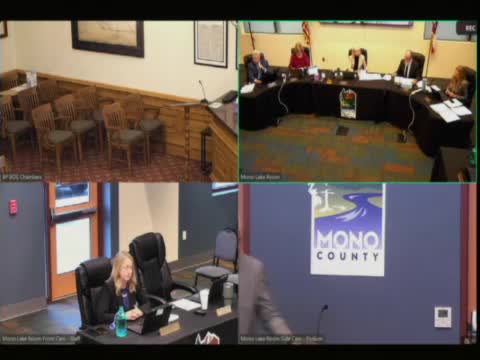
MONO COUNTY, Calif. — On Oct. 21, the Mono County Board of Supervisors held a day‑long workshop to review a comprehensive short‑term rental (STR) policy package, including a General Plan amendment (GPA 25‑01), proposed zoning and permitting changes, and locally targeted measures for condominium complexes such as Interlochen in June Lake.
The county’s Community Development director, Wendy Sigimura, told the board the draft package is the product of roughly two years of study that began after a moratorium on new STR permits. "This whole report and all of the information before you is really the culmination of that last 2 years of work," Sigimura said. The board took public comment, asked staff for clarifications and signaled several policy directions; staff will return Nov. 18 with a redlined package for formal action.
Why it matters: The package aims to limit the conversion and commodification of residential housing into visitor rentals while preserving visitor capacity. Staff said the proposals are designed to protect community housing without immediately reducing the county’s visitor bed base; the board’s decisions this fall will shape how July and winter visitor economies and local housing availability interact going forward.
Key points from the workshop
- Scope, outreach and data: Staff summarized outreach (online survey, RPAC meetings, Planning Commission workshops) and research from a February 2024 STR study. Staff told the board Mono County had about 106 permitted STRs as of February 2024 (85 of them in June Lake), with much of the county’s STR concentration in resort areas. Sigimura said 60% of county housing is occupied year‑round and over 80% of vacant units are second homes or seasonal/recreational properties.
- Numeric cap: Staff presented alternatives including a countywide cap, a June Lake‑only cap and no cap. The Planning Commission recommended eliminating a numeric cap. During the workshop the board conducted a nonbinding straw poll; several supervisors favored not imposing a cap but were explicit that the board could revisit the question when it takes final action. Support and opposition differed by community and stakeholder group in earlier outreach.
- Waiting periods after sale or new construction: Staff proposed a waiting period (Planning Commission recommended two years) before a new owner or newly built residential unit could become an STR. The board signaled support for a shorter waiting period and settled on directing staff to return with language for a one‑year waiting period (with exemptions) when the package is redlined. Planned exemptions include properties that have been continuously operating as permitted STRs for a specified period, units deed‑restricted to middle or lower AMI thresholds (the draft used 120% AMI), and owners who already operate qualifying long‑term rentals.
- Incentives and mitigation: Staff discussed an incentive option in which developers or owners could propose multiple deed‑restricted long‑term units in exchange for STR allowances (the packet described a 3:1 unit ratio as one example). Staff noted that the county’s current Housing Mitigation Ordinance (HMO) already charges fees intended to offset STR impacts but that the fee captures a fraction of the policy study’s calculated housing impact.
- Compliance and inspections: The draft would retain nuisance rules and add stronger compliance tools, including third‑party inspections to verify safety and occupancy conditions. Staff said the county currently lacks a standardized inspector program and would need to train or accept qualified inspectors.
- Consolidated permitting and condominiums: Staff proposed a single permitting pathway for STRs so similar residential units are processed consistently across land‑use designations. Most condo complexes in June Lake would be brought under the same permitting requirements; Interlochen was discussed separately because of its current land‑use classification and historical nonconforming status.
Board action on Interlochen
The board voted 4‑1 to adopt the Planning Commission’s recommendation to initiate a general plan amendment for Interlochen to a land‑use designation that allows visitor accommodations (Commercial Lodging Moderate) and, while that GPA is processed, to allow existing STRs to be permitted under the existing nonconforming‑use findings and processed with vacation‑home‑rental permits (short term rental approvals would continue to transfer on sale during the interim). The roll call was: Dugan — yes; Kreitz — no; McFarland — yes; Peters — yes; Salcedo — yes.
What’s next: Staff will prepare redline code and general plan language and return on Nov. 18 for formal hearings and possible adoption. The draft package will also be subject to required noticing for zoning changes and any state consultation requirements noted by staff.
Public response and dissent
Public comment at the workshop reflected a wide range of views. Several June Lake property owners, local reservation managers and realtors urged the board to avoid rules that they said would depress property values or reduce visitor lodging capacity. Some residents and community groups urged tighter limits, saying STR growth has worsened housing access for local workers and year‑round residents. Board members repeatedly emphasized the package does not seek to revoke existing, valid STR permits.
Closing and timing
Staff emphasized the board’s role at the workshop was to give direction; final legal text and a formal hearing that meets state notice rules will follow. The county attorney and community development staff will return with a final redline on Nov. 18. The board also instructed staff to fold in additional clarifications, for example clearer definitions of which land‑use designations are treated the same and how exemptions will be assessed.
Ending note: The STR package remains a multi‑step policy process: staff and the board must reconcile the county’s housing goals, land‑use rules, and the requests of property owners before final adoption. The Nov. 18 return will be the next formal decision point.