Syosset board weighs NISBA resolutions, instructs delegate on several positions
Summary
Board members debated proposed Nassau-Suffolk and New York State School Boards Association resolutions on school meals, academic standards, AI and bylaw reporting; the board instructed its voting delegate on recommended stances.
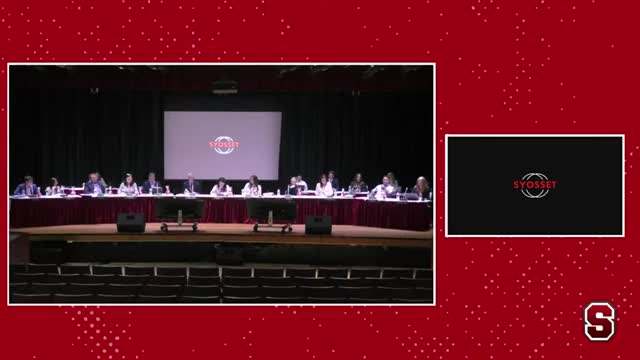
The Syosset Central School District Board of Education reviewed proposed resolutions for the Nassau-Suffolk School Boards Association (NISBA) business meeting and gave direction to its voting delegate, Mr. Rotolo, on how to represent the district.
Board discussion focused on several contested items. On Resolution 32 — a proposal asking NISBA to advocate for removal of genetically modified and bioengineered ingredients, heavy metals and certain chemicals from student meals — several board members said they supported stronger nutritional advocacy and asked the district delegate to back the resolution in its original or amended form; the board directed Mr. Rotolo to vote in favor.
The board debated Resolution 28, a proposed statement that the state school boards association should oppose any policies or regulatory changes that do not “promote academic excellence, high expectations and merit‑based opportunities.” Some trustees said the language was overly restrictive and could unintentionally block non‑academic programs; others argued a lobbying group should keep academic excellence central. That item ultimately did not receive the board’s recommendation for the business meeting.
On artificial intelligence, the board supported changing the recommendation on Resolution 11 so the district’s delegate will back a resolution that calls for the state to “safely incorporate AI into curriculum and district operations.” Trustees said the district has active AI pilots and wanted a state-level approach emphasizing data security and safe implementation.
The board also endorsed proposed bylaw changes that would increase NISBA’s member reporting about lobbying and advocacy efforts, instructing its delegate to support at least two of the proposed bylaw changes requiring periodic reporting of NISBA lobbying activity to member districts.
Board members repeatedly noted that a resolution’s state-level lobbying role does not change local district priorities and that the delegate should present amendments if language could unintentionally hinder vocational or whole-child programming.
Mr. Rotolo was asked to represent the district’s positions at the NISBA business meeting, reflecting the board’s instructions to support Resolution 32 (original/amended), support Resolution 11, not recommend Resolution 28 and not recommend Resolution 14 (recess-counting proposal), and to support the proposed bylaw reporting amendments discussed during the meeting.