Get Full Government Meeting Transcripts, Videos, & Alerts Forever!
Get email alerts on the Curriculum Education topic
No spam. Unsubscribe anytime.
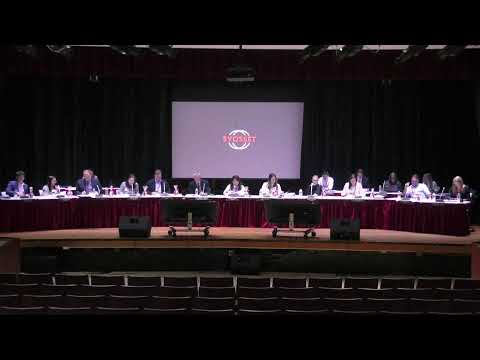
Syosset board hears curriculum, AI and social-emotional learning updates; plans wellness suite and three district buses
Summary
District leaders briefed the Board of Education on elementary transdisciplinary initiatives, secondary scope-and-sequence work and AI pilots; reported progress on writing and science PLCs; outlined a new high-school wellness suite and confirmed purchase of three district buses.
Syosset Central School District Superintendent Dr. Rogers and district instructional leaders updated the Board of Education on curricular work across elementary and secondary schools, ongoing social-emotional learning (SEL) initiatives and related supports.
The presentation summarized three main strands: elementary transdisciplinary projects under the district’s “SCIO Inspire” initiative, secondary curriculum mapping and learning walks, and SEL expansions that include a planned high-school wellness suite and expanded peer-leader programming.
District administrators said the elementary-level work focuses on transdisciplinary learning and a learner profile aligned with the district’s portrait-of-a-graduate attributes. Teachers and an elementary curriculum council have produced resources and a new website of lessons that align New York State SEL benchmarks with grade-level standards, the presenters said. An AI instructional pilot (AI Pilot 2: SCIO Inspire edition) will allow teachers to expand earlier AI pilots to support differentiated texts and real-world, project-based learning; one teacher used AI to generate leveled, decodable texts for small-group instruction.
At the secondary level, Assistant Superintendent Mr. Steinberg described creation of “typical scope and sequence” documents for the district’s 360-plus courses across three secondary buildings. Those documents are intended to be living, department-maintained templates that the district will analyze with in-house tools and selected AI assistance to surface redundancies, assessment patterns and opportunities for integrated, real-world instruction. The district will pair that work with “learning walks” — non-evaluative classroom visits focused on the district’s six portrait attributes — and with student curriculum committees to collect student voice.
Steinberg described established professional learning communities (PLCs) that use action-research to solve instructional problems. Examples include an English PLC that produced a common writing rubric used across sections and a “writing across the curriculum” PLC that created discipline-specific rubrics and launched a writing fellows peer-tutoring program. The writing fellows program includes a Syracuse University partnership; participating students receive a Syracuse 300‑level course credit, the district said.
District staff also described multi-district work on New York State’s revised science standards. Leaders said the district delayed administering certain legacy state exams to allow teachers more time to align curriculum to the new standards. The transcript of the presentation reported aggregate scoring data from other districts: 55% mastery on a legacy Earth and Space Science exam versus 15% mastery on an early administration of the new version — a 40-percentage-point difference cited by the presenters as evidence that postponing the exam was prudent to allow for curriculum alignment.
On SEL and mental-health supports, administrators outlined elementary clubs that pair general and special-class students to build soft skills, an expanded peer-leader program in which high-school students will deliver a three-part lesson series to elementary students, and a district SEL website that will aggregate monthly theme-aligned resources from partners and curricula. For the high school, the district said bond funding will create a centralized wellness suite housing guidance counselors, social workers and psychologists; Northwell Health will assist with related professional development.
Transportation leadership was recognized in the meeting; the superintendent noted the district operates more than 100 buses (about 125 in daily service) and said the board is in the process of acquiring three district-owned buses that will increase the district’s direct operational responsibilities.
Board members asked how student feedback is being collected. Administrators replied that principals and student leadership groups meet regularly with central office staff, the new student curriculum committee will surface student voice, and advisories will be used to gather middle-school feedback. The district described an iterative approach that combines scope-and-sequence documents, learning-walk evidence forms and student feedback to identify next steps.
District leaders said they will return with periodic updates as the work progresses.