Get Full Government Meeting Transcripts, Videos, & Alerts Forever!
Get email alerts on the Self Checkout Regulation topic
No spam. Unsubscribe anytime.
Grocery workers press lawmakers to limit self‑checkout machines, citing understaffing and safety concerns
Summary
Union leaders and grocery workers told the Joint Committee on Consumer Protection and Professional Licensure that Senate Bill 237 should be reported favorably to address worker safety and customer experience concerns tied to self‑checkout machines.
Union leaders and grocery workers told the Joint Committee on Consumer Protection and Professional Licensure that Senate Bill 237 should be reported favorably to address worker safety and customer experience concerns tied to self‑checkout machines.
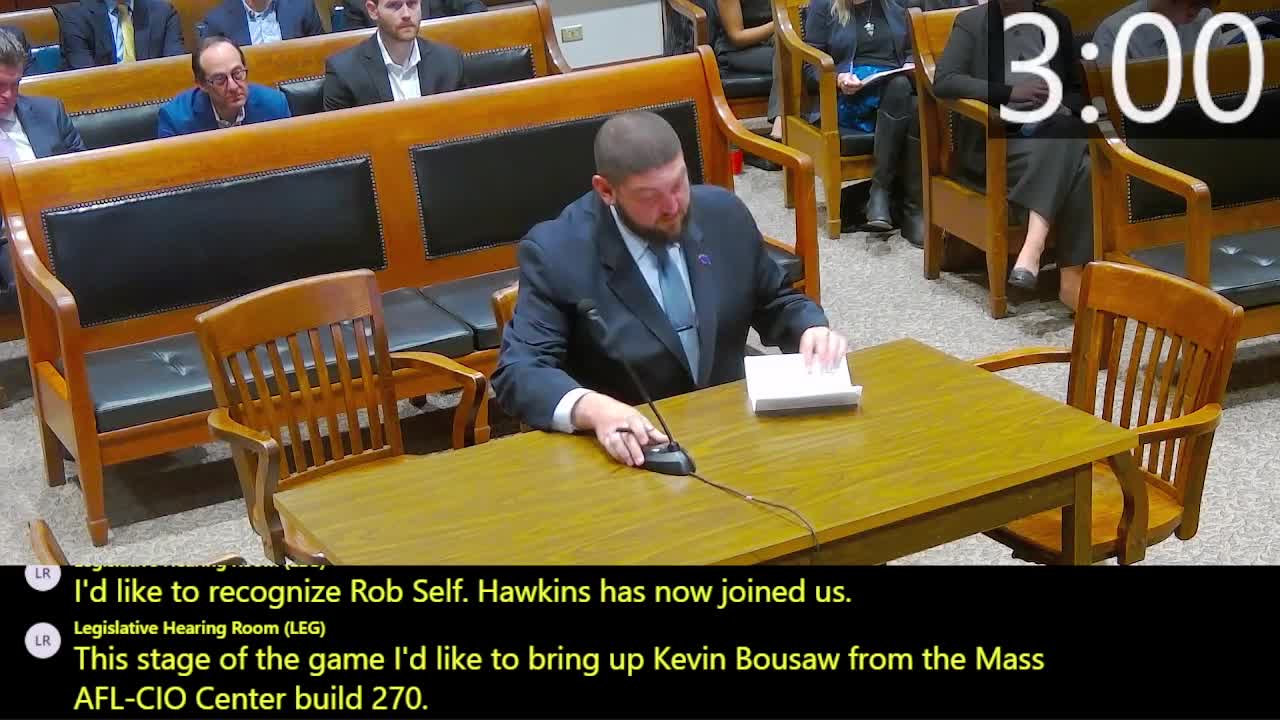
"Many workers have seen their hours cut and their responsibilities change," said Kevin Russo, secretary‑treasurer of the Massachusetts AFL‑CIO. He said self‑checkout rollout has led stores to schedule fewer staff for manual lanes while assigning workers to monitor multiple self‑checkout stations at once.
The bill presented by unions would cap self‑checkout machines at eight per store, impose a 2:1 ratio requirement for self‑to‑manual checkouts and require one employee to monitor no more than two self‑checkout stations at a time, Russo said. "If assigned to oversee self checkout, workers cannot be also assigned to additional tasks," he added.
Jack Kentslow, political director for United Food & Commercial Workers Local 1445, said self‑checkout increases theft, degrades customer service and can create safety risks when a single worker must manage many machines. "We had a worst case scenario... a member was intervening and she was assaulted and she was on the ground for a few minutes before anyone even noticed," he said.
Several frontline employees described stressful working conditions at self‑checkout stations. "My experience with self checkout has been very stressful," testified Kathy Oliveira, a Stop & Shop employee. She described threats and the difficulty of assisting customers with language barriers. Shalena Warren, another Stop & Shop worker, said being the sole attendant during busy periods leaves customers waiting and workers overwhelmed.
Retailers' representatives have faulted some proposed restrictions in past hearings but were not detailed in the committee record at this session. United Food & Commercial Workers asked the committee to keep workers "at the center of this conversation" and to report the bill favorably; the committee heard testimony but did not vote.
The hearing record shows differing proposals around staffing and machine limits; proponents said the measures aim to reduce theft, improve safety and speed transactions for customers. No legislative action was recorded at the session.