Legal expert urges clearer hate-crime statutes and community impact statements in sentencing
Loading...
Summary
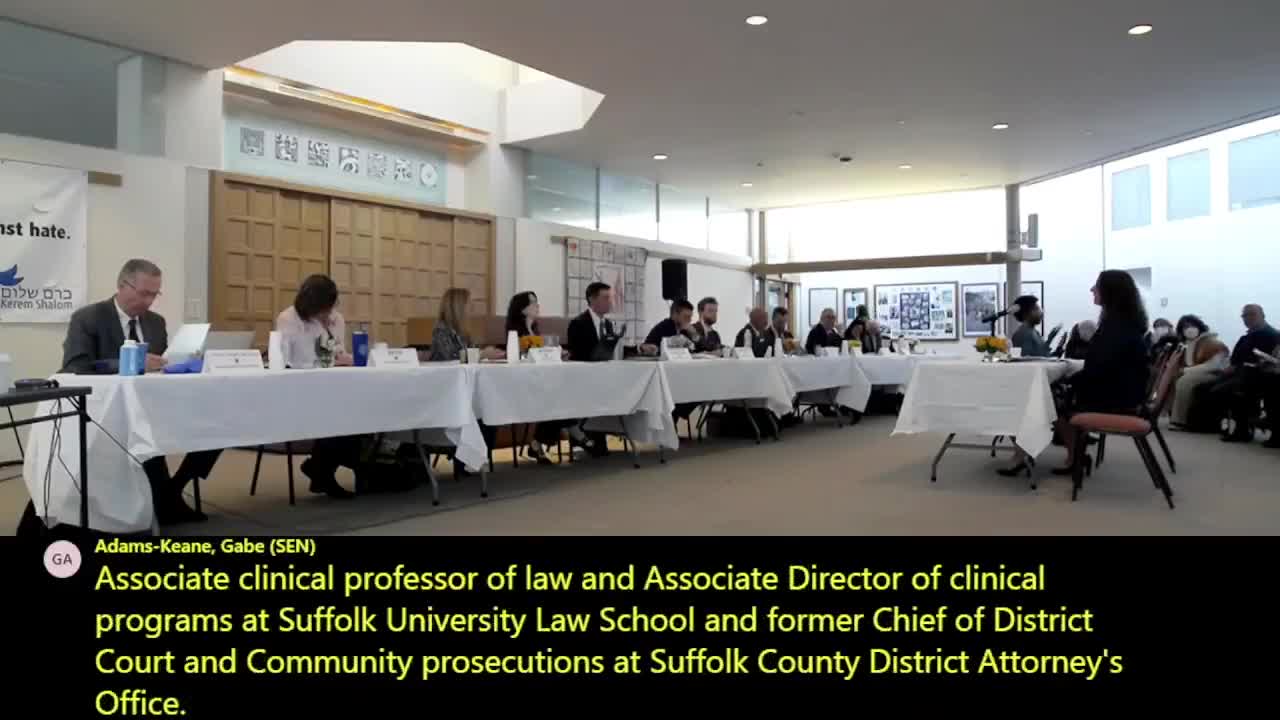
Professor Christina Miller, an experienced former prosecutor, told the commission that Massachusetts law should be clarified to reduce mixed-motive uncertainty in hate-crime prosecutions, improve jury instructions, and allow community impact statements when hate crimes affect broader communities.
Christina Miller, associate clinical professor of law at Suffolk University and a former chief of district court and community prosecutions, told the commission that prosecutors face three common patterns in hate-motivated incidents: group attacks, reactive incidents tied to publicity around foreign events, and unplanned assaults by persons with addiction or mental-health challenges. She warned that "mixed motive" cases '1 where an act (for example, a robbery) includes bias-motivated language or selection '1 can obscure charging and jury comprehension.
Miller said existing Massachusetts statutes can be unclear. She contrasted a statute often used in civil-rights contexts (referred to in testimony as a violation of constitutional rights statute) with Section 39, which explicitly provides enhanced penalties for assault or property destruction "for purposes of intimidation." Miller told commissioners jurors and clerks find the constitutional-rights statute difficult to apply and recommended clearer statutory language and jury instructions so that judges, clerks and jurors have a common framework to determine when a hate-motivated enhancement applies.
On sentencing and victim participation, Miller recommended developing a formal community impact statement that courts could accept in the same way individual victims make statements under the Victim's Bill of Rights (cited in testimony as c. 258B). She said community impact statements give courts testimony about how hate-motivated crime affects an entire group''0's sense of safety, access to services and daily life.
Miller also supported using restorative justice and a menu of funded educational or restorative conditions in some cases, but she cautioned that programs must be high quality and funded. She told commissioners that small-victim communities and smaller police departments sometimes lack the specialized training to identify or investigate hate motivation, and called for sustained law-enforcement training and clerk-magistrate education.
Ending: Miller urged the commission to consider statutory clarification, clear jury instructions, community-impact statements, and funded restorative options as concrete steps to strengthen hate-crime investigation, prosecution and community healing.