Get Full Government Meeting Transcripts, Videos, & Alerts Forever!
Get email alerts on the Alternative Portfolio Standard topic
No spam. Unsubscribe anytime.
Witnesses urge cutting or reworking Massachusetts' Alternative Portfolio Standard, warn of uneven benefits
Summary
Witnesses at a Joint Committee hearing urged the Legislature to scale back or eliminate the Alternative Portfolio Standard (APS), arguing it subsidizes fossil-fuel combined heat and power and woody biomass while delivering limited benefits to ratepayers and uneven benefits to residential customers.
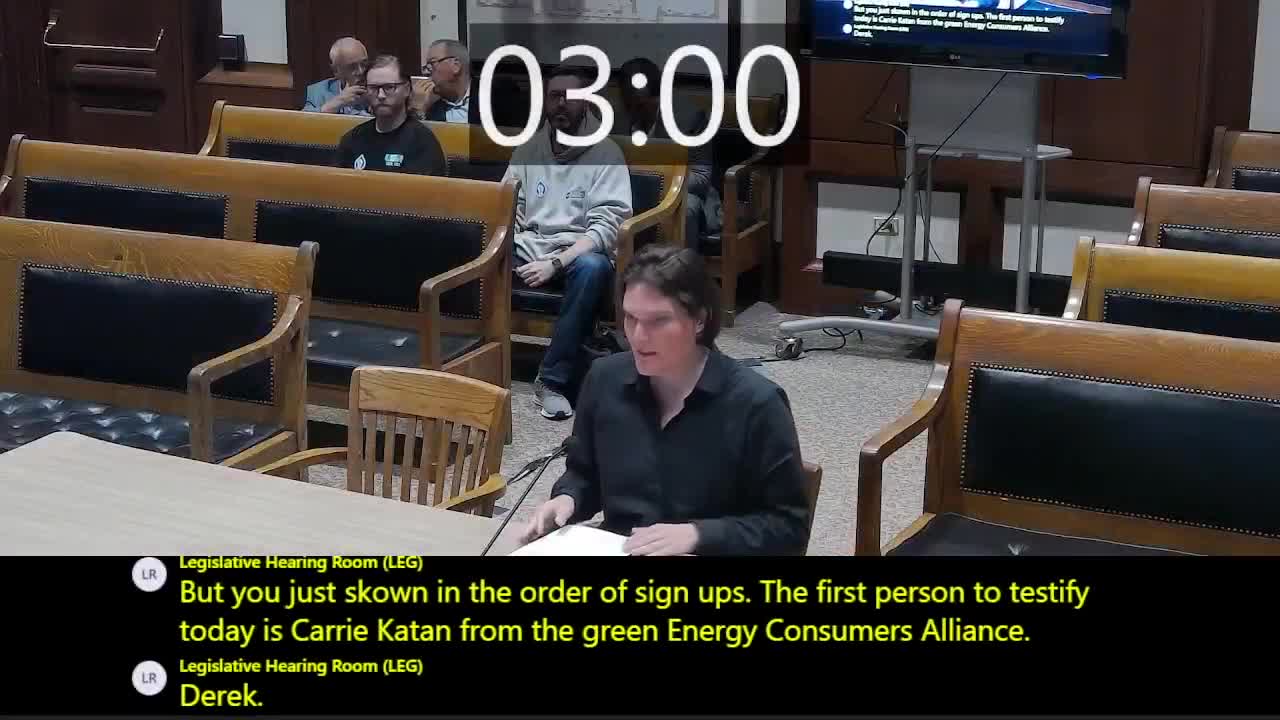
Kerry Catayan, testifying for Green Energy Consumers Alliance, told the Joint Committee on Telecommunications, Utilities, and Energy that the Commonwealth's Alternative Portfolio Standard (APS) should be scaled back or abolished, saying, “Every year, the ratepayers of the Commonwealth pay electric bills that are roughly $30,000,000 higher than they otherwise would be because of the APS.”
Catayan said the program currently sends most funding to fossil-fuel-powered combined heat and power systems that she said would have been built without the subsidies, and that APS subsidies also go to biodiesel-blending heating oil dealers and woody biomass systems. “Subsidizing fossil fuel burning equipment runs directly contrary to the state's emission reduction goals,” she said, and noted instances in which high biodiesel blends damaged heating equipment.
The testimony raised specific numbers and program mechanics the committee may consider. Catayan said roughly 11,995 air-source heat pump units have generated APS credits and that 831 solar-thermal units have also been credited in Massachusetts. She told the committee most small heat-pump and many solar-thermal installations receive a lump-sum APS payment at installation; larger facilities such as combined heat and power systems earn credits over time based on operation.
Catayan recommended moving APS support for desirable technologies into Mass Save — the state's energy-efficiency program — saying, “I we believe it makes more sense to say put $30,000,000 more dollars into Mass Save… and get rid of the APS so you don't have two bureaus.” Committee members pressed Catayan on potential local impacts. One legislator noted that the Lexington high school's planned net-zero project expects roughly $4 million per year in APS credits to achieve financial viability and asked whether outright abolition would harm such projects. Catayan responded that narrowing the APS rather than abolishing the program — for example, preserving heat-pump support while removing subsidies to combined heat and power and biomass — would be preferable.
Catayan also highlighted air-quality concerns with woody biomass, noting the legislature had previously removed woody biomass from the Renewable Portfolio Standard because of air-quality impacts. She argued the program's “complexity” and the fact that many APS technologies are not suitable for typical residences means residential ratepayers fund benefits that largely go to businesses.
The hearing included no formal committee action on APS language; testimony referenced draft legislation and the governor's affordability bill but committee members did not vote on statutory language during the session.
Less urgent but related testimony at the hearing addressed renewable procurement and the broader RPS review (see separate article). The hearing closed without votes on the bills discussed; a motion to close the hearing passed by voice vote at the end of the session.