
Senate debate pits fiscal discipline against one-time spending; Tarr amendment to restore stabilization rule fails
Get AI-powered insights, summaries, and transcripts
Sign Up Free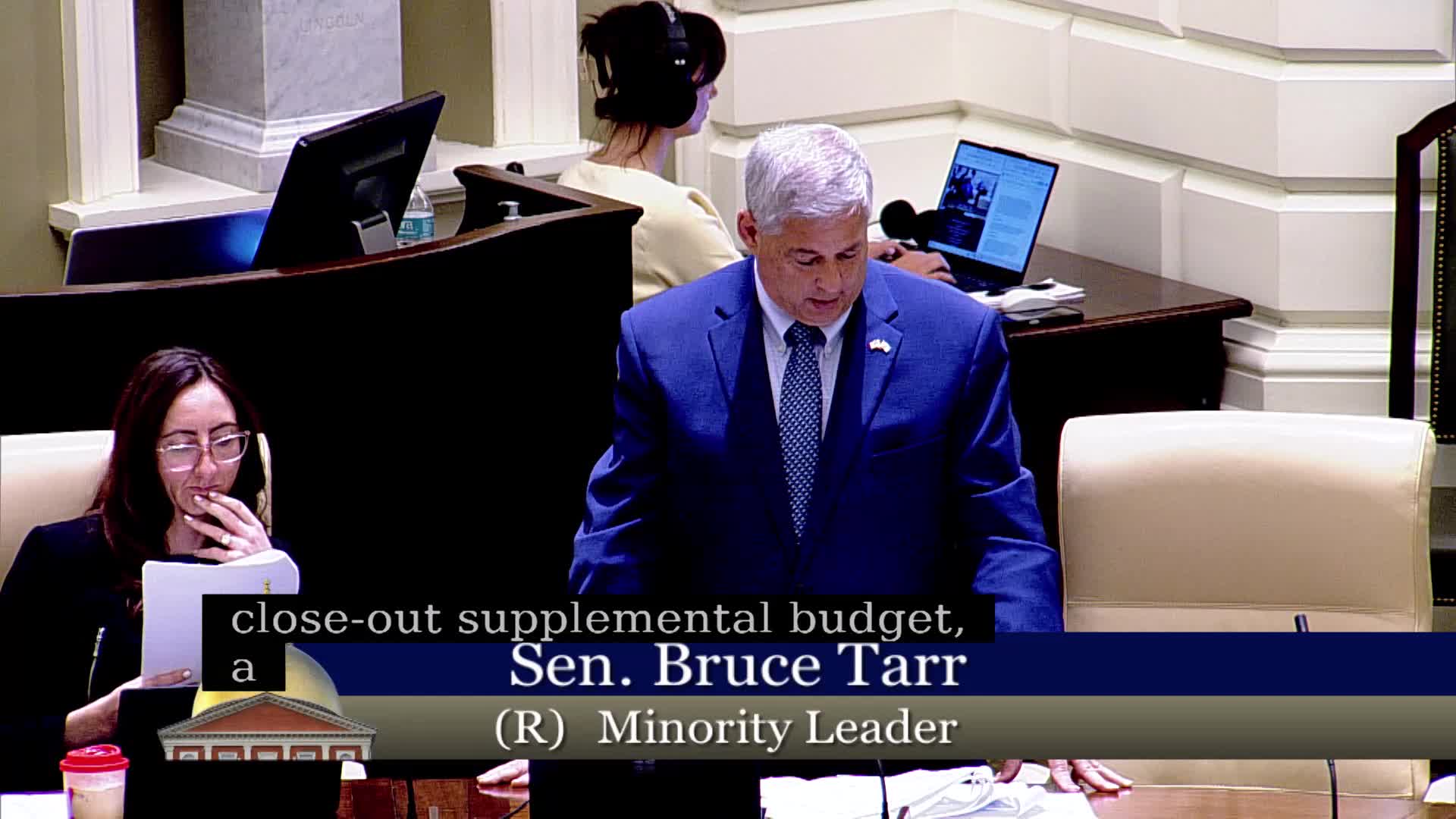
Summary
Senator Tarr proposed an amendment to direct a larger share of excess capital gains into the Commonwealth Stabilization Fund; the amendment failed on a roll call after extended floor debate with Ways and Means leadership defending a proposal to seed a new deficiency reserve account.
Senator Tarr proposed an amendment to change how excess capital gains are allocated, arguing the statute (chapter 29, section 5(gs) as cited on the floor) intends 90% of excess capital gains to go to the stabilization fund. Tarr said last year's closeout deviated from that practice by directing only 5% to the stabilization fund and spending the remainder.
Tarr said lawmakers should "return to the policy of our commonwealth for decades" and proposed an amendment that would place 75% of excess capital gains into the stabilization fund, 15% into a deficiency reserve, and 5% each to the pension liability fund and the OPEB account. On the floor he emphasized, "Now is not the time to depart from the practices that for years have allowed us to build a strong stabilization fund."
Senator Michael J. Rodricks, chair of Ways and Means, urged colleagues to reject that amendment. Rodricks said the Ways and Means proposal instead seeds a "deficiency reserve fund" with a larger share of excess capital gains so the Commonwealth can backfill unanticipated shortfalls in already funded accounts. He defended the committee's approach by noting the stabilization fund currently stands at a balance north of $8,000,000,000 and argued the Ways and Means plan would add $25,000,000 to the stabilization fund while also preserving resources to address revenue impacts from recently announced federal tax changes.
The roll call showed five senators in the affirmative and 33 in the negative; the amendment was not adopted. The underlying debate highlighted differing fiscal philosophies: prioritize bolstering the rainy-day fund now, or preserve flexibility to respond to near-term revenue shocks.