
Mass. House passes bill increasing penalties for assaults on transit workers
Get AI-powered insights, summaries, and transcripts
Subscribe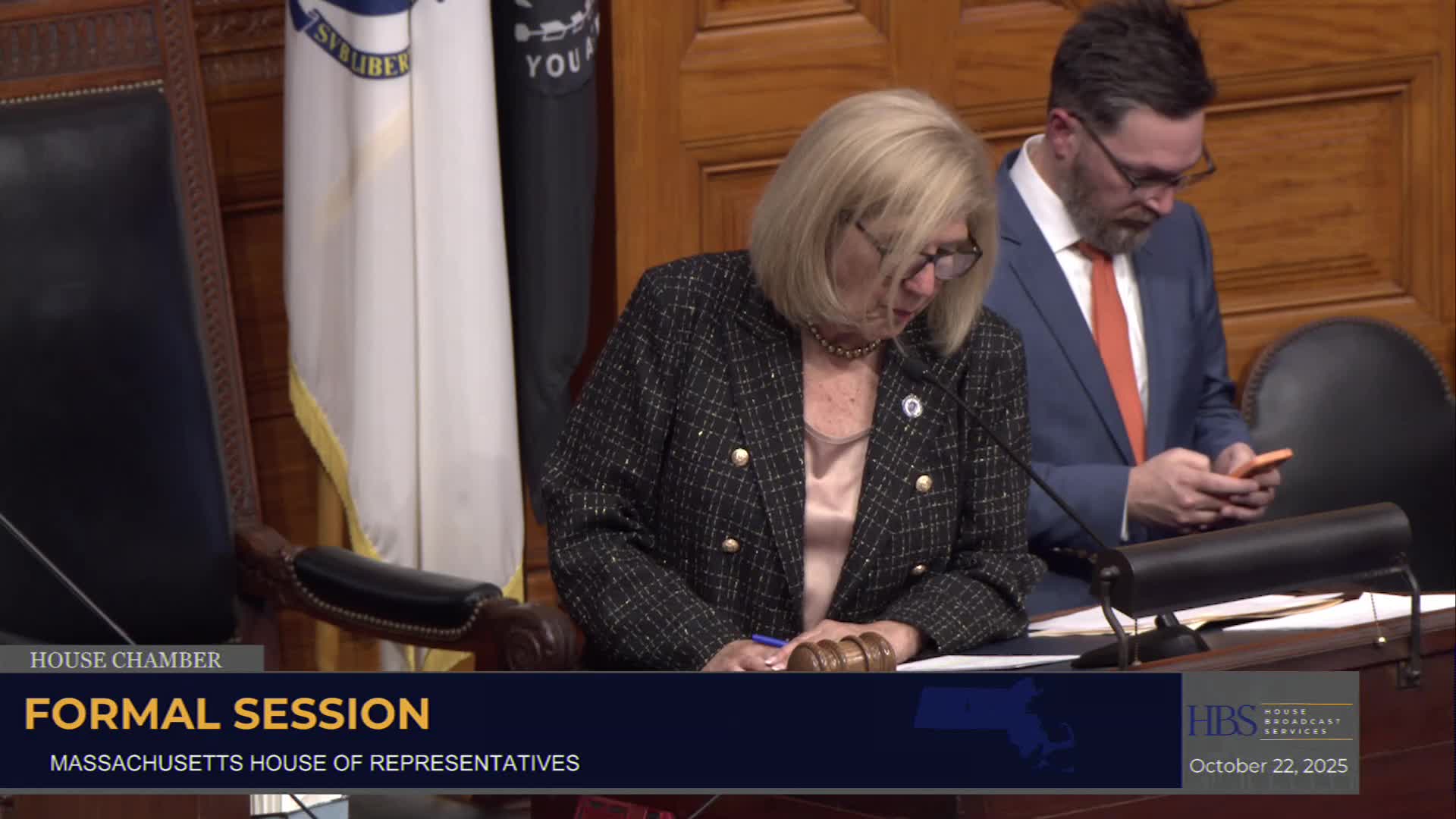
Summary
The Massachusetts House voted unanimously to pass a substitute bill that designates transit workers as public employees and raises penalties for assaults, including those involving bodily fluids.
The Massachusetts House on Oct. 17 passed a substitute bill making assaults on public transit employees a distinct offense with higher minimum penalties. The chamber recorded a roll-call tally of 116 in the affirmative and 0 in the negative to pass the substitute bill to be engrossed.
The measure, described on the House floor as House Bill 46-45 and presented as a substitute for House 1877, changes state law to make clear that public transit employees are public employees for purposes of assault and battery statutes and specifies enhanced penalties. Representative Day of Stoneham, speaking in support, said the bill would impose a fine “of not less than $500 and not more than $5,000 or incarceration for at least 90 days and up to 2 and a half years in the houses of correction depending on the severity.”
Representative Day framed the legislation as a response to a rising national and local trend of violence against transit staff, citing Federal Transit Administration data and agency reports. He said, “From 2014 to 02/2024, the Federal Transit Administration indicates that the rate of assaults and batteries on public transit employees increased by 232 nationwide in 10 years.” He also cited MBTA figures that “there were over 600 assaults in 02/2024, including 33 assaults with weapons, 72 physical assaults and batteries, and 38 assaults and batteries with bodily fluids.”
Representative McGonigal of Everett, who the chair recognized to speak in support, told lawmakers he had heard from transit workers who described stabbings, threats with firearms, assaults with bodily fluids and long-lasting injuries. McGonigal described multiple firsthand accounts and asked the chamber to vote for the legislation as a measure to “effectively penalize those responsible for the crime and set a standard that prevents future assaults on our hardworking transit employees.”
The bill also explicitly lists the throwing or projecting of bodily fluids or secretions as conduct that constitutes assault and battery on a public employee.
The roll call on the engrossment passed 116–0. With that vote, the House sent the substitute bill forward as engrossed for further legislative steps.