Get Full Government Meeting Transcripts, Videos, & Alerts Forever!
Get email alerts on the Animal Welfare topic
No spam. Unsubscribe anytime.
Debate on banning sale of newly farmed fur products pits animal‑welfare groups and public‑health advocates against industry representatives
Summary
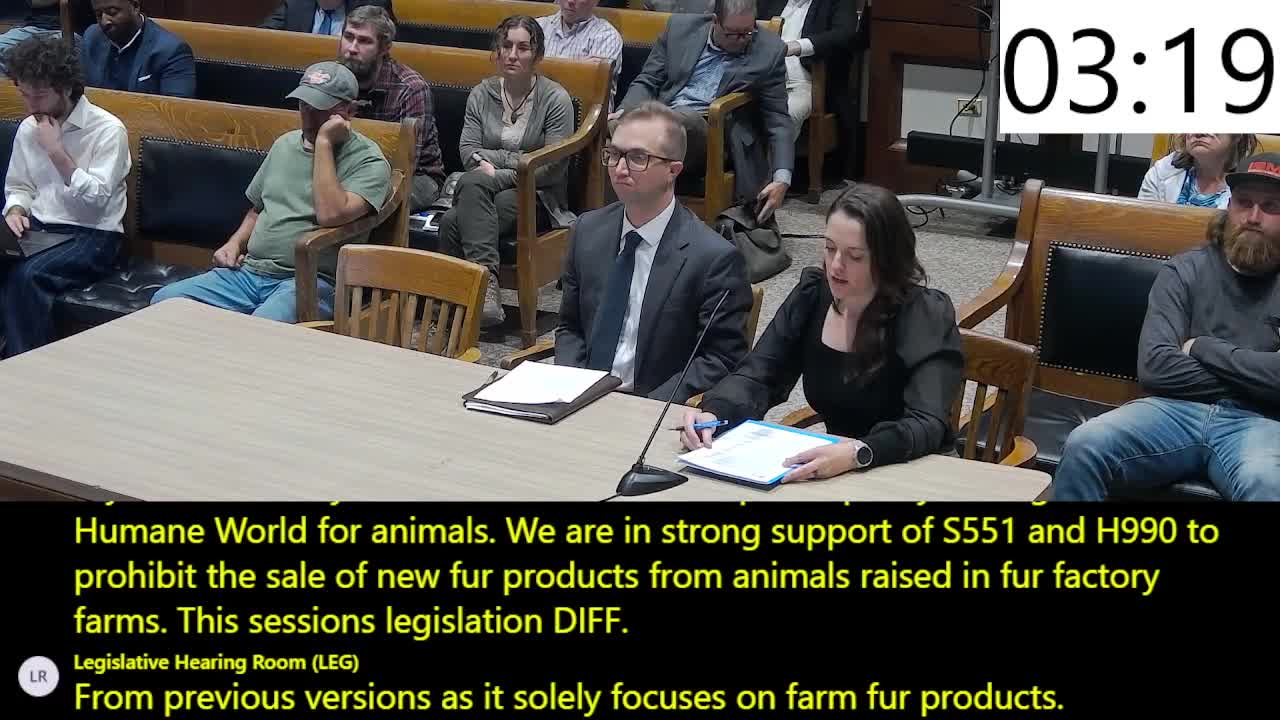
Bills S.551/H.990 to prohibit the sale of newly farmed fur products drew split testimony: animal‑welfare and public‑health witnesses urged the ban, calling fur farming cruel and an infection risk; fur industry groups and some retailers and antique dealers opposed bans and warned of economic impacts and legal issues.
Advocates for animal welfare and public health urged the Joint Committee to report S.551 and H.990 favorably to ban the sale of newly farmed fur products in Massachusetts. Witnesses described the conditions on modern fur farms as inherently cruel, urged that fur production is unnecessary for consumers, and cited public‑health risks experienced in recent outbreaks that involved farmed mink.
Key testimony in favor
- Humane World for Animals and other NGOs provided field rescue accounts from U.S. fur farms and described conditions of animals kept in small wire cages, untreated wounds, and other signs of neglect or cruelty. A senior policy manager said: “No one who witnessed these conditions could ever see a fur coat the same way again.”
- Public‑health witnesses and veterinarians pointed to past coronavirus (SARS‑CoV‑2) transmission events on mink farms in Europe and North America and argued that fur farms can act as disease reservoirs and mutation points.
- Municipal advocates and community groups said multiple Massachusetts municipalities have already restricted or banned fur through local ordinances and urged state action for uniformity.
Opposition and practical concerns
- Representatives of fur farmers and fur industry organizations said U.S. fur farms participate in voluntary certification programs, argue regulation is possible, and noted the industry supplies small retail and craft markets. The Fur Commission noted third‑party audit programs and emphasized family‑run operations.
- A fur wholesaler and antique dealer testified that bans can have unintended consequences, including increased illicit activity and loss of livelihoods for regulated small businesses; an antiques dealer urged caution and noted that much sales infrastructure already restricts illicit trade (labeling laws, auction house policies).
Legal and policy considerations
- Witnesses on both sides discussed the federal Fur Products Labeling Act and potential preemption issues; a fur‑industry representative warned that state laws cannot impose conflicting labeling rules.
Committee context
The committee received a mix of cruelty‑focused rescue testimony and industry briefs on regulation, public‑health evidence of infection risk on farms, and economic perspectives from retailers and dealers. Several legislators asked for follow‑up material, including evidence regarding disease risk, the scope of U.S. farmed fur production, and the projected consumer and retail impacts of a statewide ban.
Next steps
Members accepted written materials and testimony from both industry and animal‑welfare groups for further review. The committee did not take a vote at the hearing and requested additional studies and documentation on disease risks and economic impacts.