Get Full Government Meeting Transcripts, Videos, & Alerts Forever!
Get email alerts on the Animal Testing topic
No spam. Unsubscribe anytime.
Witnesses urge Massachusetts to require non‑animal testing for cosmetics and household products; research community raises narrow concerns
Summary
Supporters of S.640 and H.989 told the Joint Committee on Environment and Natural Resources that modern, validated non‑animal test methods should replace animal tests for cosmetics and household products when alternatives exist; medical‑research groups urged careful drafting to preserve drug‑safety exemptions.
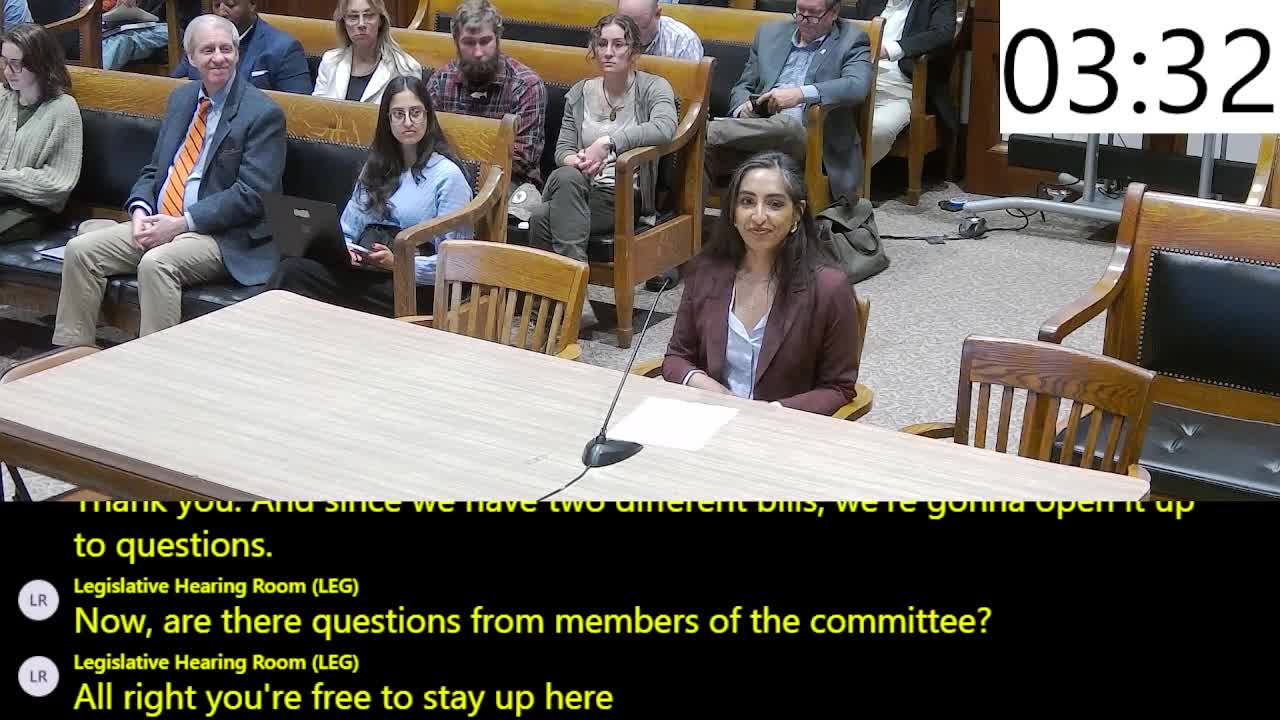
Good afternoon. My name is Michelle Shaw. I'm senior program manager of animal research issues at Humane World for Animals. Thank you, Vice Chair Cataldo and members of the committee for the opportunity to testify in strong support of S.640 and H.989. These scientific‑driven bills require the use of non‑animal test methods for cosmetics, household cleaners, and industrial chemicals. They do not apply to testing done for medical or pharmaceutical research.
Why supporters back the bills
Supporters, including scientific program managers, students, veterinarians and cruelty‑free manufacturers, called the bills an evidence‑driven update that aligns regulations with modern non‑animal alternatives such as human cell‑based tests, organ‑on‑a‑chip systems and predictive computer models. Michelle Shaw told the committee these alternatives are faster, often more predictive for human response, and widely available in Massachusetts commercial labs. Young testifiers recounted ethical concerns and cited studies showing high drug‑failure rates when animal data are used alone.
Research community concerns
Representatives of the Massachusetts Society for Medical Research and other biomedical groups testified in opposition or asked for study. James O’Reilly, speaking for the Massachusetts Society for Medical Research, said that while the bill contains an exemption for medical research, institutions worry that similarly drafted laws in other states had later been expanded in ways that unintentionally restricted legitimate preclinical and safety testing needed for drug development. He asked the committee to hold the bill for study so the scope and definitions cannot be misunderstood.
Drafting and implementation points
Supporters and neutral stakeholders urged the committee to ensure the bill's definitions are aligned with standard scientific terminology and to give the state health agency clear rulemaking authority to evaluate and list validated alternative methods. The Animal Legal Defense Fund representative said the bill was the product of multi‑session negotiations and noted prior work to add explicit regulatory authority to set standards and validation criteria.
Next steps and committee interest
Committee members asked for text clarifications to ensure medical and pharmaceutical research remain exempt and requested technical follow‑up from DPH and research institutions. Witnesses offered to provide technical lists of validated alternatives and to meet with committee staff to tighten definitions.
Bottom line
Supporters urged the committee to move the bills because Massachusetts research and commercial labs already develop and use non‑animal methods and the change would align the Commonwealth with other states that have adopted similar laws. Some biomedical researchers asked for additional safeguards in the language to prevent misinterpretation and preserve legitimate drug‑safety testing exemptions.