Get Full Government Meeting Transcripts, Videos, & Alerts Forever!
Get email alerts on the Curb Management topic
No spam. Unsubscribe anytime.
Supporters tell committee H.4402/S.2639 would let Massachusetts cities adopt automated curb enforcement with privacy safeguards
Summary
Industry witnesses and an Automotus representative told the Joint Committee on Transportation that H.4402 and S.2639 would enable municipalities to adopt automated curb management and curb-enforcement tools via local ordinance, help reduce double parking and congestion, and include privacy and public-notification provisions.
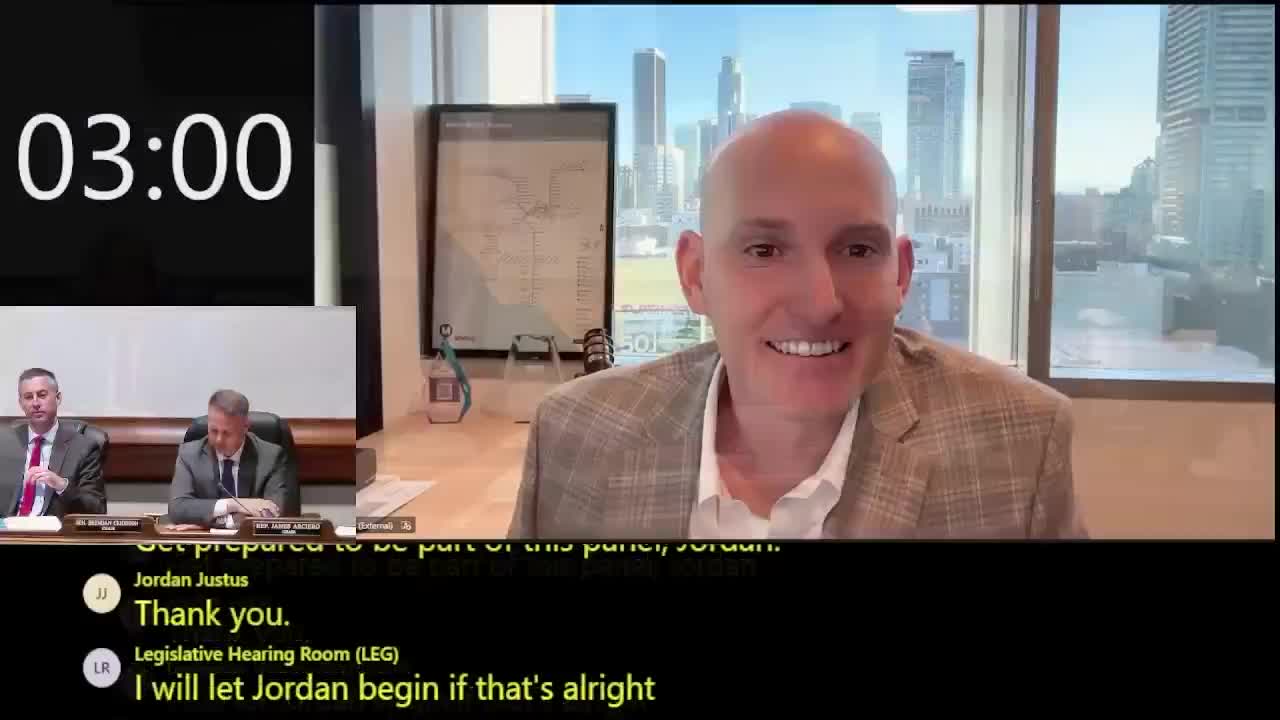
Jordan, identified in testimony as the CEO of a company that implements curb-management systems, told the Joint Committee on Transportation he supports H.4402 and S.2639, bills authorizing automated curb enforcement and changes to parking-violation procedures.
“This legislation represents a necessary step forward for Massachusetts cities to be able to follow cities and other states' leads in managing the curb for the 21st century,” Jordan said, describing deployments in U.S. cities that automated curb management to reduce double parking and improve traffic flow.
Jordan and another panelist said automated systems can reduce double parking and related hazards when paired with policy safeguards. Jordan said Pittsburgh reduced double parking by 97 percent after deploying an automated curb-management program, and he cited Philadelphia's reduction in center-city traffic by 52 percent from targeted curb management. Testimony emphasized that H.4402 and S.2639 are opt-in tools for municipalities, not a state mandate; municipalities would implement systems through local ordinance if they choose.
Panelists emphasized privacy and public notification provisions in the bills and said the proposals target automated enforcement of commercial loading and curb-usage activities rather than general surveillance. An Automotus employee who identified themselves as a recent hire and a Boston resident said the bills would help Boston meet goals in the Go Boston 2030 plan and help manage private carriers, delivery services and emerging autonomous vehicles.
The panel described benefits for residents, businesses and city operations—reducing double parking, improving safety for cyclists and pedestrians, and easing commercial loading. They urged careful policy design and technology safeguards to protect civil liberties but said the legislation contains language to focus systems on automation of curb-management tasks.
No committee action or vote on H.4402 or S.2639 was recorded in the transcript section that contains the panel’s testimony.