Advocates push bill to require monthly reporting, bank depositories for ballot question campaigns
Loading...
Summary
At a hearing of the Joint Committee on Election Laws, advocates urged lawmakers to require ballot question committees to use the state's depository system and file monthly disclosures to close an eight-month reporting gap.
At a hearing of the Joint Committee on Election Laws, witnesses urged lawmakers to require ballot question committees to report monthly and to use the state depository system so voters can see who funds campaigns earlier in the election cycle.
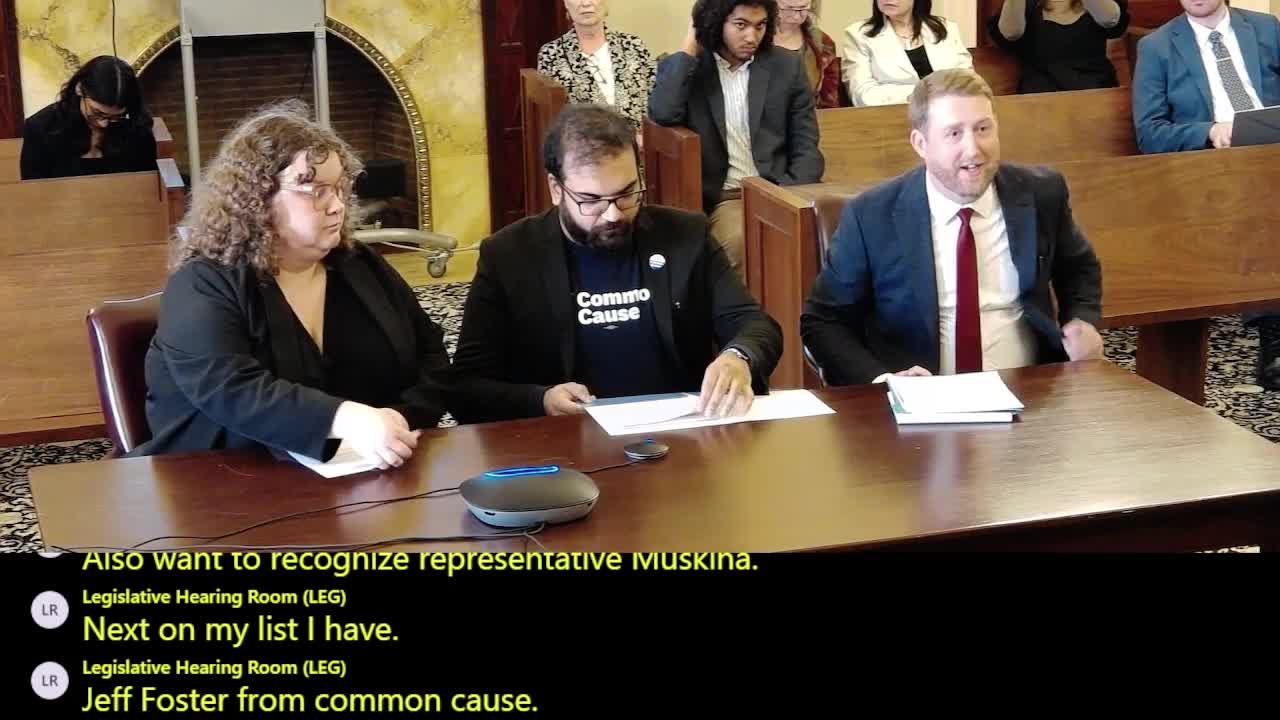
Supporters told the committee that current reporting leaves an eight-month window when millions of dollars flow into ballot campaigns without public disclosure. Jeff Foster, of Common Cause Massachusetts, described House Bill 868 and Senate Bill 507 as the “Ballot Spending and Transparency Act” and said the bill would move ballot question committees into the same bank depository system used by candidate committees so contributions and expenditures are reported monthly.
The proposal would keep the existing filing schedule but add monthly reporting, Foster said, giving voters “real time” access to contributions and reducing the chance that powerful out-of-state interests can spend large sums without timely public scrutiny. “This adds a vital layer of accountability and confidence,” Foster said.
Dev Chatterjee, who presented compiled OCPF data to the committee, told lawmakers that Massachusetts ballot question campaigns have received more than $43,000,000 in cash and in-kind contributions in 2024 alone and that, across six election cycles, ballot committees raised more than $340,000,000. Chatterjee said roughly one-third of that — about $120,000,000 — was raised in months when no reporting was required. “When tens of millions of dollars are at stake, voters deserve to know where the money is coming from and how it's being spent,” he said.
Celia Canavan, executive director of the League of Women Voters of Massachusetts, testified that volunteers and campaign workers also lack timely access to funding information. She said that requiring earlier and more frequent disclosures would put ballot question committees on the same transparency standard as candidate committees and would help campaign staff and volunteers hold employers accountable.
No formal action was taken at the hearing. Proponents asked the committee to give H 868 and S 507 a favorable report so the depository reporting and monthly disclosure requirements can be enacted before the next round of major ballot campaigns.
The hearing included back-and-forth with committee members clarifying that the bill would not prevent grassroots signature gathering and that the depository mechanism already exists for candidates. Advocates emphasized the change is limited to disclosure; it does not impose contribution limits. The bills were described repeatedly as a disclosure and transparency reform intended to preserve the initiative process while improving public information.
Supporters asked the committee to move the bills forward; no opponents testified in the record presented to the committee during this session.