Get Full Government Meeting Transcripts, Videos, & Alerts Forever!
Get email alerts on the Direct Care Workforce topic
No spam. Unsubscribe anytime.
Supporters ask for a MAP registry to ease test barriers for direct‑care workforce
Summary
Unions, providers and certified instructors told the committee that a registry (H237/S162) of direct‑care workers who need or have taken the Medication Administration Program (MAP) test would help target bilingual preparation and reduce job losses; witnesses said the sector has 20% vacancy rates and estimated 15,000–20,000 workers are subject to a
Boston — Labor and provider witnesses told the Joint Committee that creating a state registry of direct‑care workers who have taken or need to take the Medication Administration Program (MAP) test would help reduce barriers to certification, expand bilingual training and address workforce shortages in programs funded under Chapter 257.
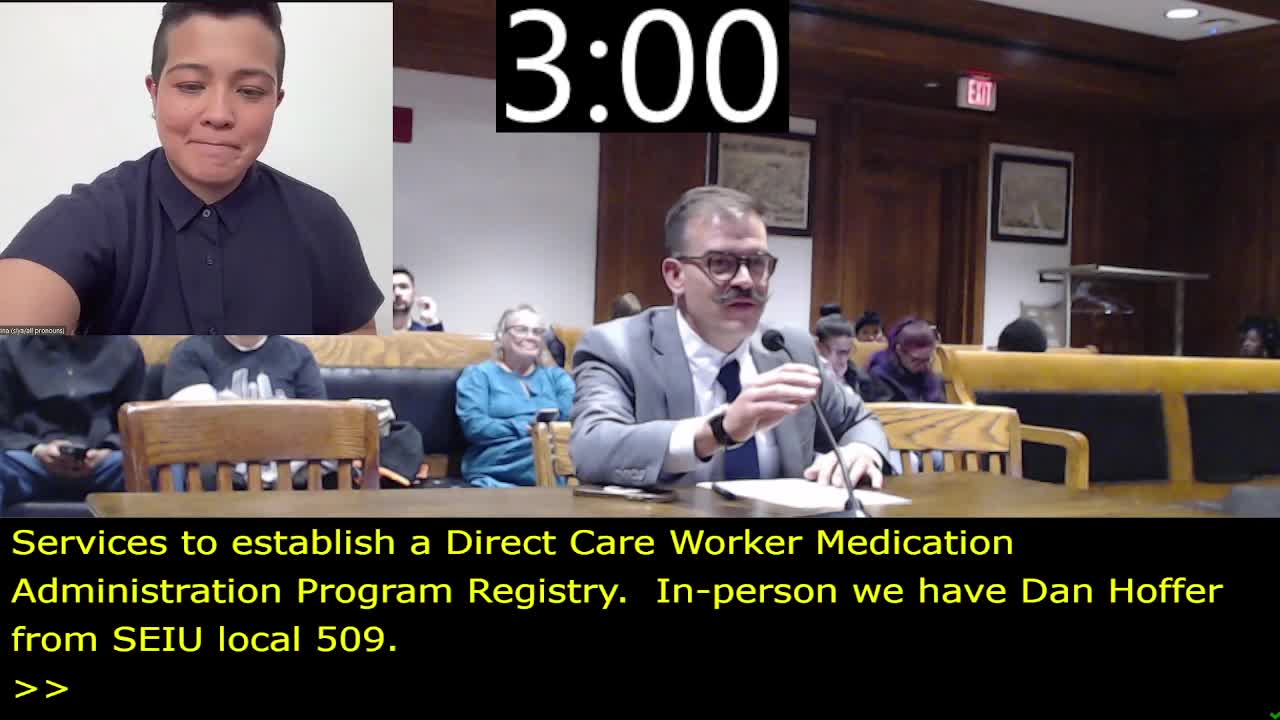
"If we're going to make a meaningful dent in getting people into this workforce, we need to bring that list out of the darkness and into the light," said Dan Hoffer of SEIU Local 509, which represents 25,000 human‑service workers. Hoffer said the registry would be modeled on existing state registries for nursing aides and home‑care workers and would allow unions and nonprofits to offer targeted training to people who need it.
Certified MAP instructors and current direct‑care staff described language and timing barriers: training and test preparation are often offered only in English, and English‑language learners struggle with the test format. "The language barrier confuses them and they start to second‑guess themselves," said Adisa Abogi Marfo, a certified MAP instructor with Delta Projects.
Witnesses asked the committee to support H237/S162 so that third‑party managers and the state can authorize industry groups and training providers to access de‑identified lists of workers who have failed or are due for recertification. Supporters said an estimated 15,000–20,000 individuals in Massachusetts are subject to the MAP requirement and that the fieldwide vacancy rate exceeds 20%, making test‑access an urgent workforce issue.
The committee heard no formal opposition during the panel; details about privacy protections, data access rules and whether the registry would include individual identifiers were raised as policy decisions to be worked out if the committee advances the bill.
No committee action was taken during the hearing.