Get Full Government Meeting Transcripts, Videos, & Alerts Forever!
Get email alerts on the Designer Selection topic
No spam. Unsubscribe anytime.
Medford High building committee reviews four design proposals, approves $25,000 OPM invoice
Summary
At a meeting in BSR 489, the Medford High School Building Committee discussed four architect/engineering proposals for Medford High, asked standardized questions for interviews, and approved the August OPM invoice for $25,000.
The Medford High School Building Committee met in person at BSR 489 in Medford to discuss four design proposals for the high school and approved an OPM invoice for $25,000.
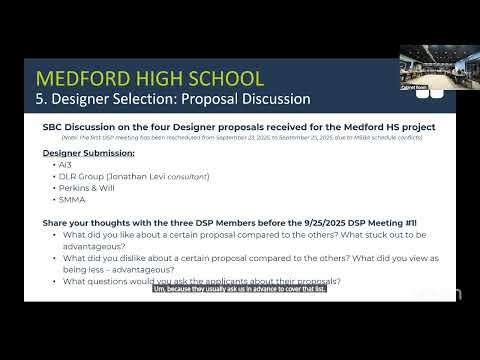
Committee members framed the evening around a required, non‑ranking review of four design teams. “We cannot rank. We cannot do that,” Jenny Graham said, repeating guidance from the Massachusetts School Building Authority (MSBA) that the committee avoid discussing rankings or favorites while proposals are still being considered. The committee spent the bulk of the meeting reviewing strengths, weaknesses and standardized questions to use at upcoming interviews with finalists.
Why it matters: the designer selected through the MSBA process will shape whether the project is a renovation, partial reconstruction or full rebuild, where CTE (career and technical education) space is placed and how the site’s steep grade and circulation issues are handled. Committee members stressed that the next step is the Designer Selection Panel (DSP), with an initial DSP meeting scheduled the week after this meeting and interviews set for early October.
Discussion highlights
- Common process points: The meeting leaders reminded members that MSBA guidance prohibits public ranking of firms during these review sessions. The group agreed to use a set of uniform questions for every firm during the interview round.
- DLR (with Jonathan Levy/Lehi Architects): Several members said the DLR submission showed strong CTE emphasis. Maria Dorsey said, from an educational standpoint, DLR’s materials “had a leaning more toward the shops,” and she wanted clarity on how the firm would balance CTE with core classroom needs. Some members worried the proposal’s imagery and layout made it hard to assess classroom flow or enrollment assumptions.
- Perkins (Perkins‑style team): Members liked Perkins’ emphasis on community space and outdoor learning; one committee member noted their central shared space concept would allow community access and flexible student learning areas. Questions remained about the team’s vocational experience and how that experience would translate to Medford’s comprehensive high school model and Chapter 74 requirements.
- AI3 (referred to in the packet as AI 3): Members praised AI3’s acknowledgment of the site’s hill and multilevel opportunities, plus creative ideas such as underground parking; they asked for clarification about staffing (percent time allocations for project managers) and the apparent amount of learning space in the concept compared with other submissions.
- SMMA: Committee members described SMMA’s submittal as cohesive with a strong solar strategy and clear sectional/side‑cut diagrams. Concerns included how the firm’s proposals addressed steep site grade and whether blocks of the building appeared too flat for the slope on site.
Common questions and concerns raised for all firms included how teams plan to integrate CTE with core academics (noting Medford’s comprehensive high‑school structure and Chapter 74 requirements), how often principal staff would be on site versus remote, how firms would handle circulation and student travel times between classes on a sloped site, parking and traffic/entry management, and team diversity and composition.
Process and next steps
The committee reiterated that the Designer Selection Panel meeting to narrow finalists is next week, and interviews with shortlisted firms will be held in early October (committee materials cite an October 6 interview date). Committee members will submit additional cross‑cutting questions to be asked of all firms during the interview round.
Administrative action
The committee approved the August OPM invoice (a lump sum of $25,000, third monthly invoice with no reimbursable costs reported). The motion was moved by Ken Lord; the committee recorded 13 votes in the affirmative and 2 members absent.
Tapering note
Members stressed that selecting a designer does not lock the committee into every concept shown in a proposal. Jenny Graham and others said the next phase allows the committee to tell finalists what to keep or discard and to request refinements during the MSBA interview and schematic phases.