Get Full Government Meeting Transcripts, Videos, & Alerts Forever!
Get email alerts on the Foia Training topic
No spam. Unsubscribe anytime.
FOIA council outlines process to approve training for FOIA officers; staff will manage reviews
Summary
Following passage of training requirements in the 2025 session, the FOIA council discussed an application form, timeline and approval criteria for courses that will satisfy FOIA officer training. The council directed staff to craft criteria and set a submission schedule; it tentatively favored one‑year approvals for outside courses.
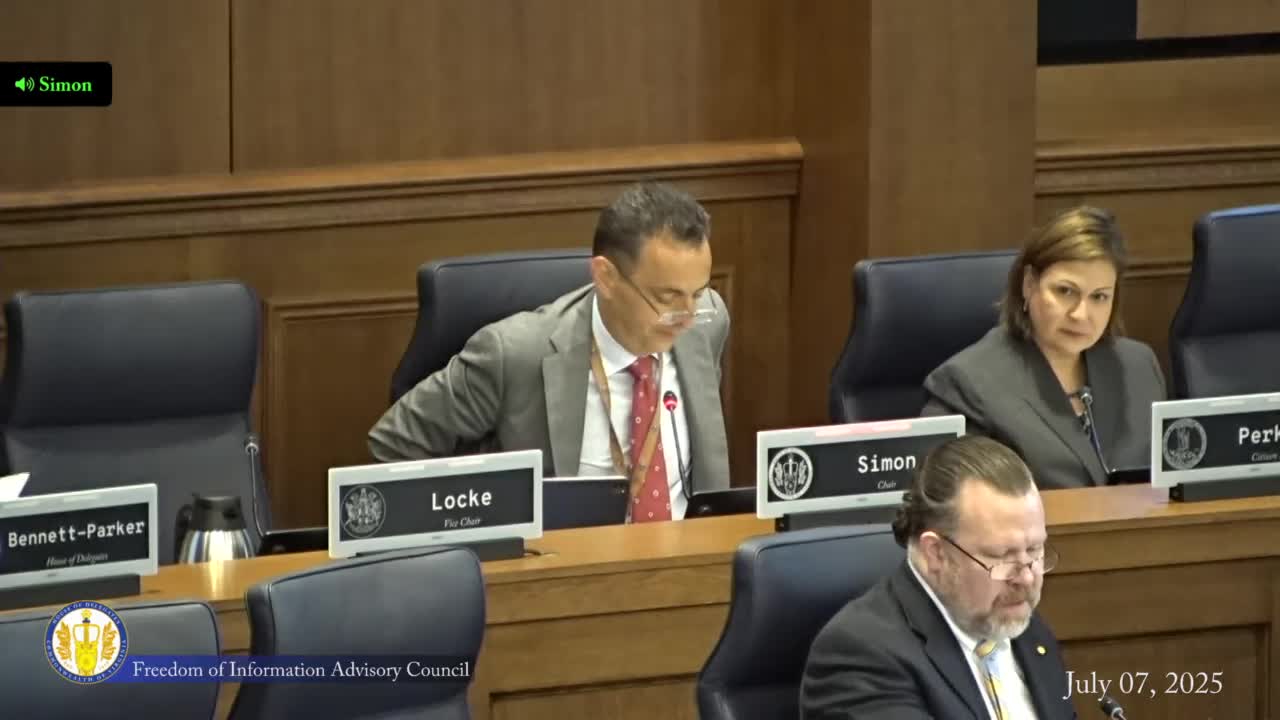
The Freedom of Information Advisory Council spent much of its July 7 meeting detailing how it will review and approve training courses to satisfy new statutory requirements for FOIA officers and for legal counsel who serve as FOIA officers.
Council staff said House Bill 2152 (2025) requires training at least once every two calendar years for designated FOIA officers and requires legal counsel who serve as FOIA officers to complete a training session approved or offered by the council. Staff presented a draft application and a series of procedural questions for the council to resolve: who will approve courses (staff, subcommittee, or full council), how long approvals will last, minimal content criteria, whether prerecorded online courses will be allowed and how completion will be verified, and whether providers must submit attendance or retention records to the council.
Council members generally favored delegating routine application screening and schedule-setting to staff, with the option for staff to send more complicated or contested applications to a small subcommittee or to the full council. Several members noted that other professional boards use a model with an education committee that vets applications on a set schedule; staff said it would propose submission deadlines and a review calendar.
On the question of approval length, the council indicated no objection to a one‑year approval period for outside providers, while some members argued for two years to match the two‑year training cycle for individuals. The council asked staff to recommend specific language and to draft separate guidance or expedited review criteria for courses already approved by CLE providers so that attorneys can use CLE‑approved FOIA courses when appropriate.
The council also addressed prerecorded online courses. Members agreed they would allow prerecorded offerings so long as providers include a verifiable completion mechanism (for example, automated tracking that prevents users from skipping content, random verification prompts, or other monitoring) and document course completion for attendees. Staff offered to work with the Library of Virginia on records-retention series for applications and completion lists; the Library staff volunteered to assist with retention schedule advice.
Other directions from the July 7 discussion: the council asked staff to add a question about fees to the application form so the council can track whether courses are offered free or for a cost; to include questions about course delivery format (live in‑person, live online, prerecorded), instructor qualifications and intended audience (attorneys, FOIA officers, clerks); and to outline an expedited review process for CLE‑approved courses.
Next steps: staff will draft a proposed approval process, an application form that includes fee information and delivery format, minimum content suggestions for FOIA officer courses, and a recommended schedule for submission and review. Staff will circulate the materials to council members for review before the next full meeting.