Get Full Government Meeting Transcripts, Videos, & Alerts Forever!
Get email alerts on the Public Safety Infrastructure topic
No spam. Unsubscribe anytime.
Council members seek data, funding and assignment of responsibility in copper wire-theft brief
Summary
Council members discussed constituent reports of copper wire theft in parks, trails and street lighting and asked staff for a detailed accounting of city spending, responsibilities for reporting and repair, and evidence behind a reported 60% decline in incidents through April.
Council members opened a status-discussion on increasing reports of copper wire theft across St. Paul and asked staff to return with a clearer accounting of city responses, the dollars allocated to mitigation efforts, and a breakdown of which departments should receive and route constituent reports.
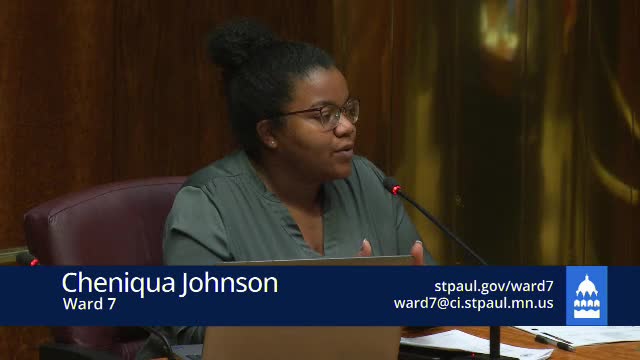
Chair Johnson invited comments after staff from the mayor’s office, Public Works, police and other agencies were not available to present. Councilmembers said thefts are concentrated along trails, parks and streets in multiple wards (Ward 3, Ward 5, Ward 7 were specifically mentioned) and described constituent safety concerns where theft leaves sidewalks, bike lanes and park paths unlit.
Vice President Kim and other council members requested concrete budget detail: how much the city has allocated or spent on copper-theft initiatives (a $500,000 allocation for 2026 was referenced on the council’s budget attachments), whether that money is sufficient, and how the city prioritizes repair work (staff reported Public Works is attempting to repair in geographic batches to increase efficiency). Vice President Kim also noted legal challenges in the recycling/scrap industry that may complicate enforcement and said the city’s recent data showed reported incidents were down 60% through April compared with a prior period; councilmembers asked staff to explain what contributed to that decrease.
Members asked who is responsible for response and reporting. Chair Johnson and others said constituent confusion about whether to contact Public Works, Parks, police or another office is common; they asked staff to identify a single, clear point of contact and to provide reporting guidance for residents. Councilmembers also asked for a cost-benefit analysis comparing the expense of leaving lights on in vulnerable areas versus the cost and frequency of repairs and replacement, and whether non-copper alternatives (solar options, aluminum wiring or other materials) could be used where appropriate. Public Works practices were summarized in discussion as including temporary measures to keep lights on and batching repairs to reduce repeated site visits.
Councilmembers also requested updates on implementation and outcomes of recent state and local policy changes aimed at curbing scrap-metal theft and asked staff to track enforcement and the effects of any legal challenges. One councilmember noted that a recent recycled-materials industry injunction against a state law raised questions about the clarity of definitions in the law and potential implementation gaps.
Ending: Council members asked staff to return with: (1) an accounting of city expenditures and allocations for copper-theft response and prevention; (2) a clarification of which office or contact residents should use to report incidents; (3) data showing the trend referenced (the 60% decrease through April) and attribution for that change; (4) a cost-benefit analysis of lighting strategies versus repair costs; and (5) an assessment of technical alternatives to copper wiring and the feasibility of wider use. Staff who were not present will be asked to present at a future meeting or provide follow-up by email.