Get Full Government Meeting Transcripts, Videos, & Alerts Forever!
Get email alerts on the Invasive Species Emerald Ash Borer topic
No spam. Unsubscribe anytime.
Minnesota Department of Agriculture details new emerald ash borer finds, expands quarantines and issues management guidance
Summary
The Minnesota Department of Agriculture (MDA) held a recorded informational webinar explaining the emerald ash borer lifecycle, recent confirmed detections in multiple counties, the state quarantine rules that restrict movement of ash material and firewood, and management options for homeowners and communities.
The Minnesota Department of Agriculture on a recorded informational webinar outlined recent confirmed detections of emerald ash borer (EAB) across several Minnesota counties, described the state's quarantine rules and urged residents and businesses not to move firewood or unprocessed ash material.
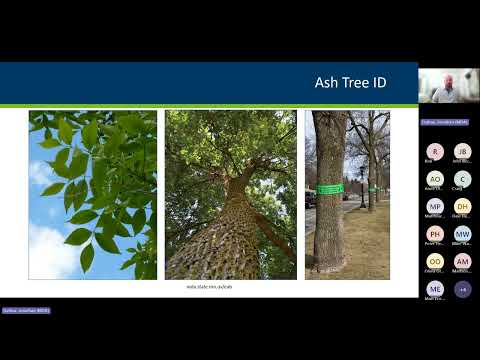
Jonathan (no last name provided), the emerald ash borer technical assistance coordinator with the Minnesota Department of Agriculture, gave a 40- to 45-minute presentation that covered EAB biology, signs and symptoms, where it has been confirmed in Minnesota, quarantine requirements and management options for individual trees and community tree inventories. "I am recording this, and we will make this presentation available on the Department of Ag's YouTube channel," he said at the start of the session.
The MDA emphasized the public-health-of-the-urban-forest implications of EAB, noting that Minnesota has an especially large ash resource and that mortality can be rapid once the insect establishes locally. The presentation listed recent confirmed finds in Carlton, Meeker, Murray and Otter Tail counties and cited specific reports including a farm near Fulda and the Murray County fairgrounds in Slayton, a site south of Litchfield in Meeker County, trees identified near Deer Creek and near Wadena in Otter Tail County, and multiple locations in Carlton County, including reports near the Fond du Lac tribal area. The agency said these and nearby detections triggered new county-level emergency quarantine actions and that specific quarantine boundaries would be announced to stakeholders in the coming weeks.
Why this matters: Minnesota has roughly one in five community trees as ash on average and nearly a billion ash trees statewide, concentrated in both community plantings and black ash forest stands. MDA staff warned that because EAB is cryptic before visible symptoms appear, the insect typically spreads beyond where it's first detected. That makes early reporting and quarantines important to reduce long-distance human-assisted spread, the presenter said.
Key points from the presentation
- Biology and detection: Jonathan described the EAB life cycle (one- and two-year development in Minnesota), the adult active flight period (broadly May through September), and detection indicators such as woodpecker "blonding," vertical bark splits exposing S-shaped larval galleries, D-shaped adult exit holes and the two-spined larval tail. He explained that females lay about 60 to 90 eggs each and that populations often go unnoticed for years before tree mortality becomes obvious.
- Extent and timing: The presenter said EAB has been confirmed in more than 50 Minnesota counties and that typical natural spread averages about two miles per year; human-assisted movement of infested firewood or ash material can produce long-distance jumps. MDA maintains an EAB status map that is updated nightly and recommends landowners and managers consult the map and begin planning management if they are inside a "generally infested" polygon or within roughly 10 to 15 miles of one.
- Quarantine and regulated articles: The MDA described two quarantine types: internal (limits movement within Minnesota) and external (restricts material entering from other states or Canada). Regulated materials include any Fraxinus (ash) material, any life stage of EAB, hardwood firewood (defined as cut to 4 feet or shorter), mulch containing regulated material, and bark or wood chips from ash. The agency explained that transit through quarantine counties without overnight stops is allowed for nonregulated loads but that moving regulated material from a quarantine county to a non-quarantine county is prohibited unless covered by a compliance agreement. Businesses that must move regulated material across quarantine boundaries must work with MDA on compliance (options include chipping to <1 inch dimensions, kiln drying/heat treatment, fumigation or debarking).
- Management options: MDA recommended that removal and major pruning of ash trees be done outside the beetle's active period when possible (October'April) to reduce the chance of moving immature stages. For communities, the presenter recommended creating management plans, prioritizing removal of low-quality or hazardous ash, and considering strategic treatment on high-value trees to stagger tree mortality and budgetary impacts. Treatment options discussed included soil drenches (typically annual) and trunk injections of emamectin benzoate (professional application, commonly effective for two years), with the agency noting large mature trees are best handled by licensed arborists because some products are restricted-use pesticides.
- Reporting and resources: The MDA asked observers to report suspected EAB finds with clear photos and precise locations (photos of galleries, woodpecker damage or the insect are most useful). Reports may be made via EDDMapS, the MDA online "report a pest" form, email or voicemail. MDA staff noted additional resources such as the Minnesota DNR Forest Stewardship Program (for landowners with woodland) and the DNR Urban and Community Forestry Program (for community planning and grants).
Questions from attendees focused on county-level disposal rules, when to begin treatment, and whether cold winters reduce populations. Jonathan said disposal and surcharge fees for wood waste are county decisions and vary by location; MDA does not set local disposal fees. He advised that cold winters might reduce local populations some but do not eliminate EAB or prevent eventual tree-killing population levels. He closed by reiterating the importance of reporting suspected detections and taking photographs: "Please take pictures," he said, explaining photos and precise locations are critical for follow-up.
The session was recorded and the MDA said the video and slides would be posted to the agency's EAB web resources and YouTube channel within a few days of the meeting.