Get Full Government Meeting Transcripts, Videos, & Alerts Forever!
Get email alerts on the State Budget And Local Impacts topic
No spam. Unsubscribe anytime.
MICA reviews 2025 legislative outcomes; counties spared major program aid cuts but face future shortfalls
Summary
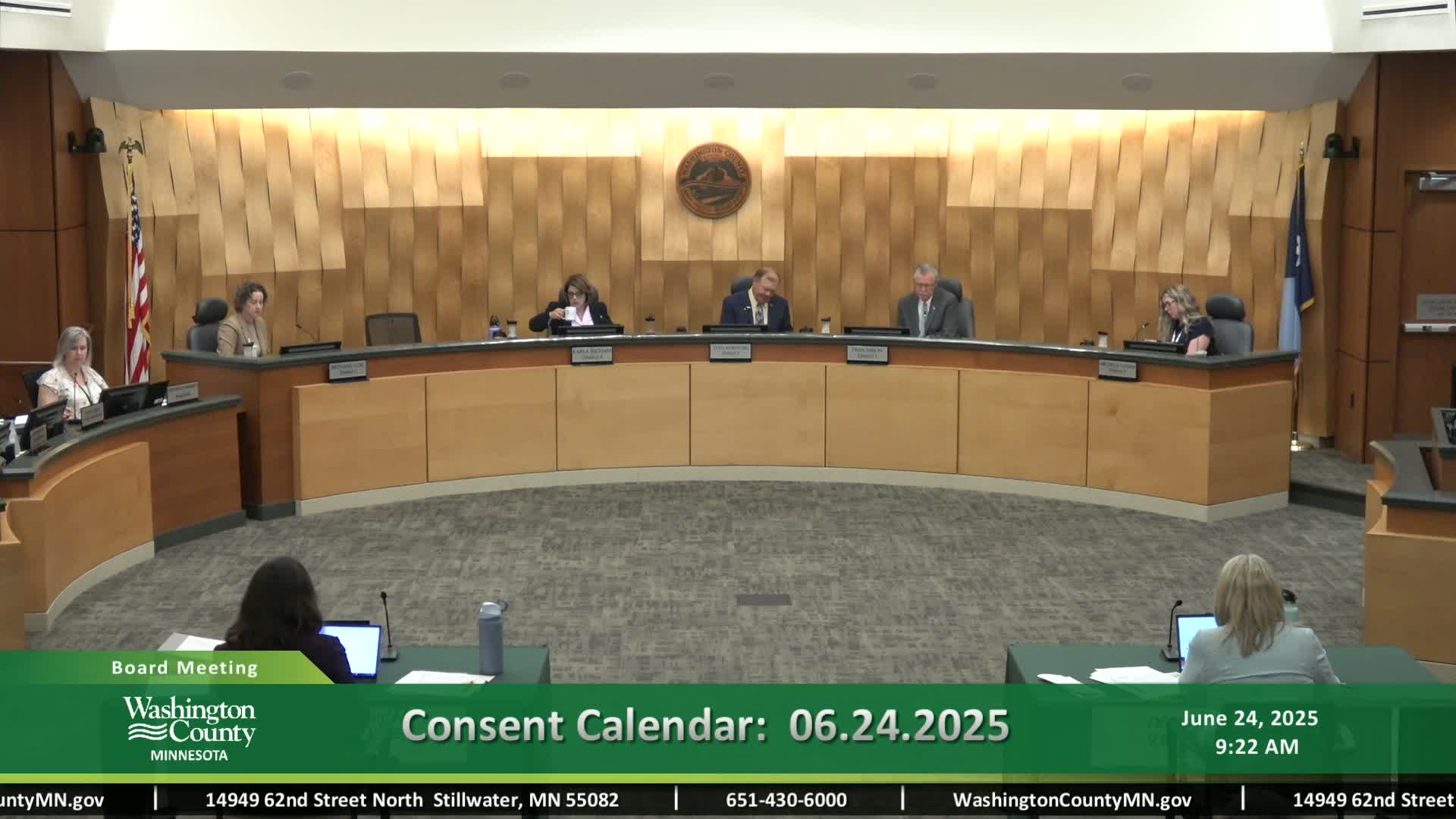
Nathan Jessen, executive director of the Minnesota Intercounty Association (MICA), told the Washington County Board of Commissioners on June 24 that the 2025 legislative session produced mixed results for counties but avoided the deepest cuts MICA had expected.
Nathan Jessen, executive director of the Minnesota Intercounty Association (MICA), told the Washington County Board of Commissioners on June 24 that the 2025 legislative session produced mixed results for counties but avoided the deepest cuts MICA had expected.
“One of the values that MICA provides … is that we can be quick and responsive on some issues,” Jessen said, describing MICA’s role in representing larger counties at the Capitol and amplifying county testimony during negotiations.
The takeaway: counties avoided proposed cuts to county program aid and payments in lieu of taxes (PILT) but lost some anticipated new revenue and face delayed reductions that will affect later budgets.
Why it matters: County program aid (CPA) and PILT are recurring revenue streams used in county budgets. Washington County officials said avoiding immediate cuts preserved a short-term budget baseline but left unanswered questions about future state shortfalls and local cost shifts.
What MICA told the commissioners
- Taxes and local aids: Jessen and MICA staff said the final tax agreement repealed the local government cannabis aid that had been projected at about $23.7 million for the current biennium and $41 million for the next. MICA noted Washington County had not yet received cannabis retail revenue because no retailers were operating in the county, so the repeal removed a potential future source rather than an existing appropriation.
- Cuts avoided: MICA highlighted that, amid wide concern about a multibillion-dollar out‑biennium deficit, the session did not cut county program aid or PILT — both had been targeted for steep reductions earlier in the process. Jessen said Washington County receives roughly $635,000 a year in PILT.
- Aquatic invasive species (AIS) aid: MICA reported a reduction in AIS aid that will take effect for aids payable in 2027; for Washington County the AIS reduction was described as roughly $140,000 a year.
- Sales tax exemptions and data centers: MICA staff said a long‑standing county priority — a functional statewide sales tax exemption on construction materials for county projects — saw no movement this year because of budget constraints (staff cited an estimated statewide cost over $60 million a year). The Legislature also removed an electricity sales tax exemption for data centers and added several narrow changes to the tax code.
Transportation and bonding
Amber Backus, MICA’s transportation representative, said transportation faced a deep general‑fund target and that negotiators shifted significant items to cover the shortfall.
“They had to cut $115,000,000 in general fund spending for the upcoming biennium,” Backus said, adding that much of the pressure was placed on transit programs because general‑fund transportation funds primarily back transit.
Key transportation and capital items described to the board included: - A $94 million reduction to the trunk highway fund was largely offset by new charges on electric and plug‑in hybrid vehicles and other adjustments, leaving a reported net loss of about $18 million to the trunk highway fund over the near term. Backus said recent electric vehicle surcharge increases produced roughly $76 million in additional revenue for the trunk highway fund. - A bonding package passed during special session: MICA described a $700 million bonding bill with substantial allocations for local infrastructure, including $42 million for the Local Road Improvement Program, $20 million for local bridges, and $5 million for the local government road wetland replacement program. MICA staff said the unusually large transportation allocations reflected last‑minute negotiations to secure votes for the special session agreement.
Environment and solid waste
Rachel Sosnowjik, MICA’s environmental liaison, said environmental and clean‑water priorities were constrained by the overall budget but that the Clean Water Council’s recommendations were funded in the legacy bill. She also noted a small pool of capital assistance funding for wastewater and drinking water projects ($6 million) and $176 million in public facilities authority funding for local water projects, including an $18 million emerging contaminants program. She said counties and cities should watch how the Minnesota Pollution Control Agency (MPCA) and the Public Facilities Authority decide to distribute the funds.
Sosnowjik also reported that MICA spent time defending the 2024 Packaging Waste and Cost Reduction Act from rollback attempts and described continuing work to secure greater county funding for solid‑waste programs.
Health and human services
Nancy Solecki, MICA’s health and human services policy lead, summarized several items affecting county human services operations: - Technology and case management: $35 million was included for SSIS (systems modernization) in the human services bill; when combined with prior state amounts the total available for modernization grew to $45 million, which MICA described as an important step toward replacing aging “green screen” systems. - Assessment and reassessment changes for long‑term care assessments: the legislature allowed abbreviated reassessments when a client’s situation has not changed and expanded the number of remote reassessments counties may use. - Facilities and capacity: MICA said the Legislature provided funding for additional capacity at state treatment facilities (including operating and bonding dollars tied to projects at Anoka and AMRTC). MICA staff said the combination of legislative operating and bonding steps addressed part of the capacity concerns discussed during session; a work group and interim reports were also continued.
Corrections and public safety
Emilio Lamba, MICA’s public‑safety analyst, described a broadly positive funding outcome for corrections and public safety relative to other areas: the judiciary and public safety committees had a positive spending target. Notable changes reported to the board included a three‑year averaging method for the community supervision formula, extension of local supervision fee authority through 2029, and executive adjustments to earned incentives and release credits under the Minnesota Rehabilitation Reinvestment Act.
Lamba also told the board the Department of Corrections will decommission Stillwater (Bayport) prison with a full decommissioning targeted for 2029 and a study and plan due in 2027; MICA said the department expects to manage capacity in other facilities and that counties should not, at present, expect an increase in supervision caseloads tied to that closure.
County administration and federal outreach
Margaret Bessel of Larkin Hoffman Public Affairs briefed the board on Washington County’s capital priorities and the bonding outlook. She said most of the county’s priority capital requests did not receive earmarks in the 2025 bill but noted that many project sponsors expect to renew requests in the 2026 bonding year. Bessel urged readiness: the next state budget forecast is in November and 2026 will be an election year that could affect bonding politics.
Deputy Administrator Jan Lucky and staff described two federal letters at the dais: (1) a thank‑you letter to members of the county’s congressional delegation for sponsoring or picking up congressionally directed spending requests, and (2) a policy letter urging Washington County’s congressional delegation to oppose proposed SNAP and Medicaid changes in reconciliation legislation. The board voted to approve the SNAP/Medicaid letter with a minor wording change requested by a commissioner.
County action and votes at the meeting
- Consent calendar (items A–K): motion to approve made by Commissioner Bigham, seconded by Commissioner Miron; roll call vote recorded as 5–0 in favor. - Federal policy letter (SNAP/Medicaid): motion to approve the drafted letter to the county’s federal delegation was made by Commissioner Claussen, seconded by Commissioner Miron; the board approved the letter after a minor edit; outcome recorded as approved. - State standard measures declaration and resolution: the board adopted a resolution to participate in the State Standard Measures Program and authorized the county administrator to file the county’s declaration and performance measurement review with the Office of the State Auditor by July 1. The motion passed by roll call, 5–0.
What board members emphasized
Commissioners thanked MICA and contract lobbyists for outreach and testimony at the Capitol and echoed MICA’s view that avoiding immediate cuts to CPA was a short‑term victory. Several commissioners cautioned that the state’s larger out‑biennium deficit means Washington County will likely face fiscal pressure in coming budget cycles and asked staff to plan for potential cost‑shift scenarios.
Looking ahead
MICA staff said they will remain engaged through summer and fall as the counties prepare for 2026 policy work and the anticipated bonding year. The county asked MICA and staff to study local impacts of facility closures (for example, the Bayport/Stillwater prison decommissioning) and to continue coordination on transportation, clean water, and solid waste funding.
Ending
Board members and staff agreed to keep the county’s delegation and stakeholder partners informed as special sessions or federal reconciliation processes move forward, and to return to the board with more precise budget‑planning scenarios when the November forecast is released.