Get Full Government Meeting Transcripts, Videos, & Alerts Forever!
Get email alerts on the Budget Millage topic
No spam. Unsubscribe anytime.
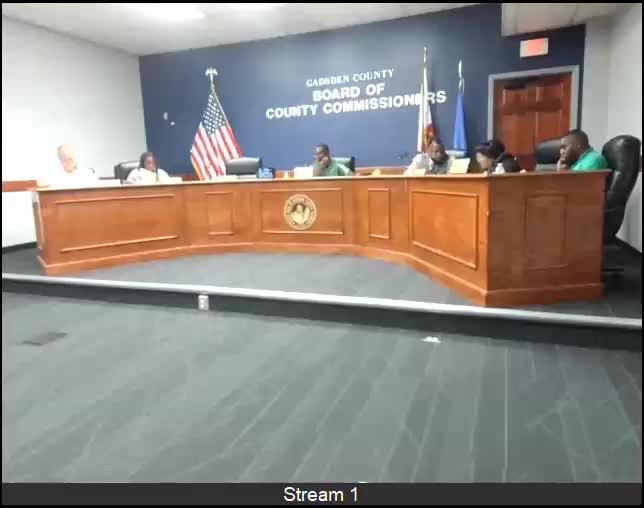
Gadsden County commissioners give staff millage guidance amid budget, Medicaid and EMS funding risks
Summary
At a budget workshop, county finance staff outlined the TRIM/millage process and commissioners gave directional guidance — not a formal vote — to prepare Department of Revenue filings while debating whether to hold the millage at 9 mills or plan higher as a precaution amid uncertain state and federal funding.
Gadsden County commissioners directed staff to prepare the Department of Revenue Form 4 20 with a working millage assumption while continuing budget work, after a finance presentation described how property values, rollback calculations and one-time federal dollars shape available funding.
Finance director Rose told the commission the county’s taxable property value for 2025 is approximately $2.4 billion, up about $112–113 million from the prior year, and explained how the rollback rate (calculated to be 8.638) determines whether a proposed millage constitutes an advertised tax increase. Rose said the county’s current millage is 9 mills and that, using the Department of Revenue formulas, keeping last year’s rate generates roughly $1.4 million in ad valorem proceeds under the rollback calculation compared with about $1.9 million collected last year at 9 mills.
The discussion centered on three pressures that will affect final proposals: rising operating costs (including higher FRS employer rates and health insurance), dwindling one-time ARPA funds that previously offset general fund costs, and potential state and federal changes that could shift administrative or benefit costs to counties. Rose said ARPA money had offset nearly $3.8 million in general fund costs in the previous year and that only about $300,000–$400,000 of ARPA remains for general fund use.
Commissioners repeatedly stressed the county must balance resident services with reserve levels to prepare for natural disasters and potential changes to Medicaid, SNAP and other federal programs. Several commissioners warned that newly proposed state rules could require counties to absorb larger administrative costs for Medicaid and SNAP in coming years. One commissioner asked staff to model what a 50% cut to Medicaid reimbursements would mean for county revenues; staff said recent Medicaid reimbursements were in the $500,000–$600,000 range and agreed to analyze multi-year impacts.
Emergency services and facilities needs framed much of the budget debate. Commissioners and staff noted the high operational cost of ambulances and fire apparatus — an estimated roughly $675,000 for a single fire truck was cited — and described continuing needs for additional EMS units and deputies. Commissioners also raised staffing-compression issues and asked HR and finance to identify a limited set of reclassifications and targeted salary adjustments already under review to address compression; staff said only a small number (about eight to ten positions) remain in the compressed classification tier.
No formal millage ordinance was adopted at the workshop. Instead, commissioners gave staff directional guidance to prepare the August 4 Department of Revenue filing using a working millage number and to continue detailed line-by-line budget review. At the end of the discussion one commissioner offered a working figure of 9.45 mills for staff to use when preparing the DOR form, while several other commissioners insisted they were not willing to authorize a formal increase to 9.5 mills and asked for additional scenario analyses. Staff said the August 4 filing is “locked in” as a maximum and that the board may reduce the proposed millage later but cannot increase it after filing.
Staff committed to return with scenario analyses including (a) the budget impact of different millage rates, (b) the effect of a hypothetical 50% reduction in Medicaid reimbursements, (c) the remaining ARPA balance and how it affects recurring obligations, and (d) targeted options for reducing nonessential expenditures while preserving first-responder capacity.
Commissioners set the next, more detailed budget workshop dates and asked staff to provide the line-item analyses they requested. The finance director emphasized the importance of deciding a millage direction soon so the Department of Revenue Form 4 20 can be filed on the August 4 deadline; she reiterated that once filed the board can lower but not raise the proposed millage.
Ending: The board left the workshop without a formal millage vote and with staff directed to return with the requested fiscal scenarios and line-item review. The August 4 filing will reflect the millage guidance the board provides before that deadline; the board will consider final millage and budget adoption at subsequent public meetings.