Get Full Government Meeting Transcripts, Videos, & Alerts Forever!
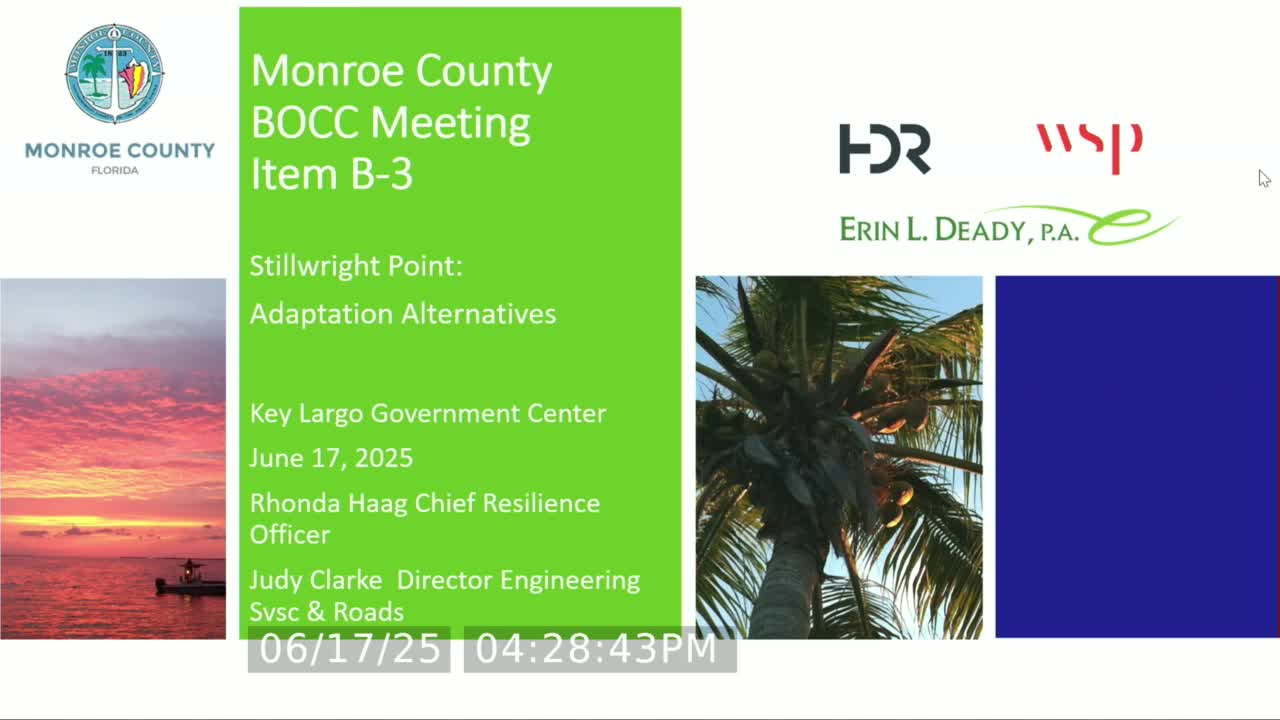
Monroe County weighs six Stillright Point road-adaptation options; design will finish but construction is on hold
Summary
Monroe County commissioners on June 17 discussed six technical alternatives for adapting Stillright Point roads to rising sea levels and tidal flooding, and after staff and consultant presentations directed staff to finish grant-funded design work but delay construction until funding, easements and permits are resolved.
Monroe County commissioners on June 17 discussed six technical alternatives for adapting Stillright Point roads to rising sea levels and tidal (king) flooding and heard staff explain legal, regulatory and funding constraints that limit the county—s options. After consultant and staff presentations and public comment, the board directed staff to finish the design work required under existing grant agreements but indicated it will delay construction until funding, easements and permitting questions are resolved; commissioners also asked staff to pursue a capital-budget request for routine repaving and maintenance.
Why it matters: Stillright Point is one of a number of Monroe County neighborhoods identified in the county—s roads vulnerability work as at risk from tidal flooding. Construction estimates presented during the meeting ranged from roughly $2.5 million for limited repaving up to about $38–39 million for full road elevation projects that include drainage systems and pump stations. County staff and consultants warned that regulatory requirements for water quality and off-site impacts, easement needs and litigation risk make it difficult to pursue reduced-design options without jeopardizing grant funding and exposing the county to liability.
What staff and consultants said: Aaron Deedy, the county—s policy lawyer, summarized the regulatory framework that governs these projects and the limited options available to deviate from statutory and rule-based requirements. He said state water resource and pollution statutes (chapters 373 and 403, Florida Statutes) and the Florida Administrative Code (notably rule 62-330) create a performance-based permitting system overseen by the Department of Environmental Protection and the water management districts; that framework evaluates pre- and post-project water quantity/quality and off-site impacts. Deedy described three theoretical pathways — variance, waiver and legislative change — and explained limits and risks:
- Variances address property-specific hardships and typically do not apply to the county—s scenario. - Waivers are rare, generally used for de minimis encroachments, and would not likely allow the county to avoid state water quality standards or the obligation not to displace storm/tidal water onto adjacent private property; Deedy said “0 to 3 waivers are filed each year with the water management district” and the waiver pathway is narrow. - Legislative changes are lengthy, politically difficult and…
Already have an account? Log in
Subscribe to keep reading
Unlock the rest of this article — and every article on Citizen Portal.
- Unlimited articles
- AI-powered breakdowns of topics, speakers, decisions, and budgets
- Instant alerts when your location has a new meeting
- Follow topics and more locations
- 1,000 AI Insights / month, plus AI Chat