Get Full Government Meeting Transcripts, Videos, & Alerts Forever!
Get email alerts on the Flood Adaptation topic
No spam. Unsubscribe anytime.
Monroe County weighs six Stillright Point road-adaptation options; design will finish but construction is on hold
Summary
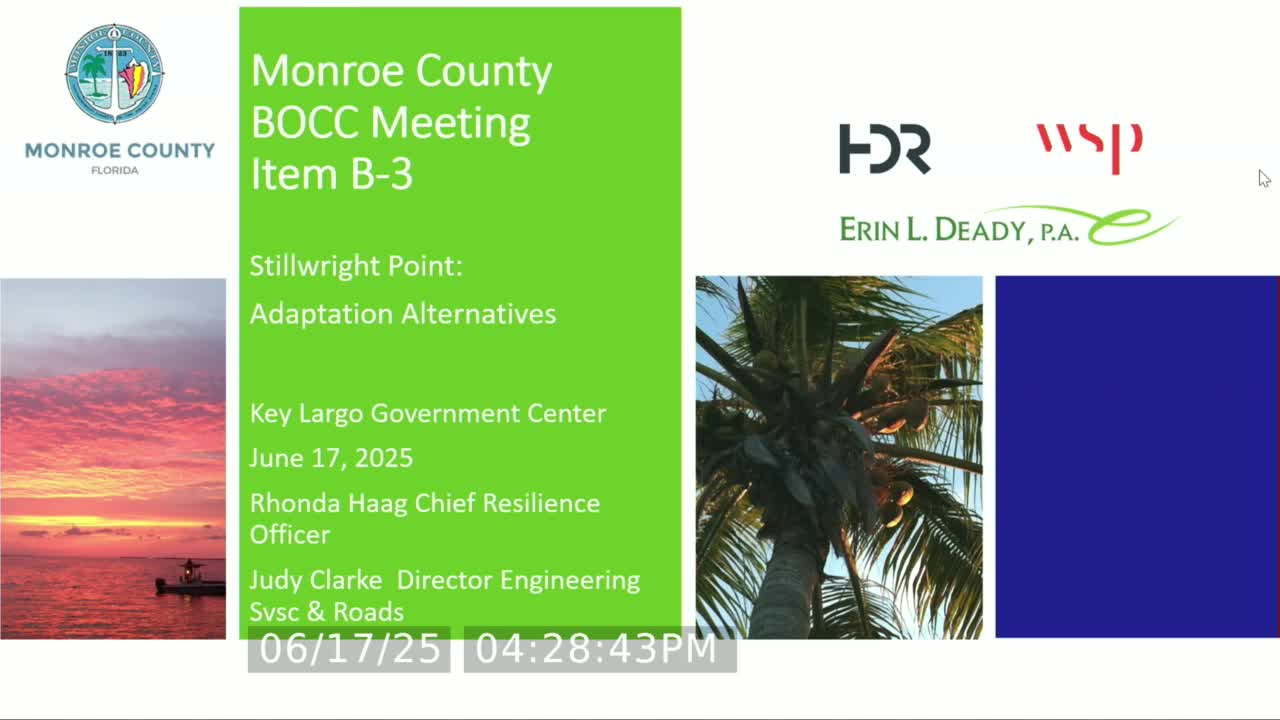
Monroe County commissioners on June 17 discussed six technical alternatives for adapting Stillright Point roads to rising sea levels and tidal flooding, and after staff and consultant presentations directed staff to finish grant-funded design work but delay construction until funding, easements and permits are resolved.
Monroe County commissioners on June 17 discussed six technical alternatives for adapting Stillright Point roads to rising sea levels and tidal (king) flooding and heard staff explain legal, regulatory and funding constraints that limit the county—s options. After consultant and staff presentations and public comment, the board directed staff to finish the design work required under existing grant agreements but indicated it will delay construction until funding, easements and permitting questions are resolved; commissioners also asked staff to pursue a capital-budget request for routine repaving and maintenance.
Why it matters: Stillright Point is one of a number of Monroe County neighborhoods identified in the county—s roads vulnerability work as at risk from tidal flooding. Construction estimates presented during the meeting ranged from roughly $2.5 million for limited repaving up to about $38–39 million for full road elevation projects that include drainage systems and pump stations. County staff and consultants warned that regulatory requirements for water quality and off-site impacts, easement needs and litigation risk make it difficult to pursue reduced-design options without jeopardizing grant funding and exposing the county to liability.
What staff and consultants said: Aaron Deedy, the county—s policy lawyer, summarized the regulatory framework that governs these projects and the limited options available to deviate from statutory and rule-based requirements. He said state water resource and pollution statutes (chapters 373 and 403, Florida Statutes) and the Florida Administrative Code (notably rule 62-330) create a performance-based permitting system overseen by the Department of Environmental Protection and the water management districts; that framework evaluates pre- and post-project water quantity/quality and off-site impacts. Deedy described three theoretical pathways — variance, waiver and legislative change — and explained limits and risks:
- Variances address property-specific hardships and typically do not apply to the county—s scenario. - Waivers are rare, generally used for de minimis encroachments, and would not likely allow the county to avoid state water quality standards or the obligation not to displace storm/tidal water onto adjacent private property; Deedy said “0 to 3 waivers are filed each year with the water management district” and the waiver pathway is narrow. - Legislative changes are lengthy, politically difficult and unlikely to authorize flooding of adjacent properties; Deedy referenced the Clean Waterways Act rulemaking process (2020–2024) as an example of how long and contested water-quality rule changes can be.
He also noted potential litigation risk from adjacent property owners or environmental groups even if statutory or regulatory relief were obtained, and cautioned that altering a grant-funded design could trigger resubmission or rescoring by grant programs.
What the technical presentation showed: County and consultant engineers (Emilio and HDR/WSP staff) presented six alternatives, summarized as follows:
- Alternative 1 (pump-assisted, 2045 design year): Full road elevation with pump station, closed drainage, 10-foot easements each side in many locations; estimated construction cost about $39 million; largest elevation in the design area up to about 2.56 feet at the highest location; lowest probability of causing private-property flooding among options presented but requires extensive easements, ongoing operations and maintenance, and grant/permit compliance.
- Alternative 6 (pump-assisted, lower target year): Similar to Alternative 1 but using a lower design-year projection (2030-level basis in places), smaller maximum raise (~1.91 feet) and 5-foot easements in many locations; cost estimate roughly $38 million; staff noted cost savings are limited because drainage infrastructure and treatment are still required.
- Alternatives 4 and 5 (gravity drainage systems, 2030 and 2045 design-year variants): Elevation with gravity collection (French-drain-style trenches), substantial trenches and right-of-way requirements, but performance degrades as groundwater/surface levels rise and trenches become saturated; require significant easements and still offer only short- to medium-term benefit.
- Alternative 3 (paving-only / shallow overlay): Add 0.5–2.5 inches of asphalt within existing right-of-way based on topology; rough cost estimate about $2.5 million; staff warned that locations vary and anything beyond about 2 inches risks displacing water onto private property and would require flowage easements or other agreements.
- Alternative 2 (no adaptation): Continue routine maintenance; highest probability of continued roadway and private-property flooding.
Funding and permitting implications: Staff reported the Stillright Point construction design was ranked in the top 10 for a Resilient Florida grant application. County staff said they have identified approximately $20 million in FEMA HMGP (Hazard Mitigation Grant Program) earmarks and have applied to Resilient Florida for roughly $21 million; however, staff cautioned that (a) award is not guaranteed, (b) changing a funded design could require re-evaluation or rescoring by granting agencies, and (c) federal grant program rules and benefit-cost analyses influence eligibility and final award amounts. Staff also noted construction oversight and implementation costs (construction inspection/CEI) need budgeting.
Public comment and neighborhood concerns: Several Stillright Point residents spoke during public comment. Kim Sikora described repeated meetings and frustration over decades of incremental discussions, questioned why alternatives such as Alternative 6 were not presented earlier, and urged the county to produce a workable solution rather than repeated briefings. Emily Stewart urged that any signage or real-estate disclosure policy be applied consistently across all neighborhoods at risk, and asked for clarity on how many houses and the tax base are affected (she noted Stillright Point—s assessed value in the Upper Keys). Engineer and resident Stetson Hines raised technical questions about generator reliance for pump stations, longevity of designs and the practicality of elevating to various target years.
Board discussion and direction: Commissioners expressed frustration with the challenging technical, legal and fiscal tradeoffs. Several commissioners said they are reluctant to pursue any alternative that would elevate the road without a functioning drainage system because that would shift water onto private properties and expose the county to legal risk. The board reached consensus on the following operational directions (these appeared as board consensus/direction in the transcript rather than a recorded roll-call vote):
- Staff will finish the design required under existing grant agreements because the county is contractually obligated to complete design work. - The BOCC will not proceed immediately to construction without resolving funding, easement and permitting/legal issues; commissioners said construction will be delayed until those matters are addressed. - Staff will prepare a capital-budget request to pursue routine repaving/maintenance (mill-and-overlay) as a near-term capital project; staff estimated the typical paving/mill-and-overlay cost in the neighborhood at roughly $2.0–2.5 million. - Staff and the board will explore neighborhood-funded mechanisms (county-managed assessment districts or MSTBU-style approaches used in other Florida counties) as a possible path if residents wish to pursue an elevated design and are willing to finance it; staff said such programs typically require a high level of property-owner participation and clear legal agreements.
Policy options flagged during discussion: staff and commissioners discussed additional non-design policy tools that could be paired with lower-cost alternatives, including flowage easements (to allow county-managed storage of storm/tidal water on private land), signage and official warnings about hazardous flooding conditions, and mandatory or voluntary real-estate disclosure to notify prospective buyers of flood-prone roads. Staff noted flowage easements generally require property-owner agreement and, in one neighborhood engagement, residents indicated they would not accept a requirement for 100% participation, which would preclude the county from relying on flowage easements for permitting in that area.
Why the work remains difficult: County counsel and staff repeatedly highlighted that state water-quality standards and permitting are performance-based and emphasize avoiding off-site impacts; as a result, reduced-design or paving-only approaches that effectively move water onto adjacent properties are typically not permissible without property-owner flowage agreements or statutory/regulatory changes — both of which are difficult and uncertain. Deedy said any attempt to obtain regulatory waivers is limited in scope and rare, while legislative change would likely be time-consuming and controversial.
Next steps: staff said they will complete the grant-funded design work, prepare the requested capital-budget submission for repaving/maintenance, continue coordination with permitting agencies and grantors, and brief the board with cost and schedule implications. Commissioners asked staff to pursue outreach and to explore neighborhood-managed financing models if residents express interest in privately funding higher-level adaptation work.
What was not decided: The board did not approve construction funding, did not accept any easements on behalf of property owners during the meeting, and did not adopt a specific adaptation alternative for construction.
For residents: Staff advised that technical, permitting and funding work continues; any construction decision would require further board action, funding commitments and, where needed, property-owner easements or other legal arrangements.