Get Full Government Meeting Transcripts, Videos, & Alerts Forever!
Get email alerts on the Public Safety topic
No spam. Unsubscribe anytime.
Commissioners debate using higher fire assessment to fund brush truck, station upgrades
Summary
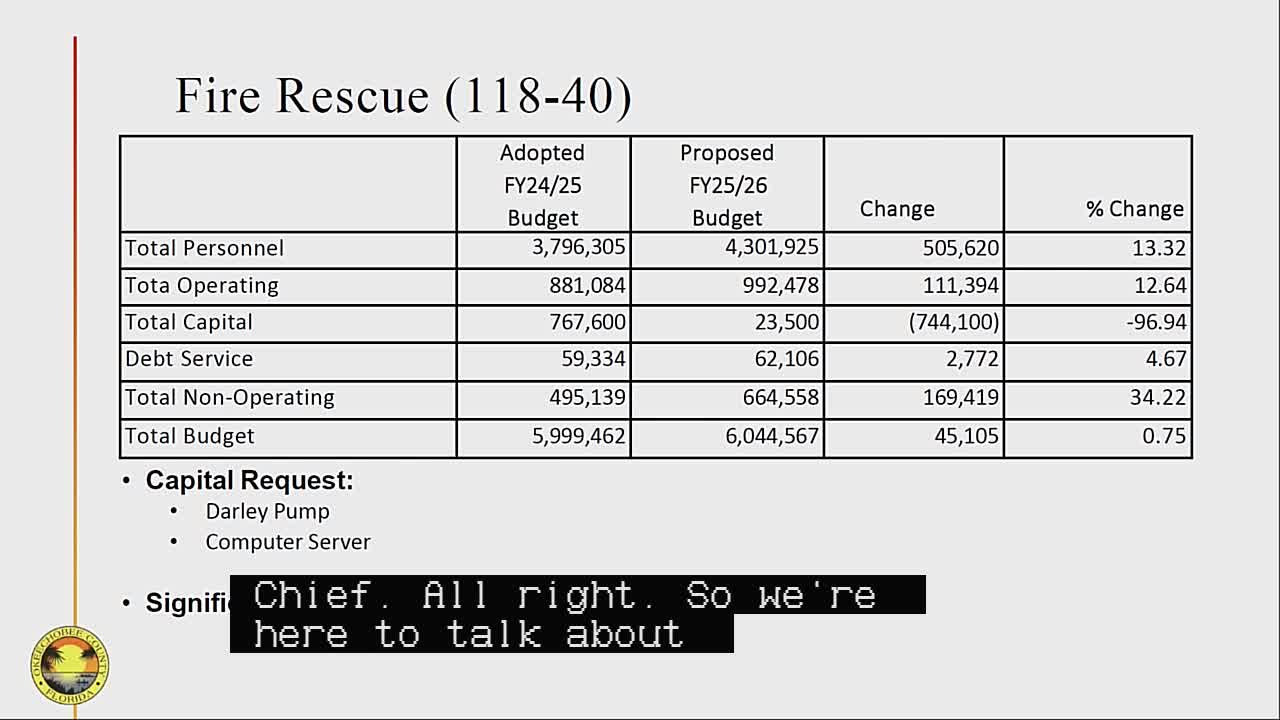
Okeechobee County commissioners and fire-rescue leaders debated whether to raise the fire/EMS special assessment to pay for a replacement brush truck and other deferred capital after consultant estimates and recent salary increases left the department's five‑year plan short.
Okeechobee County commissioners and fire-rescue leadership spent the budget workshop focused on a shortfall between the department’s capital needs and projected assessment revenue, with the replacement of an aging brush truck the top priority.
The discussion centered on how much of the fire/EMS special-assessment increase adopted previously would be available to restore capital items cut from the proposed fiscal 2025–26 budget. Chief (Fire Chief) told the board the department’s capital requests this year had been largely removed to hold the department within the current assessment level; the remaining capital request listed in the draft budget was limited to a pump and a server. He identified four higher-priority items removed earlier: a replacement brush truck, improvements to Station 4, further work on the county training tower and a staff vehicle — and said the brush truck is the single highest priority because the unit in service is roughly 25–26 years old and has high operating and idle hours.
Chairman (Chair, Board of County Commissioners) and multiple commissioners pressed for a narrower set of immediate needs rather than rebuilding the entire capital list at once. Commissioner Burrows urged buying the brush truck first and suggested using any available contingency and reserve balances to begin that purchase, while others raised concern that reserves are limited and that raising the assessment only to cover one year’s capital would leave the department constrained in subsequent years.
Chief described the trade-offs of extending vehicle life: "By extending the lives of these vehicles... we're spending more and more in repairs," he said, noting high parts and service costs and that older units can require major repairs that approach replacement cost. Commissioners asked for an updated five‑year replacement plan that reflects recent salary and overtime increases and the higher maintenance costs associated with extending fleet life.
Commissioners and staff discussed the 5-year assessment study done by Stantec and whether it incorporated the significant salary and benefit increases that followed the study. "They did the study over three years ago... these salary increases changed the picture," Chief said. Several commissioners expressed frustration that the consultant and prior inputs did not anticipate the magnitude of subsequent personnel cost increases, and asked staff to return with a revised fiscal plan. The board directed staff to model options including: (a) keeping the fiscal 2026 assessment as proposed, (b) adopting the higher 2027 assessment recommended by Stantec to restore some capital funding, and (c) revisiting the five‑year plan and consultant assumptions. Commissioners also asked staff to prioritize a minimal set of capital items the board could approve quickly — with the brush truck at the top — and to return with estimated timing, procurement lead times and financing options.
Chief and county administrative staff said construction and procurement schedules vary; brush-truck lead time could be about a year if the county needs a new build, possibly less if a ready demo unit or remount is available. Staff noted EMS had stronger reserve balances and that some station-improvement costs appeared as split funding between fire and EMS in the draft workbook.
The board did not take a final vote at the workshop. Instead commissioners asked staff to return the next day with updated numbers that: show the fiscal impacts of moving to the 2027 assessment level, reapply a 50/50 fire–EMS personnel split used in earlier years, and present firm costs and timing for the brush-truck purchase and Station 4 improvements.
The county’s next steps include updated modeling of assessment scenarios, a revised vehicle/replacement schedule and procurement timing so commissioners can decide whether to use the higher assessment option to restore capital expenditures or to phase purchases over multiple years.