Get Full Government Meeting Transcripts, Videos, & Alerts Forever!
Get email alerts on the Land Use topic
No spam. Unsubscribe anytime.
City of Largo reviews Forward Pinellas TEALS update, considers target-employment overlays
Summary
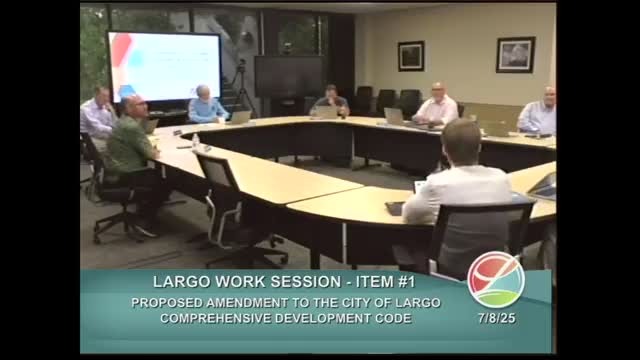
Forward Pinellas presented an update to the Target Employment and Industrial Land Study (TEALS) and countywide rules, outlining four target-employment center subcategories, potential overlay tiers that would allow density/intensity bonuses for guaranteed target-employment uses, and a local timeline for zoning and future land-use updates.
Forward Pinellas officials briefed the City of Largo commission on an update to the Target Employment and Industrial Land Study (TEALS) and related countywide rules, and described options for local implementation that would let property owners opt into overlays to receive density and floor-area bonuses in exchange for guaranteeing target-employment uses.
Jared Austin, a member of the City of Largo community development team, introduced the presentation and said Forward Pinellas is “implementing this work both with you at the city of Largo as well as in tandem with the city of Pinellas Park.” Nosheen (Nasheen) Rahmand, principal planner at Forward Pinellas, and Nicole Galasso of Forward Pinellas reviewed the TEALS update and the countywide rules that create four subcategories for Target Employment Centers (TEC): TEC urban, TEC suburban office, TEC suburban industrial and TEC local.
The TEALS update and countywide rules are intended to give cities a framework to retain higher-paying, regionally competitive employers while allowing more flexible mixed uses where appropriate. "Target employment" was described by Rahmand as employers and industries in Pinellas County “which pay above average wages,” with Forward Pinellas using county economic-development data to define the above-average threshold.
Why it matters: Forward Pinellas staff said the county has lost a substantial amount of office inventory and wants to retain sites for Class A office and other target-employment uses rather than have them convert entirely to residential. Rahmand noted that since an earlier baseline period the county has lost "at least 3,300,000 square feet" of office space; participants in the session questioned the phrasing and later clarified that the figure referenced demolition and turnover in the inventory dating back to earlier years.
What the subcategories allow: Nicole Galasso summarized the four TEC subcategories and associated ceilings adopted into the countywide rules. The urban category is intended for the largest, vertically integrated mixed-use areas (Forward Pinellas lists a ceiling example of 100 units per acre and a maximum FAR of 8). The suburban office subcategory—applicable to Bay Vista Office Park in Largo—allows mid-scale mixed use and was described during the presentation as having a 50-units-per-acre maximum and a 5 FAR ceiling under the countywide rules. The suburban industrial subcategory focuses on preservation of industrial uses (Forward Pinellas described a maximum FAR of about 3 under that subcategory, with local density left to municipal future land-use decisions). The TEC local category is intended to be implemented via a special-area plan and overlay tailored to local conditions.
Opt-in overlays, tiered incentives: Forward Pinellas and City staff described a proposed local approach using opt-in overlays with two tiers. Under the staff description, a project that opts into tier 1 would need to provide a guaranteed target-employment use to qualify for increased intensity (and in some categories density) beyond the underlying future land-use allowance. Tier 2 would require additional commitments—building form and placement, streetscape or public-realm improvements and higher design standards—in exchange for larger density and intensity bonuses; staff said tier 2 could enable stacking of uses (for example, multiple floors of Class A office with residential or other ancillary uses above) and would expand bonuses available to suburban industrial areas if the tier-2 design standards are met. Jared Austin emphasized that "any property that's currently within the target employment centers are still going to be allowed to develop based on what their current future land use category allows them to do" and that bonuses would be available only to properties that opt into the overlay.
Local outreach and interest: City staff described outreach earlier in the year to property owners and employers, including on-site engagement with TD SYNNEX employees and meetings with park property owners. Staff reported some owners expressed conditional interest in opting into overlays if greater flexibility (higher FAR or density) were available. Commissioners asked how the approach interacts with the Live Local Act (a Florida housing law referenced during the presentation) and whether the countywide rules or Forward Pinellas action is mandatory; Forward Pinellas staff said the countywide rules set a ceiling and local governments may adopt subcategories within the maximums, but they must remain consistent with the countywide plan map and rules.
Process and timing: Staff said the city would need to update its Comprehensive Development Code (CDC) if it adopts an overlay; the planned local schedule discussed during the work session was community outreach completed in spring/summer, amendment preparation (future land-use map and CDC updates) in summer/fall, and the amendment adoption process in fall/winter, with a target of second reading in December if schedules hold. Forward Pinellas staff also noted that because Largo had previously adopted earlier TEALS policies, the Forward Pinellas review of a local adoption could be handled administratively rather than as a county-level land-use case, reducing additional hearings at the Forward Pinellas board.
Concerns and unresolved items: Commissioners raised several points: adjacency to Pinellas Park (where different subcategory choices could create competitive differences across a street), whether the overlay process would reduce or increase bureaucracy, and how existing multi-tenant properties would be treated if some tenants did not meet the target-employment definitions. Staff response was that the overlay is voluntary (property owners must opt in) and that if owners do not opt in their current entitlements remain unchanged. Staff also said one purpose of adopting an overlay now is to reduce site-by-site county amendments in the future by establishing a predictable framework upfront.
Next steps: Staff said more detailed CDC amendments were in preparation and that additional public engagement and refinement of tier and bonus language would follow. Forward Pinellas staff offered to provide Commissioner-requested numeric details on tier-1 bonuses and other ceilings.
Ending: The commission did not take a formal vote during the work session; staff and Forward Pinellas will return with draft CDC text and future-land-use map amendments for formal consideration.