
Sheridan County School District #2 advances concealed-carry policy after public forum and trustee debate
Get AI-powered insights, summaries, and transcripts
Subscribe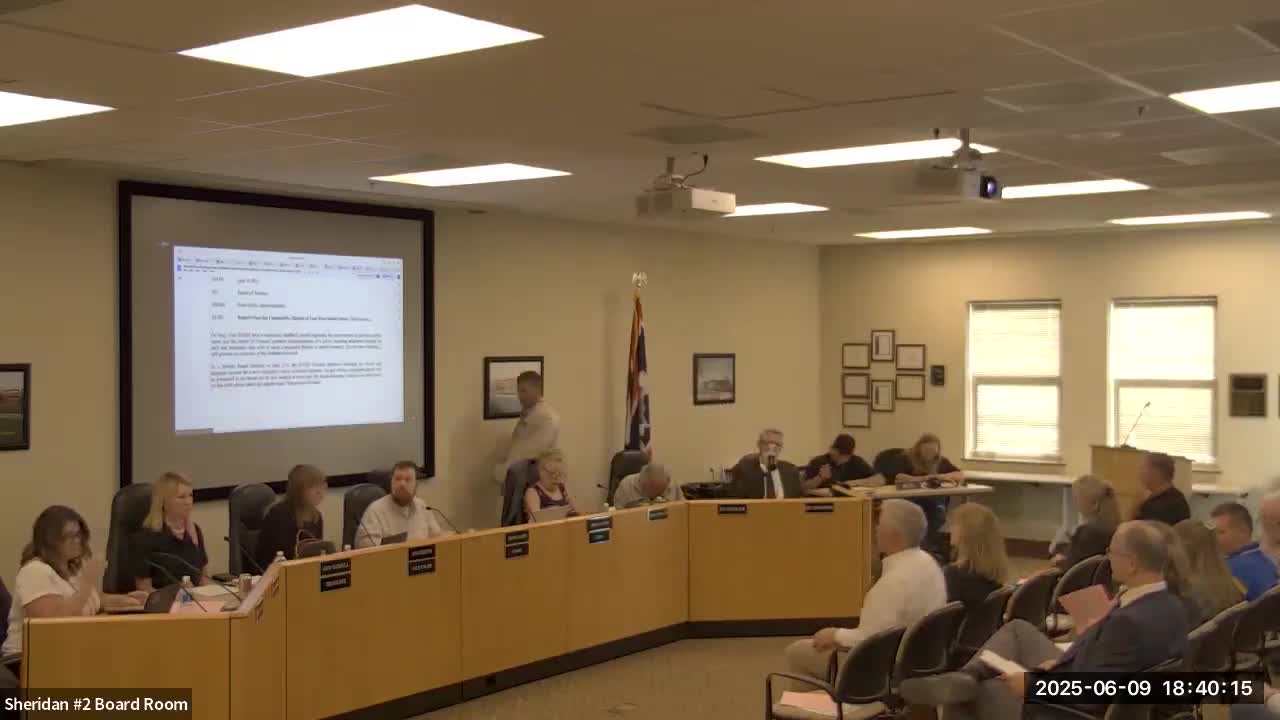
Summary
The board moved forward on a draft policy to implement state law repealing gun-free school zones, after a May community forum, public comments and extended trustee discussion about training, liability and logistics.
Sheridan County School District #2 trustees voted to approve draft policies on concealed firearms for first reading and later advanced them through board action after extended discussion and public comment.
The action follows a May 13 community forum and public comments at the board meeting about how to interpret House Bill 172 and Wyoming statute 6-8-105, the district said. Superintendent Shane Stultz told the board the statute goes into effect July 1 and that the draft policy mirrors the training and renewal requirements in the law: 16 hours of live training, 8 hours of scenario training and 12 hours annual renewal, with a biometric lockbox option for firearms not carried on the person.
The move matters because the legislation removes the prior “gun-free school zones” restriction and allows persons with concealed carry permits on school property subject to district rules. That prompted public testimony both supporting and opposing the policy. Shelly Pollock, a resident, said the district should clarify volunteer definitions and training requirements and argued that “If a person already has a concealed carry permit, they should be able to present that permit and should not be required to take further training.” Several parents and trustees pressed for clear definitions of “direct control” of a firearm and how biometric containers would be handled.
Trustees and staff discussed liability, funding for training and operational responsibilities. Stultz said the district has contacted legal counsel and insurance providers and that the district’s insurer would cover firearm-related liability if the policy is adopted. He also reported an employee survey showing 78.3% of staff do not plan to carry and that 87.1% supported the district drafting a volunteer and employee policy.
Trustees expressed differing views on whether the district should pay training costs. Trustee Gramper proposed adding funding for employee training to the policy; Trustee Tomlinson and others said training is essential and urged the district to ensure high-quality, consistent courses aligned with local law enforcement practices. Trustee Lambert said a biometric box should be “in the direct control of the person that is concealed carrying.” Trustee Ramber said she supported staff who volunteer to carry and did not want restrictions beyond the statute.
Stultz said the district is coordinating with nearby districts and a trainer identified by District 3; he said District 3 has estimated a district-level training cost of about $8,500 for a course they are scheduling and that the state set aside funding to reimburse training costs. Stultz said the Wyoming Department of Education would accept reimbursement requests for training costs and that reimbursements were being processed for other districts; he said the district could be included in a training event planned for August.
The board approved the policy on first reading and later moved toward second-reading procedures, and the draft policy will go through a 45-day rulemaking comment period before final adoption, the superintendent said. Trustees also asked staff to refine definitions (for example, visitor/volunteer), clarify oversight roles (building administrators and the superintendent were identified as compliance points) and to return with cost estimates and implementation details before final adoption.
The board’s action affects how volunteers, employees and third parties will be screened, trained and monitored if they choose to carry on district property once the state law takes effect. The district’s public materials and the draft policy state noncompliance could result in loss of volunteer status or termination for employees.
The board emphasized that the process remains subject to further rulemaking, insurance approvals and legal interpretation of the statute.