Get Full Government Meeting Transcripts, Videos, & Alerts Forever!
Get email alerts on the Capital Improvement Plan topic
No spam. Unsubscribe anytime.
Greenacres reviews FY25 capital improvement plan; fire station, emergency operations center and septic‑to‑sewer work highlighted
Summary
City staff outlined the FY25 capital improvement plan at a June 16 special meeting, describing phased budgets for a planned Fire Station 96 on John I. Leonard High School property, a $30 million emergency operations center, septic‑to‑sewer phases and funding gaps tied to delayed impact fees.
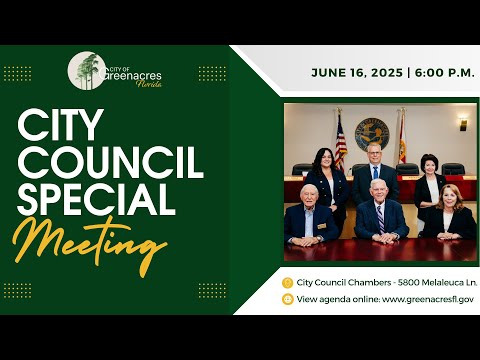
GREENACRES, Fla. — City staff presented a fiscal‑year 2025 update to Greenacres’ capital improvement plan during a June 16 special meeting, laying out phased funding for a planned Fire Station 96, a $30 million emergency operations center (EOC) and multi‑phase septic‑to‑sewer projects while flagging shortfalls from delayed impact fees and the impending sunset of an infrastructure surtax.
Miss McHugh, a city staff member, told council members the presentation focuses largely on maintenance and replacing aging infrastructure while reserving major park investments until a parks master plan is complete. “Before we get started, I just want to you know, there's a lot of effort that goes into putting all of this together. I wanna thank our departments for the work that they do in putting together our capital program,” McHugh said.
The presentation prioritized several large projects and described how the city plans to phase work and seek outside funding. The city is budgeting initial work on Fire Station 96 — a joint site the staff proposed at the John I. Leonard High School campus — but said construction depends on approvals from the school board and regulatory clearance for changes to a retention area.
McHugh described a design that would remove part of a retention lake and replace its storage with rain tanks installed under a parking area and a field. She told the council that the South Florida Water Management District (SFWMD) and the school district have been “amenable,” and said the rain‑tank phase should be completed before station construction. That initial phase is budgeted separately and could be done years ahead of building the station, she said. The staff said the parking‑deck option with piling would have cost about $8 million and the rain tank approach was more feasible.
The EOC is under a previously approved design‑build agreement and is being budgeted on a phased basis. McHugh said the total EOC project is $30 million, with a $4 million carryover from the current year being rebudgeted into FY26 to align with the project timeline. She also noted a roughly $500,000 permitting line item the city must book internally for statutory accounting purposes.
Septic‑to‑sewer work was another major focus. The city is in phase 4 of an eight‑phase septic‑to‑sewer north project that will serve homes along Broward Avenue from 10th Avenue North to Biscayne Drive. Fiscal‑year 2026 planning includes roughly $1.6 million for planning, design and construction management for that phase, and $1.5 million is budgeted for a south‑of‑Biscayne Drive phase. McHugh said the city pursues Community Development Block Grant (CDBG) funds, has discussed FDOT and county funding opportunities and will apply for Lake Worth Lagoon dollars, arguing the city lies in the lagoon watershed.
The presentation flagged a shortfall in anticipated impact fees that had been expected from several development projects, including Blossom Trail. McHugh said some projects were delayed and the city did not realize projected impact fee receipts in FY25; staff recommended a conservative approach and said a $340,000 budget adjustment may be needed if those fees do not materialize before the fiscal year ends. She noted that state legislative changes allow some developers to stagger impact fee payments at certificate‑of‑occupancy, which may delay receipts further.
Other line items discussed include:
- A $110,000 sewer camera purchase to enhance sewer inspection and flood mitigation; several vehicle replacements (two 12‑year and one 10‑year vehicles) and prepaid medic and ladder trucks the city had prepaid in February 2024 for accounting realization in FY26.
- Routine parks and recreation maintenance items in the 303 fund while the city completes a parks master plan; a planned replacement of exercise stations at Freedom Park and pickleball court resurfacing at Community Park and Freedom Park.
- Infrastructure surtax (305 fund) projects concentrated on septic‑to‑sewer and a play structure replacement at the youth programs building; staff noted the surtax will sunset at the end of the calendar year and most surtax dollars funded “quality of life” projects at council direction.
- American Rescue Plan Act (ARPA) funds (306 fund) held as a contingency for the youth programs building ($600,000 budgeted for FY26), with staff noting federal and state appropriations are pending the governor’s veto process.
McHugh said city staff are actively pursuing grants and appropriations — including federal community project funding already requested with support from Congresswoman Lois Frankel — and that the city’s lobbyists are assisting outreach to identify more funding for the EOC, Fire Station 96 and septic‑to‑sewer work.
The presentation also covered recurring city programs and smaller allocations: $100,000 for a property enhancement grant split 70/30 between residential and commercial applicants, nearly $89,000 in art‑in‑public‑places funds for centennial projects, scholarship awards already granted this year and a community events calendar for the city’s 100th anniversary starting in December.
On process and next steps, McHugh said staff will continue to phase major capital projects, seek grant offsets where possible and finalize an interlocal agreement with the school district for Station 96. She also recommended the rain‑tank first phase be budgeted in advance of any station construction to secure SFWMD approval.
Formal motions recorded in the meeting were limited to procedural items. Council members approved the meeting agenda and later voted to adjourn. The transcript does not show a recorded council vote on the Safe Streets for All safety action plan during the presentation; McHugh told the council the plan would be adopted that evening but a roll call vote is not recorded in the transcript passage.
The presentation and discussions highlight the city’s heavy reliance on phased budgeting and external funding for several large projects, the need to manage impact‑fee timing and the approaching sunset of the infrastructure surtax that has funded many local quality‑of‑life projects.
(End)