Get Full Government Meeting Transcripts, Videos, & Alerts Forever!
Get email alerts on the Urban Forestry Governance topic
No spam. Unsubscribe anytime.
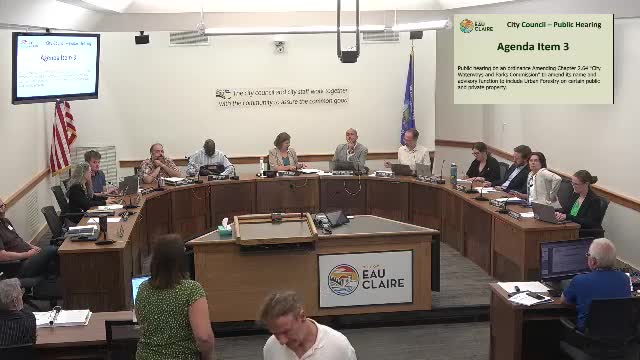
Council moves to expand Waterways and Parks Commission’s advisory role to include urban forestry
Summary
Councilors proposed amending the Waterways and Parks Commission ordinance to add urban-forestry advisory functions, define when major public-tree impacts go to commission review, and ask the commission to help develop species lists and planting standards.
The Eau Claire City Council considered an ordinance on July 21 to expand the name and advisory function of the Waterways and Parks Commission to include urban forestry. Council Vice President Worthman and Council member Miller presented the item, and they said the change would create a standing advisory path for certain public projects that affect significant trees and help the city develop updated planting standards and a preferred species list.
What the draft does
The proposed amendment renames or augments the commission’s advisory scope and specifies circumstances when projects should be referred to the commission for review. Examples called out in the draft include projects that would remove or otherwise impact five or more high-value public trees, affect a designated heritage tree, or impact 10,000 square feet or more of tree canopy. The amendment asks the commission to review and recommend urban-forest policies, planting standards, and updates to a city-approved tree species list.
Why it matters: The change creates a formal advisory route for major public-tree decisions and for city investment in urban-forest stewardship. Supporters said the measure would centralize technical advice and community input on matters such as public-planting priorities and mitigation for large canopy impacts.
Council and staff framing
Worthman said staff and commission members discussed the expansion for more than a year and cited the city forester’s workload and the need for a citizen body to advise on policy. She said the Waterways and Parks Commission had reviewed the proposal and voted unanimously to support expanded duties. City Deputy Attorney Stromberg advised that the proposed Waterways and Parks wording should reference the new tree definitions to avoid leaving “high-value tree” undefined in the code.
Questions and considerations
Council members asked about commission makeup and whether the city should require a member with urban-forestry or forestry expertise. Commissioners and staff discussed the tradeoff between explicitly reserving a seat for an expert and leaving appointment flexibility; one implementation approach mentioned was to encourage or reserve a seat for applicants with forestry experience and, if none apply, to leave the seat open rather than appointing someone without expertise.
Public comment and related testimony
During the public comment period that followed, multiple people urged strong urban-forest protections and recommended that the commission include technical expertise (certified arborists or the city forester) among its membership. Several speakers also urged that the commission and staff not dilute the city’s proposed tree-preservation language, citing canopy, climate mitigation and neighborhood quality. Industry speakers asked the council to consider administrative capacity and inspection burden if the city requires staff sign-offs for every private-tree removal.
Ending note
Council did not vote on final adoption during the July 21 hearing; staff and council members flagged that the waterways-and-parks amendment depends on the previously introduced tree-definition language and that the species list and administrative details will be finalized by the city forester and brought back in a subsequent package for Plan Commission and council review.