Get Full Government Meeting Transcripts, Videos, & Alerts Forever!
Get email alerts on the Urban Forestry Definitions topic
No spam. Unsubscribe anytime.
Council to add heritage and high-value tree definitions before broader tree policy vote
Summary
Council scheduled definitions for ‘heritage tree’ and ‘high-value tree,’ with staff saying the provisions will apply to public trees and inform later tree list and mitigation rules.
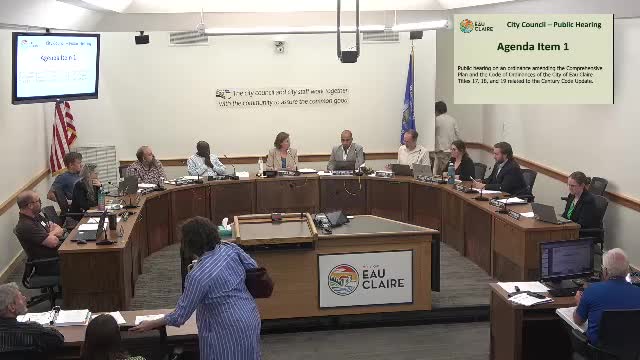
The Eau Claire City Council heard a proposal on July 21 to add two tree-classification definitions to the city code as a preliminary step before broader tree-preservation policy decisions. The proposed language would define “heritage trees” and “high-value trees” and enable other code sections to reference those terms.
Council Vice President Wirthman and Council member Miller introduced the amendments during the meeting’s second agenda item. Wirthman summarized the heritage-tree definition as capturing trees with “exceptional size or age” (trees 30 inches DBH or greater or estimated older than 100 years), historic or cultural significance, rare native species and exceptional aesthetic value. She said the proposed designation would apply automatically to qualifying trees on public property, including boulevards and rights-of-way, and noted that private-property nominations could be considered voluntarily.
The second definition — “high-value tree” — is intended to pair with the Century Code LDO provisions on tree preservation and mitigation. Wirthman said a recommended species list tied to the high-value definition was still being finalized by the city forester and staff and would be brought forward in coming months.
Why it matters: Definitional clarity is foundational when a code ties protections, mitigation choices and replacement requirements to categories of trees. Several private residents and community groups urged firm protections and a 12-inch DBH standard for trees that qualify as high value; others (including some builders and tree-care professionals during later public comment) urged careful attention to administration, inspection burden and the economic effects of fines or high per-inch mitigation fees.
Public and staff points
- Automatic public-tree designation: Wirthman said heritage-tree status would apply to qualifying trees on city-owned land without an application process and could be used to highlight and protect particularly significant public trees.
- Species list and thresholds: City staff and the consultant teams were working on a recommended species list. Draft thresholds discussed in the Century Code conversation included a 12-inch DBH threshold for high-value trees; some commenters asked for higher thresholds and others urged keeping 12 inches to maximize canopy protection.
- Implementation and next steps: Wirthman and Miller framed the definitions as prerequisites to later code changes, including a possible expansion of the Waterways and Parks Commission’s advisory role on urban forestry and a final tree-mitigation policy with fee levels and replacement rules. City deputies confirmed that related code sections (and the species list) remained under staff development.
No members of the public signed up specifically for this brief public hearing on definitions; one person in council chambers joked about their favorite species and no substantive testimony was entered against the definitions. Council members asked procedural questions and were advised the definitions would facilitate the later substantive code language.
Ending note
Council planned to consider the definitions at the July 22 legislative meeting; staff said the species list and mitigation details would follow in subsequent meetings. Because the definitions would be referenced across code sections, staff indicated they expect to bring follow-up materials to Plan Commission and council for public hearings and recommendations before final adoption.