Get Full Government Meeting Transcripts, Videos, & Alerts Forever!
Eau Claire council hears yearslong Century Code overhaul, debates housing, parking and stormwater changes
Summary
City staff and consultants presented a proposed Land Development Ordinance and related comprehensive-plan updates, including new zoning districts, lower parking minimums, housing-density incentives and stormwater rule changes. Public commenters focused on neighborhood zoning, affordable housing and the proposed tree-mitigation rules.
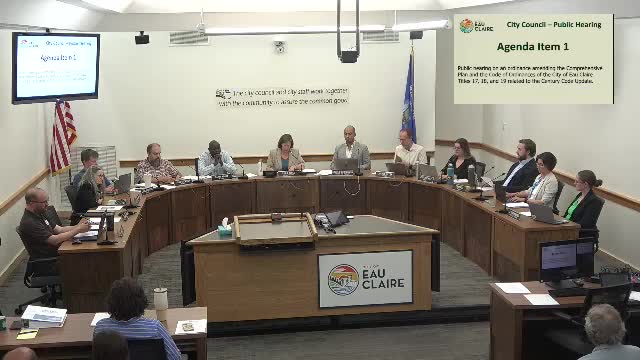
City staff and consultants presented a sweeping Land Development Ordinance (LDO) and a minor comprehensive-plan amendment at the Eau Claire City Council public hearing on July 21, describing two-plus years of public engagement and technical drafting and detailing changes affecting zoning districts, housing types, parking, design standards and stormwater rules.
The proposed ordinance combines the city’s existing Title 17 and Title 18 into a single LDO and includes a companion minor amendment to the comprehensive plan to align new district names with the land-use table. Ned Noel, identified in the meeting as city staff, told the council, “We’ve reached this point in our process over 2 plus years.” Jackie Berg, lead consultant with Hauser Levine, described the outreach and iterative drafting: “We began with a lot of public engagement...and brought you five different sections of the code to consider iteratively.” Deputy city engineer Al Rink said the Title 19 stormwater updates primarily clean up and consolidate existing language and align the ordinance with state Department of Natural Resources practice.
Why it matters: The LDO is intended to translate the city’s 2015 comprehensive plan (with 2022 amendments) into clear, objective development standards intended to increase housing supply and affordability, streamline approvals, and integrate sustainability goals. Draft changes include new district names (for example, General Commercial to Corridor Commercial), allowance of 1–4 unit housing types in low-density residential classifications, lower parking minimums and stricter rules for going above parking maximums, new subdivision formats to enable clustering, objective multifamily design standards, and a new land-disturbance permit that captures smaller sites.
Major proposals and details
- Zoning and…
Already have an account? Log in
Subscribe to keep reading
Unlock the rest of this article — and every article on Citizen Portal.
- Unlimited articles
- AI-powered breakdowns of topics, speakers, decisions, and budgets
- Instant alerts when your location has a new meeting
- Follow topics and more locations
- 1,000 AI Insights / month, plus AI Chat