Get Full Government Meeting Transcripts, Videos, & Alerts Forever!
Get email alerts on the Tax Rate Election topic
No spam. Unsubscribe anytime.
Audit and Finance Committee reviews tax-rate election options as public urges 8¢ increase for homelessness services
Summary
At a July 22 meeting, Austin’s Audit and Finance Committee heard public calls to support an 8-cent tax-rate election to fund homelessness and social services, received staff briefings on legal requirements and fiscal scenarios, and scheduled further budget hearings; no final decision was made.
The Audit and Finance Committee of the Austin City Council met July 22 to review options for a possible tax-rate election (TRE) and to hear public comment on proposed increases to the city tax rate.
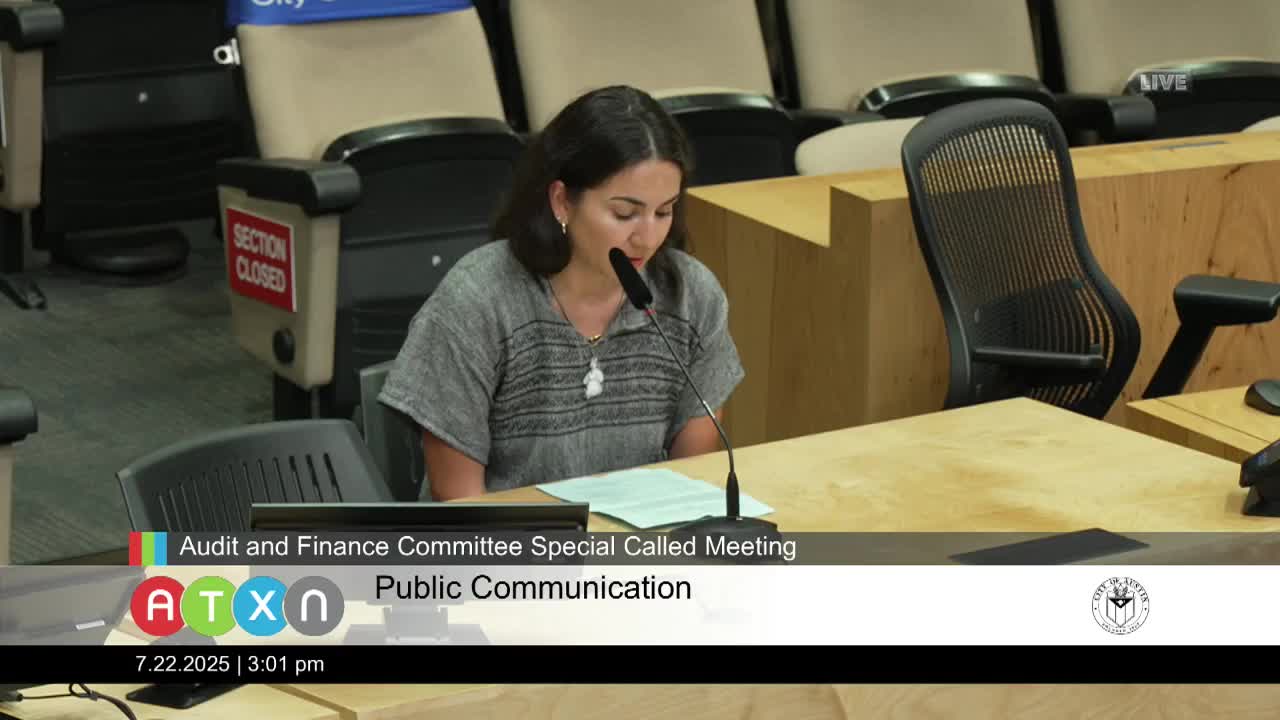
Public speakers urged the committee to put a higher rate before voters to shore up funding for homelessness, social services and prevention programs. Paulette Soltani, co-director of Vocal Texas, told the committee, "The proposed tax rate at the maximum level is the only option that meets the scale of the moment." Soltani said federal cuts and expiring one-time American Rescue Plan Act funding mean programs that provide shelter beds, case management and rapid rehousing are at risk.
Kathy Mitchell of Equity Action expressed support for the TRE proposals at the 5-cent and higher levels and said she wants to limit additional funding going to the Austin Police Department. "To me, a good first step in straightening out what it is that we think is important in this city in light of the moment that we're now in would be to, to the greatest extent possible, minimize what we are adding to the police budget," Mitchell said.
Savannah Lee, also with Equity Action, urged using any voter-approved increase for health, harm-reduction and preventive services rather than expanding police spending. "This budget projects that by next year, we will have added nearly a $100,000,000 to APD while everything else gets cut," Lee said, adding that investments in prevention yield long-term savings.
A member of the public identified as Ryan (recorded in the transcript also as "Bridal Saunders") raised operational concerns about municipal court and code enforcement processes, contending that inconsistent enforcement across departments consumes police resources and creates backlogs for residents. He asked the committee to consider those inefficiencies when evaluating public-safety costs.
Legal and fiscal briefings
Ian Howe, assistant city attorney, explained the legal mechanics of a TRE under state law. He told the committee that if the council adopts a tax rate above the voter-approval rate, state law requires the city to call a tax-rate election and that the ballot must present a single rate for voters to approve or reject. Howe said the voter-approval concept often cited as "3.5%" reflects a specific state calculation focused on maintenance and operations and referred members to Chapter 26 of the Texas tax code for the statutory details.
Eric Nelson of the Office of Budget and Organizational Excellence presented revenue and expenditure projections and the TRE scenarios staff prepared. Nelson said the proposed FY26 budget as presented relies on a $14,100,000 transfer from reserves to fund transitional social service contracts and that the city’s reserves are projected to finish the year at about 15.8%, roughly $18,200,000 below the council’s 17% policy level. He said staff started from more than $300,000,000 in spending proposals and filtered those ideas into multi-year scenarios designed to be sustainable through FY29.
Nelson also described how property-tax math translates to household impact: after accounting for collection rates and tax reinvestment financing zones, one penny of the city tax rate yields about $21.6 million net to the general fund; staff estimate each additional penny equates to roughly a 2.5% effective increase. In the presentation’s baseline scenario, the proposed FY26 budget at the voter-approval rate would project about a 7.9% increase in property-tax burden for a typical homeowner, subject to final certified values from appraisal districts.
Process and schedule
Committee members emphasized that no decision had been made. The chair said the committee would follow a decision tree policy adopted at the Audit and Finance Committee’s recommendation and promised to post that policy and the TRE alternatives on the city message board.
The committee scheduled additional meetings and deadlines: a general-fund budget work session the morning after the July 22 meeting; a special-called Audit and Finance Committee meeting on July 30 at 3:30 p.m.; a council meeting on July 31 (9:00 a.m. work session, 3:00 p.m. budget hearing) that will include setting the maximum tax rate required under state law; a requested council deadline of Aug. 4 for filing budget amendments; and potential adoption sessions Aug. 13–15.
Executive session and next steps
The committee went into a closed session under Texas Government Code section 551.071 at 3:21 p.m. to discuss legal issues related to item 1 and reconvened in open session at 4:07 p.m. Chair and staff reiterated that adopting a maximum tax rate is a procedural step required by state law to preserve the ability to place a particular rate before voters and is not a final decision on the rate itself.
The committee did not take a formal vote on a TRE at the July 22 meeting and will continue deliberations at the July 30 special meeting and subsequent public budget hearings.