Get Full Government Meeting Transcripts, Videos, & Alerts Forever!
Get email alerts on the Finance topic
No spam. Unsubscribe anytime.
Stafford EDC reports $21.49 million fund balance; outlines investments, recent payments and a large irrigation leak
Summary
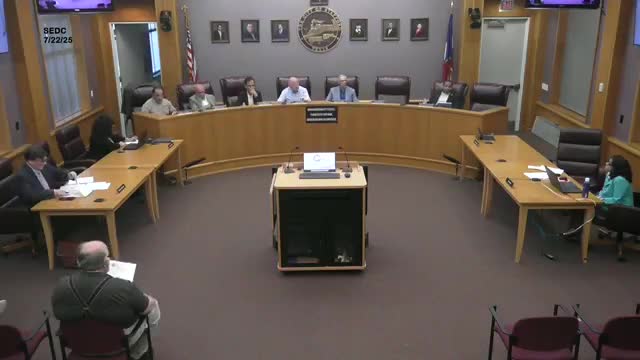
At a July 22 meeting, Stafford Economic Development Corporation staff presented the board with a financial update showing a combined fund balance of $21,489,825 as of May 31, 2025.
At a July 22 meeting, Stafford Economic Development Corporation staff presented the board with a financial update showing a combined fund balance of $21,489,825 as of May 31, 2025.
Finance staff member Michelle said, “The combined fund balance is $21,489,825, which is up by 2,500,000.0 as compared to last year at this time.” She told the board the authority’s cash and investments totaled about $20.6 million and summarized the portfolio allocation and yields.
Why it matters: the report shows the EDC is carrying a multi‑million dollar fund balance and a diversified short‑term portfolio while continuing to make operating transfers and pay for several capital and service contracts.
Staff presented the EDC’s investment mix and yields. According to Michelle, the board’s portfolio includes government pools (21% in a pool referred to as “Logic” and a newly added government pool referred to as “Texas Class,” which also holds 21% of the portfolio), about 15% in brokered certificates of deposit, 22% in government agency securities, about 10% in U.S. Treasury securities, and roughly 3% on deposit with the depository bank. Reported yields were: the Logic pool 4.42%, Texas Class 4.41%, brokered CDs 4.22%, government agency securities 4.34%, U.S. Treasury 3.75% and the depository bank 2.58%. Michelle said the portfolio’s weighted average yield was 4.26% with a weighted average maturity of 272 days (the policy allows up to 730 days).
She also reported year‑to‑date interest received of $537,100 and interest accrued but not yet received of $92,395. The EDC’s three accounting funds were described as an operating fund, a debt service fund and a capital projects fund.
Operating fund details: staff said sales tax — the operating fund’s primary revenue source — totaled about $4.3 million net of rebate through May 31, up 6.98% from the prior year at the same point. Year‑to‑date interest income in the operating fund was reported as $207,851. Total operating expenses shown on the presentation were about $2,200,000, including roughly $820,314 for services (administrative and consulting), $54,056 for utilities, $13,921 for marketing and promotion, $24,367 for pump station repair and a $92,500 payment to Flock Safety to maintain 37 cameras in the grid area under the SEDC agreement.
Staff also told the board that a water‑irrigation leak produced an unusually high utility bill. Michelle said normal irrigation bills run about $3,500, and during the leak “it was about $25,000.” She said staff had contacted the company that has oversight of the irrigation system and had requested reimbursement but had not yet received a response.
Capital and project fund activity: Michelle said the capital project fund showed total revenues of $1,679,186 consisting of a $1,394,750 reimbursement from the Lovett Agency for the Pike Road project and $284,436 in interest income. Project expenditures were listed as $1,706,902, including $7,000 to Westwood Professional for landscaping, $123,844 in engineering for Pike Road and $1,576,058 in construction costs. Michelle said the Pike Road project is near completion with a few payments remaining.
She also reported a payment of $376,751 made to “Stafford 59 and Airport LP” for calendar year 2024 under a March agreement that shares sales tax revenue from certain new businesses in the grid area. Michelle explained that the current calendar year reimbursement represented a portion of sales tax generated in the grid area and that SEDC’s portion of the arrangement was reflected in the payment.
Board member questions and follow‑up: board members asked whether the irrigation reimbursement request was covered under contract; Michelle said it was not part of the contract and SEDC was “hoping to get some money” back from the company responsible for oversight. One board member suggested adding automated threshold alerts to irrigation billing to detect abnormal usage earlier.
No formal action was taken on the finance report; staff said it would return for future updates and to answer follow‑up questions.