Get Full Government Meeting Transcripts, Videos, & Alerts Forever!
Get email alerts on the Regional Transportation Plan 2050 topic
No spam. Unsubscribe anytime.
HGAC holds Waller County outreach on 2050 regional transportation plan; residents press funding, toll and right‑of‑way concerns
Summary
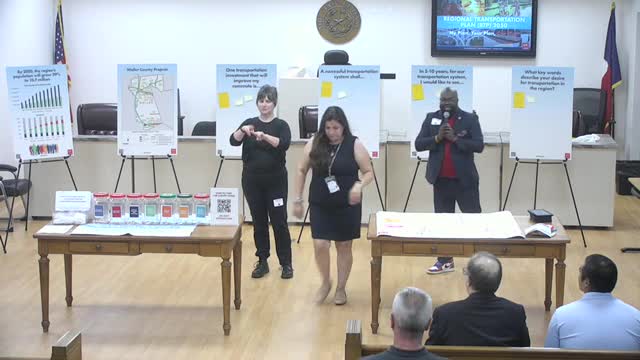
Houston‑Galveston Area Council staff and regional partners held a public outreach session in Waller County about the 2050 Regional Transportation Plan, answering residents’ questions about MPO authority, funding, tolls and potential right‑of‑way impacts.
Houston‑Galveston Area Council staff and regional partners held a public outreach session in Waller County about the 2050 Regional Transportation Plan (RTP), answering residents’ questions about the Metropolitan Planning Organization process, where federal transportation dollars come from and how projects are prioritized.
Brandon Mosley, a HGAC presenter, opened the session by saying, “I am with, HDAC, and this meeting is for our 2050 RTP,” and described the RTP as “a guide for future transportation investments, programs, policies, and development for the region for the next 20 to 25 years.” The presentation defined the RTP as a long‑range plan whose first four years form the Transportation Improvement Program (TIP), the period when projects are actually programmed for funding.
Why this matters: HGAC staff told attendees the region is expected to grow roughly 39 percent — “around 3,000,000 people by 2050” — and that planning now will influence which projects are prioritized and how federal funds are allocated. A staff member said, “It is required by law to establish an NPO when population hits a certain size,” referring to the federal requirement to have a metropolitan planning organization (MPO) for urbanized areas over the statutory threshold.
During a public Q&A, residents pressed several recurring concerns:
- Funding sources and allocation. HGAC staff explained that federal funds are allocated to the MPO region and that the Transportation Policy Council (TPC) — made up of elected officials and major transportation operators — approves how those dollars are dedicated. Staff described a multi‑step process in which the RTP lists long‑range projects and the first four years (the TIP) are where projects are funded and moved into design and construction. The existing plan’s candidate projects totalled about $118 billion, a presenter noted, adding that “that doesn't mean they're funded.”
- Representation and decision‑making. Attendees asked whether rural counties are represented and whether elected officials alone speak for residents. HGAC staff said each of the eight counties in the MPO has a representative on the policy council and that the TPC includes officials from counties, cities and operators of major modes (transit, ports, TxDOT districts). Justin Beckendorf was named in the session as the current chair of the Transportation Policy Council; staff emphasized the council includes both elected officials and technical representatives.
- Proposed alignments and local impacts. Presenters showed concept maps that include a green curved line labelled in materials as a conceptual “36A.” Staff cautioned that the line on the outreach map is not a definitive alignment and described it as a conceptual representation for discussion. A presenter said HGAC is hiring a consultant to evaluate alignments and that planners aim to avoid putting a new facility directly on top of existing FM roads. Residents raised concerns about whether proposed or state projects might require right‑of‑way acquisition or eminent domain; staff acknowledged that expansions of state and FM roads can involve right‑of‑way changes and said TxDOT and local officials usually try to work with landowners, with legal procedures available if agreements cannot be reached.
- Tolling and project funding. Several attendees asked whether unfunded projects would become toll roads. Staff said recent state policy has been unfriendly to tolling and indicated tolling is not the default solution for the region’s unfunded projects. They also noted that some projects shown on TxDOT schedules could occur before 2050 and that HGAC’s RTP includes many conceptual projects that lack committed funding.
- Evacuation and resiliency prioritization. Attendees asked whether hurricane evacuation corridors receive special consideration; staff confirmed evacuation network additions are considered for additional resources and that HGAC develops evacuation mapping as part of MPO activities.
How to follow up: Presenters encouraged residents to use HGAC’s interactive map and the RTP survey (rtp2050.com or the meeting QR code) to comment on specific locations and projects. Staff said the outreach phase is one of three in the RTP update and that public input feeds into project prioritization and the TIP process.
No formal votes or policy decisions were taken at the meeting. The session concluded with staff offering one‑on‑one follow‑ups during an open‑house portion of the event.
Ending: HGAC staff reiterated that many projects in the long‑range map are contingent on future funding, that the TIP (the plan’s first four years) is the stage when projects are brought into funded status, and that residents can continue to submit project‑level feedback via HGAC’s website and interactive tools.