Get Full Government Meeting Transcripts, Videos, & Alerts Forever!
Get email alerts on the Small Business Zoning topic
No spam. Unsubscribe anytime.
Zoning board denies request to convert first floor at 935 S. Fourth St. to salon; use variance not shown
Summary
The Allentown Zoning Hearing Board denied a request to operate a by‑appointment salon on the first floor of 935 South Fourth Street because the use is not allowed under current home‑occupation rules and the applicant did not demonstrate the hardship required for a use variance.
The Allentown Zoning Hearing Board denied an application for a use variance to allow a personal‑service salon on the first floor of a building at 935 South Fourth Street, concluding the owner did not meet the legal standard for an exceptional use variance and that the proposed use is not permitted under current zoning rules.
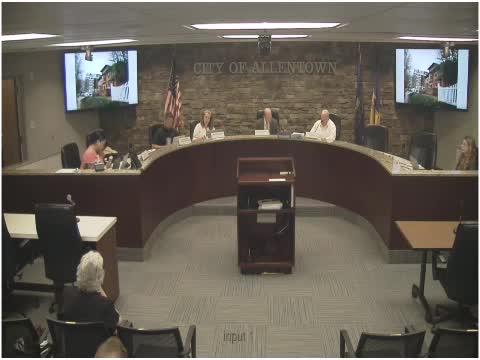
The case was listed on the agenda as an appeal by GFC Investment on behalf of the business Develvia Emery’s. The owner, sworn in at the hearing as Develvia Reyes, said she has lived in the building for about four years and proposed to operate a by‑appointment salon on the first floor while continuing to live in the second and third floor apartments. Reyes said she would be the only person working in the salon and that clients would be directed to use the rear entrance; she said the operation would be by appointment and that she had limited parking available on site.
Board members and staff reviewed whether the proposed use could be treated as a permitted home occupation under current rules or whether it would be a commercial personal‑service use requiring a use variance. City staff told the board that personal services of the type described are not allowed as a home occupation under the present code and that the proposal therefore required a use variance — the most demanding standard under local zoning law. A board member summarized: without evidence of an unnecessary hardship or a unique characteristic of the property that prevents any permitted use, a use variance cannot be granted.
Board members found the record did not show an inability to use the property for a permitted zoning use (it continues to function as a residential dwelling), and there was no factual showing of economic hardship or other legal criteria necessary to support a use variance. One member emphasized that the current zoning ordinance explicitly excludes personal services from home‑occupation uses.
A motion to deny the application was made and seconded and the board voted to deny the request. The board and city staff told the applicant that the city is in the final stages of adopting a revised zoning ordinance, and that under the draft code the applicant’s proposal might be treated differently (potentially permitted by right or by special exception in certain locations). The city representative encouraged patience and suggested the applicant follow the zoning rewrite and consider returning under the new ordinance if adoption makes the use allowable with a permit.
The denial rests solely on the board’s legal finding that the applicant did not meet the high legal standard for a use variance under the current code; it does not address whether the property meets building or safety codes for a commercial operation. City staff noted that code, inspections and permitting requirements would apply if the use were permitted later under the new ordinance.