Get Full Government Meeting Transcripts, Videos, & Alerts Forever!
Get email alerts on the Regional Transit Funding topic
No spam. Unsubscribe anytime.
San Francisco Transportation Authority backs reaffirming support for SB 63, seeks 1% local participation
Summary
The San Francisco County Transportation Authority voted to move forward on guidance to support Senate Bill 63 and recommended the city opt into a regional transit sales tax at 1%, while the board asked for continued engagement as key details of the billare finalized.
The San Francisco County Transportation Authority on July 22 reaffirmed its support in concept for Senate Bill 63 and recommended that San Francisco participate in a proposed regional transportation sales tax at a 1 percent rate, while adopting principles to guide the city's engagement as the bill is amended.
The authority's staff presentation said the bill, as drafted, would form a multi-county transportation revenue district with Alameda, Contra Costa and San Francisco as default participating counties and San Mateo and Santa Clara able to opt in by Aug. 11. If all five counties join and San Francisco participates at a 1 percent rate while other counties participate at one-half cent, the measure is forecast to generate roughly $1 billion annually, the presentation said. Most revenues would be dedicated to supporting transit operations for major operators named in the bill, including Muni, BART, Caltrain and AC Transit.
Board members and staff framed the action as necessary to avoid large, near-term operating shortfalls. Staff presented an estimate of more than $800 million in annual operating shortfalls for the four major operators named in the bill beginning in fiscal year 2027. The bill also contains a provision authorizing up to a 5 percent regional set-aside (reduced from an earlier 10 percent proposal) for rider-focused regional improvements; staff noted a notional annual allocation to that set-aside of about $45 million, including roughly $25 million for fare programs, $10 million for accessibility and paratransit improvements, and $10 million for transit priority and wayfinding investments.
"This is a product of many, many months and a lot of work by our staff, our executive director, myself, and folks in the mayor's office," Chair Mirna Melgar said before the staff presentation. Principal planner Martin Reyes and rail program manager Jesse Koehler explained the anticipated revenue distribution, that the Metropolitan Transportation Commission (MTC) would serve as the governing body for the district, and that the bill requires a third-party financial efficiency review of operators.
Public commenters included representatives of planning and advocacy groups who urged support and suggested modifications. Sebastian Petty of SPUR said regional transit operators carry the bulk of the region's riders and called the measure "deeply essential." Sarah Greenwald of 350 San Francisco praised the staff materials but urged the authority to push for alternative or supplemental revenue proposals (such as a gross receipts tax on large corporations) to reduce regressivity of reliance on a sales tax.
Commissioner/Board members acknowledged concerns about sales-tax regressivity but emphasized the need to act regionally to avoid service cuts. Staff noted the bill has passed the Senate and is in the Assembly, and that additional amendments incorporating an expenditure framework are expected soon. Staff recommended the board: (1) reaffirm support for SB 63 as amended; (2) adopt four principles to guide San Francisco's engagement (including focusing on measure success, rider benefits, sufficient funding for major operators serving San Francisco, and transparent administration); and (3) recommend San Francisco participate at a 1 percent sales tax rate.
A motion to proceed on first appearance with the staff recommendations was made and seconded during the meeting (motion by Supervisor Cheryl; seconded by Commissioner Chan). The transcript records the motion and the board's agreement to use "same house, same call," but the roll call vote or final tally for Item 14 is not recorded in the provided transcript.
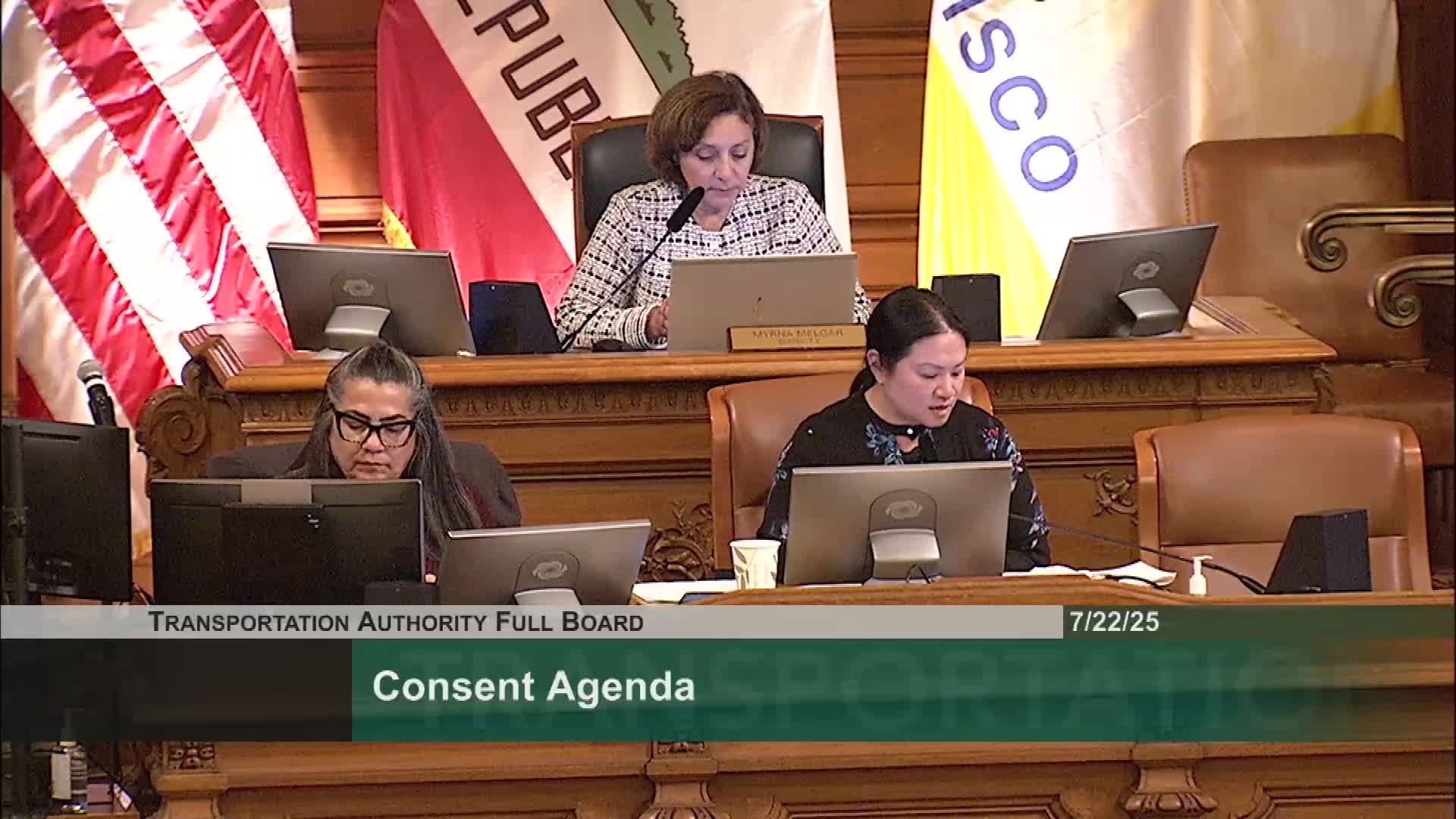
Votes at a glance: Item 4 (minutes approval) was moved by Mandelmann, seconded by Chen and approved by roll call with 10 ayes (detailed roll call recorded in the transcript). Consent agenda items 5 through 13 were moved by Commissioner Dorsey, seconded by Commissioner Mandelmann, and the motion passed (the transcript records the motion passing but does not include an itemized roll call). For Item 14 (SB 63), a motion and second were recorded; the transcript does not include the roll call or final vote result for this item.
Why it matters: Board staff said the measure aims to prevent an abrupt contraction of transit service across the Bay Area by addressing projected deficits and by funding rider-focused programs that could increase affordability and reliability. The measure would require coordination across multiple counties and will depend on decisions by San Mateo and Santa Clara to opt in by Aug. 11, as well as on the assembly's incorporation of an expenditure framework into bill language.
Next steps: Staff said they will brief the authority's community advisory committee and return to the board in early September with an update. The bill continues to move through the state legislative process and may be further amended; counties and operators continue to consider opt-in decisions and the final expenditure framework.