Get Full Government Meeting Transcripts, Videos, & Alerts Forever!
Get email alerts on the Behavioral Health Beds topic
No spam. Unsubscribe anytime.
San Francisco health department proposes converting two floors at Behavioral Health Center to locked subacute psychiatric beds
Summary
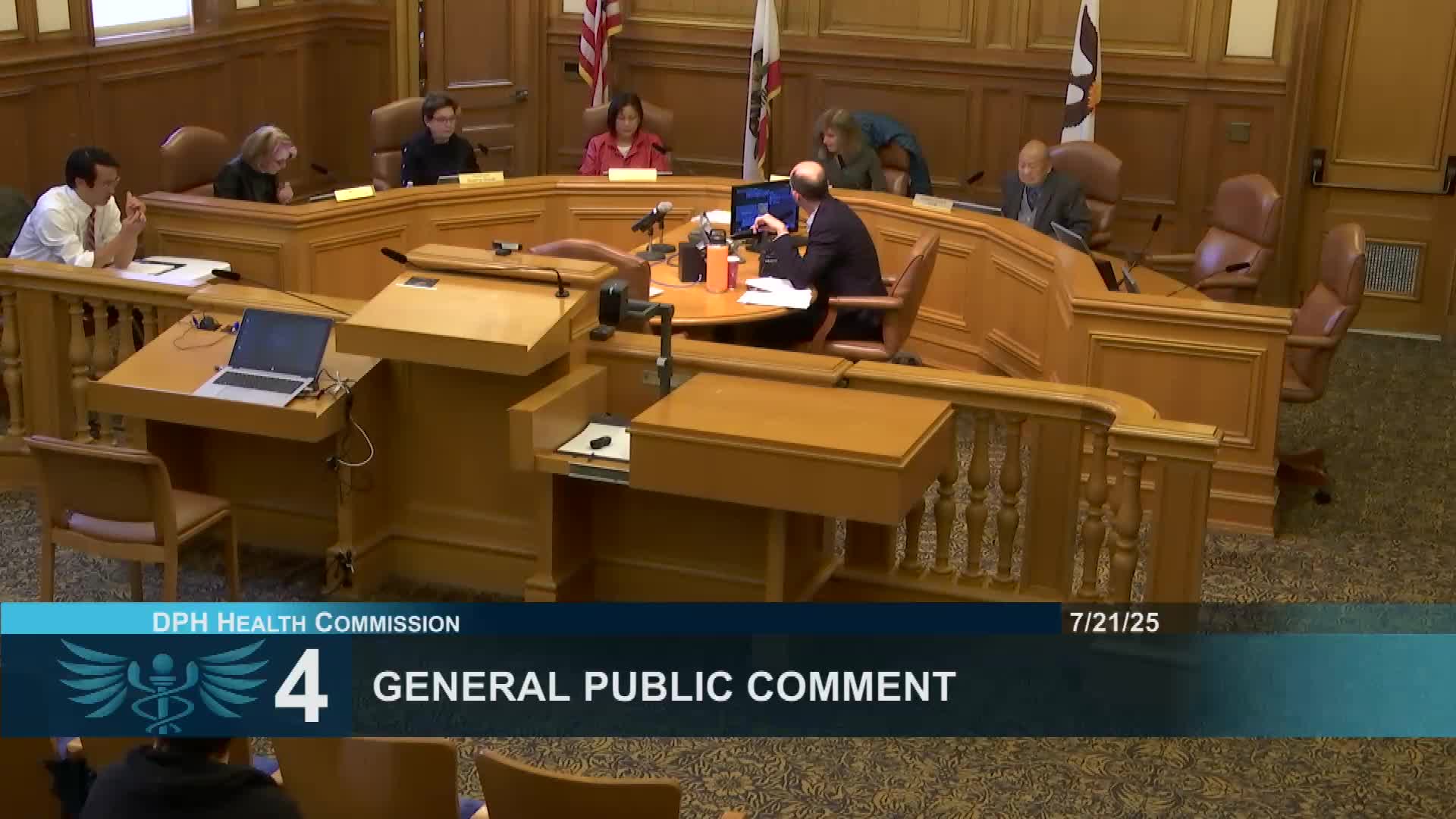
At a Health Commission meeting, San Francisco Department of Public Health staff described plans to convert the first and second floors of the Behavioral Health Center on the Zuckerberg San Francisco General campus into locked subacute treatment units, increasing in‑county capacity to roughly 90 beds.
At a Health Commission meeting, San Francisco Department of Public Health (DPH) staff described plans to convert the first and second floors of the Behavioral Health Center on the Zuckerberg San Francisco General Hospital campus into locked subacute mental health treatment units, increasing the city's in‑county locked-bed capacity to about 90 beds.
DPH presenters said the change would allow the city to keep more people needing locked psychiatric care in San Francisco rather than sending them out of county. "It is of no surprise to any of the commissioners that San Francisco is in desperate need of additional locked facility beds," Angelica Hamada, chief integrative officer at ZSFG, told the commission. Eloise, a DPH presenter, said, "Number 1, we want to make sure we can serve everybody as much in the community as possible, as quickly and responsibly as possible." Director Tsai added, "We do not want to be having to send San Francisco residents to Southern California for care at a very complex point in their lives."
Why it matters: DPH officials said the shortage of locked subacute beds interferes with conservatorship and clinical care and has forced some San Francisco residents to be treated far from home. Officials also framed the project as an equity issue, saying people of color are disproportionately affected by conservatorship and by sending patients out of their communities.
What DPH proposed and why: Staff described converting floors currently used as residential care facilities and a peer respite into mental health rehabilitation centers (locked subacute units) so the building would have locked units on all three floors. DPH said the building requires fewer structural upgrades than other candidate sites and therefore is the most feasible location to expand locked capacity within a reasonable timeframe. Angelica Hamada said the Behavioral Health Center's original construction as a skilled nursing facility makes conversion practicable.
Capacity, funding and staffing: DPH said the conversion would increase locked-bed capacity to roughly 90 beds (about 57 beds proposed for the second floor and 40 for the first floor in one slide). The department reported it has secured a $21,000,000 Prop 1 bond (B CHIP) grant to support the work without drawing on the city's general fund. DPH anticipates adding roughly 20 to 30 civil service positions to staff a higher-acuity population and said there will be no layoffs for existing staff; employees will retain civil service protections and be prioritized for reassignments or opportunities to apply for new positions.
Relocating current residents: DPH plans to relocate current residents of the Behavioral Health Center to other residential care facilities the department is acquiring or expanding on Laguna Street (624 Laguna, which DPH has purchased, and a proposed 601 Laguna acquisition). DPH said those Laguna sites are being acquired or rehabilitated to create enhanced residential care settings and to allow some residents to move as communities where desired. Staff said current counts are 43 residents on the Behavioral Health Center second floor and 39 on the first floor; officials said they are working with each resident, family members, case managers and conservators to arrange placements and transitions.
Timeline and regulatory/finance limits: Department staff said earliest moves from the second floor could begin in fall of this year, with most moves to 624 Laguna occurring later this calendar year or in early 2026; moves from the first floor were projected to begin in fall 2026 because 601 Laguna requires more extensive renovation and purchase approvals. Staff cautioned that because many mental health rehabilitation centers exceed 16 beds, the Institute for Mental Disease (IMD) exclusion limits Medicaid reimbursement for those beds, which means DPH will not receive Medicaid dollars for the converted units. DPH described the conversion as necessary despite the IMD limitation because local locked beds are critical to patient care and conservatorship pathways.
Union engagement and resident outreach: DPH said it is conducting meet-and-confer negotiations with unions and holding repeated community and individual meetings with residents and their support systems to reduce anxiety and tailor placements. Eloise said staff are sending written follow-ups after meetings and offering site visits; Commissioner Dorado suggested photographing rooms and hallways in advance to reduce residents' anxiety about moves.
Public comments and concerns: Public commenters praised the plan's aim to restore locked subacute capacity but urged assurances about staffing and discharge planning. Dr. Palmer said she wanted "adequate staffing and that familiar staff will be assigned to work there and accompany the patients because that will protect the more vulnerable ones from having psychiatric decompensation." Mr. Manette Shaw urged DPH to acknowledge prior decisions that reduced in-county locked capacity and to document evidence when contesting federal or state findings.
Outstanding issues and next steps: DPH acknowledged there is more to do on staffing plans, operator selection for Laguna-site residential care, construction timelines and the financial implications of IMD limitations. Staff said they would return with updates as purchases and renovations progress.
Ending: Commissioners thanked staff for the detailed, resident‑focused planning and requested further staffing and timeline updates at future meetings.