Get Full Government Meeting Transcripts, Videos, & Alerts Forever!
Get email alerts on the Public Pensions topic
No spam. Unsubscribe anytime.
Abilene council debates TMRS non-retroactive COLA option; council declines immediate action
Summary
City manager presented a proposal to adopt a non-retroactive repeating TMRS COLA (30% of CPI). Council discussed costs, impacts on general fund (~$1.4M partial-year), and firefighter pension obligations, and did not adopt the change at the meeting.
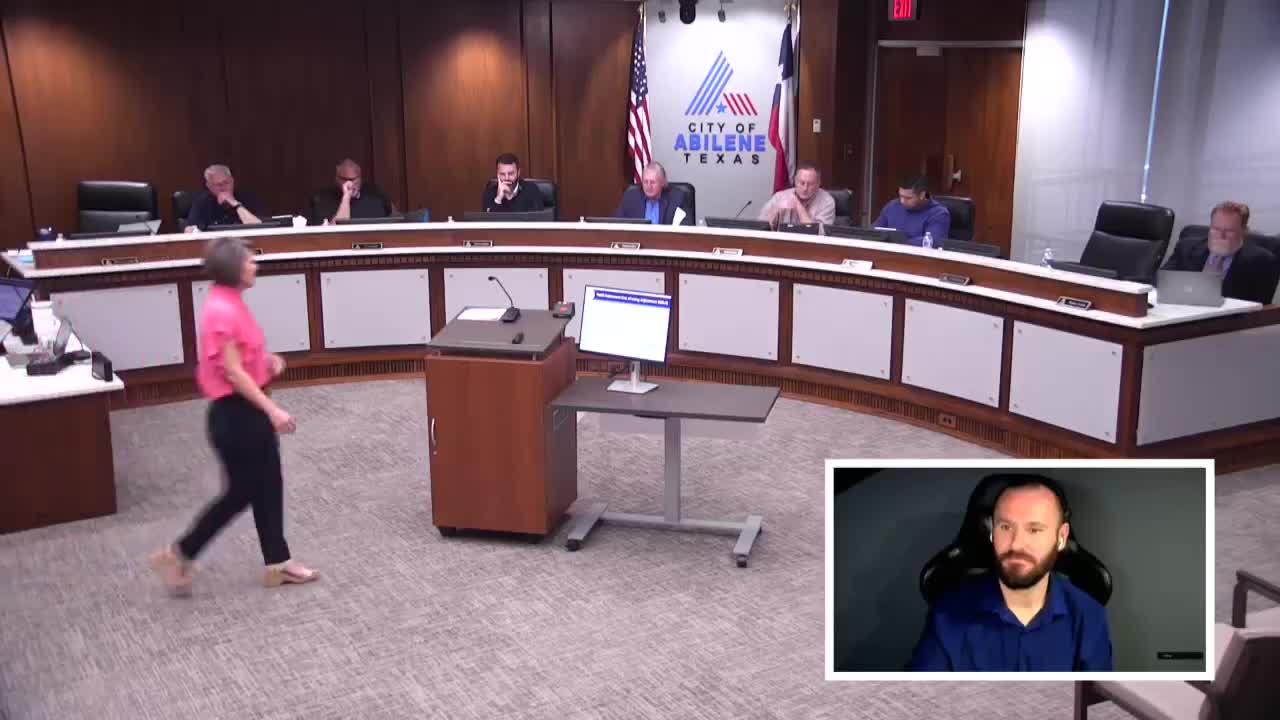
City Manager Emily Crawford presented a proposal for the Abilene City Council to adopt a non-retroactive, repeating cost-of-living adjustment (COLA) for the Texas Municipal Retirement System (TMRS) at a special meeting as staff described financial and recruitment benefits and estimated costs.
Crawford told council the option — authorized by a 2023 amendment to the TMRS statute and with an adoption window running through 2025 — would replace the city’s prior pattern of periodic, non-formula COLA adjustments with an annual, non-retroactive plan. She described the most modest available repeating option as a “30% repeating COLA,” meaning 30% of the prior 12 months’ Consumer Price Index would be applied annually (she used the 2024 CPI of 2.9% as an example, which would yield a 0.87% adjustment).
Crawford and finance staff outlined estimated costs. Staff presented an all-funds cost increase from roughly $8.9 million to about $11.4 million under the non-retroactive option, while the specific near-term impact to the general fund and health fund combined was shown as about $1.9 million. Because the change would not take effect until Jan. 1 and would therefore not apply for a full fiscal year in 2026, staff estimated the actual 2026 general-fund impact at roughly $1.4 million.
Council members asked about alternatives, including a one-time “catch-up” COLA and the more-expensive retroactive COLA option. Staff explained the retroactive option (which looks back to each retiree’s hire date or retirement date) would carry a significantly larger employer cost, and that the non-retroactive repeating option was the most affordable way to provide regular adjustments to benefits.
Several council members voiced concerns about the timing and cost. One council member pointed to the city’s separate firefighter retirement fund, which the council acknowledged would require significant additional funding and could pose a higher near-term fiscal obligation. Others said wage increases and recruitment-focused pay adjustments remain a higher immediate priority in some departments (for example, transit driver pay increases and other market-based adjustments).
Council did not adopt the non-retroactive TMRS option at the meeting. The mayor summarized the discussion by saying the council was not ready to move forward “right now” and that staff would return with options later. The city manager clarified that a separate ordinance would be required for adoption and that council could revisit retroactive or other COLA options in future legislative windows.
Direct quotes from the presentation: “What I am recommending today is the most entry level cola benefit that is available through TMRS non retroactive, which is a 30% repeating cola,” City Manager Emily Crawford said during the presentation. Finance staff added that the change would increase employer contribution rates and noted that the general fund’s share of the cost would likely be about $1.4 million in the partial fiscal year.
Council members asked multiple follow-up questions about funding sources, potential offsets, and the competitiveness of TMRS changes relative to other cities. Staff said other Texas cities vary in approach: of the municipalities offering any COLA, a minority have adopted the non-retroactive repeating option.
Staff and several council members also discussed alternatives: a one-time catch-up COLA (which would be limited and nonrecurring) and continued reliance on pay adjustments to address recruitment and retention needs. The city manager also noted that the legislature may revisit TMRS options in future sessions.
Ending: Council asked staff to return with options rather than adopt the non-retroactive TMRS change at this meeting; no ordinance was introduced or adopted at the session.