Get Full Government Meeting Transcripts, Videos, & Alerts Forever!
Get email alerts on the State Legislature Briefing topic
No spam. Unsubscribe anytime.
City legislative director summarizes 89th Legislature outcomes; special session will focus on flood response, tax and housing issues
Summary
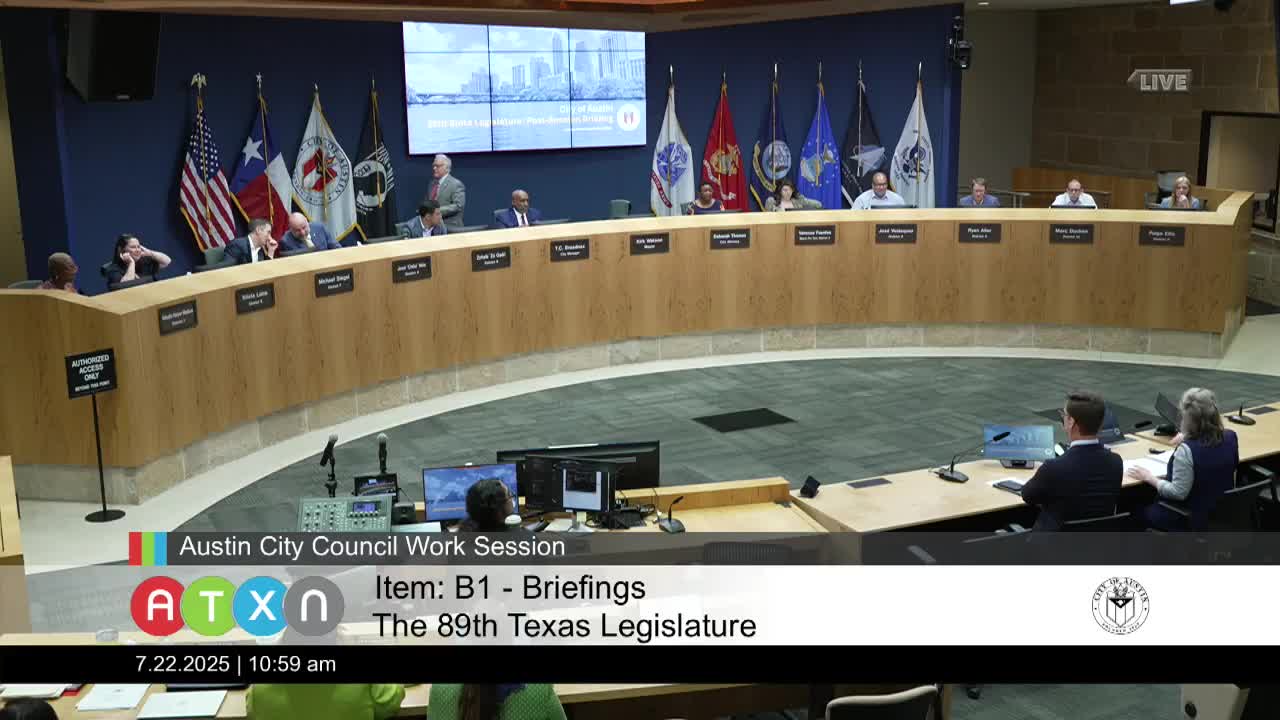
Carrie Rogers, the City of Austin’s legislative director, briefed the council on July 22 about outcomes from the regular 89th Texas Legislature and the governor’s newly convened special session, highlighting firefighter pension changes, preemption measures, housing and water bills, and a planned focus on flood response.
Carrie Rogers, legislative director for the City of Austin, briefed the council on July 22 about major outcomes from the regular session of the 89th Texas Legislature and the start of a governor-called special session.
Rogers told the council the city tracked about 1,500 bills out of roughly 9,000 filed during the regular session and that about 26 bills were vetoed by the governor. She said the city’s priorities included preserving local authority, fiscal responsibility and public safety, and that staff worked to build relationships with legislators to improve or mitigate bills that could affect Austin.
Rogers highlighted several specific outcomes discussed during the briefing: work on firefighters’ pension reform carried by Representative Busey and others that the city supported and which the governor signed; a bill affecting collective bargaining for firefighters (identified in the briefing as Senate Bill 77); preemption measures that affect local food-service regulation; and a legislative focus on water infrastructure that produced Senate Bill 7 and House Joint Resolution 7 in modified form. Rogers also noted housing-related bills that passed, including House Bill 21 (eliminating so-called traveling housing finance corporations) and House Bill 24 (notice process for rezoning), plus a measure to allow office-to-residential conversions in some commercial areas (identified in the briefing as Senate Bill 840). Austin Energy-related reporting requirements — including wildfire mitigation reporting to the Public Utility Commission — also passed, Rogers said.
Rogers told the council that a proposed Senate bill addressing county-level mental health crisis service centers (described in the briefing as Senate Bill 2487) did not reach final passage once associated funding was removed, but lawmakers told city staff they intend to revisit mental-health responses in future work.
The legislative director also previewed the governor’s special-session call. Rogers said items on the call include flood response and emergency communications, citing Kerr County as the example regulators are using to develop best practices and potential targeted funding. She said the special session began July 21, is limited to the topics named in the governor’s proclamation and may last up to 30 days.
A member of the public who spoke during the work session, Jen Robicheaux, identified herself as a South Austin resident and urged the council to apply Texas laws to homelessness. "SB 617 supports integrating homeless individuals back into the community through community guided rapid rehousing," Robicheaux said; she also cited "SB 1164 and the health and safety code" and urged council to combine permanent supportive housing with intervention services as called for under those state laws.
Rogers and council members said the city will continue to monitor regular-session outcomes and the special session and that law and relevant departments are already working to operationalize new statutory requirements. The legislative office said it will keep council informed as the special session proceeds.