Get Full Government Meeting Transcripts, Videos, & Alerts Forever!
Get email alerts on the Landfill Financing topic
No spam. Unsubscribe anytime.
Caroline County approves up to $28 million bond for Midshore Regional landfill work
Summary
The Board of County Commissioners approved a Maryland Environmental Service revenue bond resolution allowing up to $28 million to fund construction of landfill cells, a leachate tank and other capital needs at the Midshore Regional landfill.
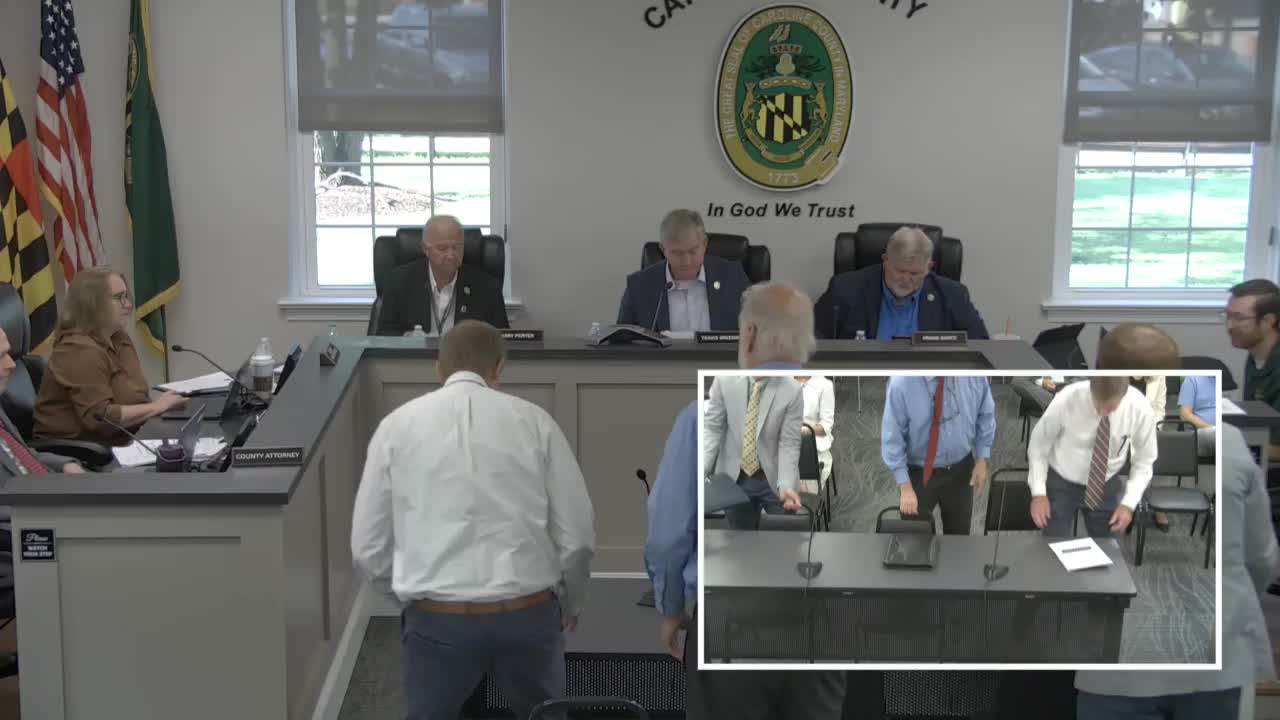
DENTON, Md. — The Caroline County Board of Commissioners on July 22 approved a resolution authorizing Maryland Environmental Service (MES) to issue up to $28,000,000 in revenue bonds to fund construction and capital needs at the Midshore Regional landfill.
MES officials told commissioners the $28 million figure comes from engineers’ probable cost estimates for multiple projects needed through the remaining life of the landfill, including construction of Cells 1 and 5, a new leachate tank, road resurfacing, engineering and project-management costs, and about $3 million in capitalized interest to bridge debt payments through 2031.
“The total dollar amount we’ve asked on this bond resolution is up to $28,000,000,” said Gary, a Maryland Environmental Service managing director. “That number was arrived at through engineers probable cost of construction. It’s a multiple number of projects through the remaining life of the landfill.”
Why it matters: MES staff said the new borrowing is intended to fund necessary cell construction and infrastructure so landfill operations can continue until the county anticipates closure in the early 2040s. Commissioners pressed MES on debt timing, whether existing debt would be refinanced and how bond proceeds would be used and invested.
MES told the board the county’s existing landfill debt service runs through 2031 and that this new borrowing would extend debt service into the 2042–2043 timeframe, roughly when MES and county staff expect the facility to be full. “This will be paid off, 2042, 43, somewhere in our neighborhood, which is about when we anticipate the landfill being full,” the MES representative said.
Board members asked whether any existing debt would be rolled into the new bond; MES said the existing bonds were refinanced in prior years and this request is new money. Commissioners also asked about competitive procurement: MES said construction work would be let via invitation for bids (IFB) and engineering services would be selected by qualification-based selection per state procurement rules.
MES also described a proposed landfill-gas project being negotiated with Chesapeake Utilities; the agency said the bond package assumes a contingency in case a commercial deal is not finalized and the county must pay for certain gas-collection work itself. The representative clarified the likely path was to collect gas and truck it offsite under a ‘‘virtual pipeline’’ arrangement rather than place a power-generating plant on site.
Commissioners asked about environmental monitoring and PFAS. MES said the facility currently is required to sample leachate monthly and groundwater semiannually for PFAS compounds; there is no current regulatory requirement to treat PFAS, but the agency expects treatment requirements could arrive in future rulemaking, in which case treatment (for example, activated carbon) would likely be an operating cost or require higher tipping fees.
The board voted to approve the bond resolution (Resolution 2025-020), allowing MES to proceed with a bond issuance of up to $28 million, and commissioners directed staff to continue oversight of project budgets and procurement.