Get Full Government Meeting Transcripts, Videos, & Alerts Forever!
Get email alerts on the Healthcare Hospital Operations topic
No spam. Unsubscribe anytime.
Tahoe Forest Health System CEO outlines outpatient expansion, warns of federal payer cuts
Summary
Anna Roth, CEO of Tahoe Forest Health System, told a Truckee Chamber audience the system plans major outpatient expansions to improve access and affordability and cautioned that recent federal Medicare and Medicaid changes could cost the system more than $10 million annually without protective measures.
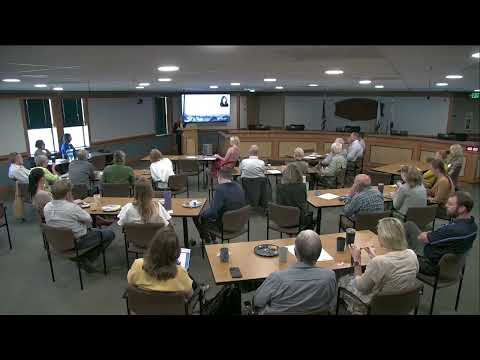
Anna Roth, chief executive officer of Tahoe Forest Health System, told the Truckee Chamber of Commerce onstage that the health system is expanding outpatient capacity across the north shore and is tracking federal changes to Medicare and Medicaid that could materially reduce revenue.
Roth said the system is increasingly focused on outpatient services: “87% of our revenue is actually coming from outpatient care,” she said, and described planned expansions at the Gateway Center, the Sierra Center (the former Rite Aid on Donner Pass Road) and a newly named North Shore Clinic. She said the Gateway Center, at full capacity, could handle about 80,000 visits a year.
The expansion plans are tied to access and affordability goals. Roth said leaders will use data to site services where demand is highest and to achieve volumes that lower per-visit costs. “One of our stretch goals for this year is to really come up with an affordability plan around those common things,” she said, adding the system wants to make “common diagnostics” more convenient and affordable so residents do not have to travel for care.
Roth also framed the expansion and financial planning amid national policy changes. She said the system estimates that applying recent cuts in Medicare and Medicaid directly to last year’s payer mix “would well exceed $10,000,000 loss a year, every year.” She noted legislation includes a $50 billion rural hospital loan program but characterized that program as largely symbolic relative to projected losses.
Roth described Tahoe Forest as a “right-sized community asset” that provides specialty services in a small-hospital setting; she said the system saw roughly 55,000 visits systemwide last year and “almost 15,500” in Truckee. She also described strong patient-satisfaction scores, saying Tahoe Forest ranks among the top performers in the state.
On advocacy, Roth said system leaders are engaged with state and national associations and have discussed concerns with Congressman Kiley’s office. She urged community partnership and feedback, noting she brought handouts for attendees and invited comments: “This is the kind of board you want to work for… the needs of the community defined by the community are a key underpinning of everything,” Roth said.
Roth closed by urging community engagement as policy changes roll out. “Change with change, there's always, like, possibility,” she said, and offered to answer questions afterward.
Audience members asked follow-up questions during the Q&A about quality ratings and the implications of federal changes for Medicaid enrollment and charity care. In response to a question about Medicare/Medicaid star ratings, Roth said rating systems have limits for small hospitals and that some rural hospitals do not receive scores because they lack the volume required by the measure.
Roth's presentation centered on access expansions, affordability strategies, and contingency planning for federal payer changes; she emphasized outreach to state and federal policymakers as the next step.