Get Full Government Meeting Transcripts, Videos, & Alerts Forever!
Get email alerts on the Ev Charging Electrification topic
No spam. Unsubscribe anytime.
Los Alamos moves ahead on EV charging and electrification planning; county wins DC fast‑charger grant
Summary
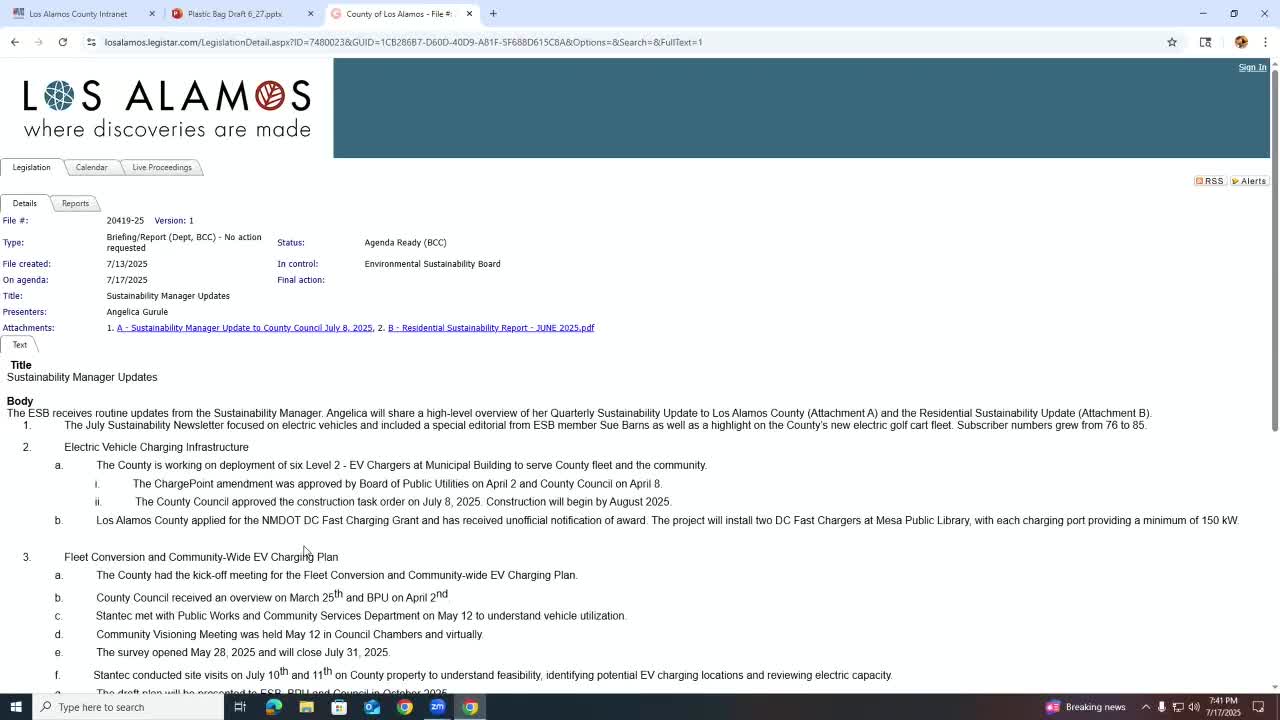
Los Alamos County staff reported July 17 that council has approved a task order for construction of six Level‑2 EV chargers at the municipal building and that the county received unofficial notice of a state grant for two 150 kW DC fast‑charger ports planned for Mesa Public Library.
Los Alamos County staff and board members reported on July 17 that the county is moving forward with several electrification and infrastructure initiatives, including municipal level‑2 electric vehicle chargers and a grant for high‑power DC fast chargers.
Angelica, the county sustainability staff member who provided the report, said County Council approved a task order allowing construction of six new Level‑2 EV chargers at the municipal building; final electrical design updates were underway and staff expected construction to begin in the coming weeks. She also reported that the county received unofficial notice of an NMDOT grant to install two DC fast chargers with a minimum 150 kilowatt output per port at the Mesa Public Library.
Sue Barnes summarized recent Board of Public Utilities (BPU) activity. She said the Foxhill Flat solar and storage project near Farmington is ready to begin construction pending Bureau of Indian Affairs approvals and that the BPU is finalizing a power coordination agreement with Los Alamos National Laboratory expected by late August. Barnes also discussed an electrification study completed by Burns & McDonnell: the study projects that Los Alamos can achieve deep electrification by the mid‑21st century with infrastructure upgrades, including a new Eastgate substation and White Rock substation improvements, and with capital planning tied to regular infrastructure replacement.
Barnes said battery storage, geothermal and other projects are being evaluated in the region for federal tax‑credit eligibility and that transmission availability remains a key constraint for new generation. She noted a possible Advanced Geothermal base‑load project under UAMPS consideration, and that any large projects would require transmission approvals.
The staff report also touched on water infrastructure and wastewater items of interest: a Jemez Mountain fire‑protection water line and tank project has started, some project components await FEMA funding, and the county is exploring additional well and San Juan‑Chama surface water options. The county’s recycling and diversion statistics were reported: the June diversion rate was 34 percent, with yard trimmings and compost keeping material out of the landfill.
No formal board votes were taken on the infrastructure items reported at the July meeting; staff were asked to continue final design and pursue grant steps and to return to boards with more detailed timelines and budget information as projects move toward construction.