Get Full Government Meeting Transcripts, Videos, & Alerts Forever!
Get email alerts on the Zoning Alcohol topic
No spam. Unsubscribe anytime.
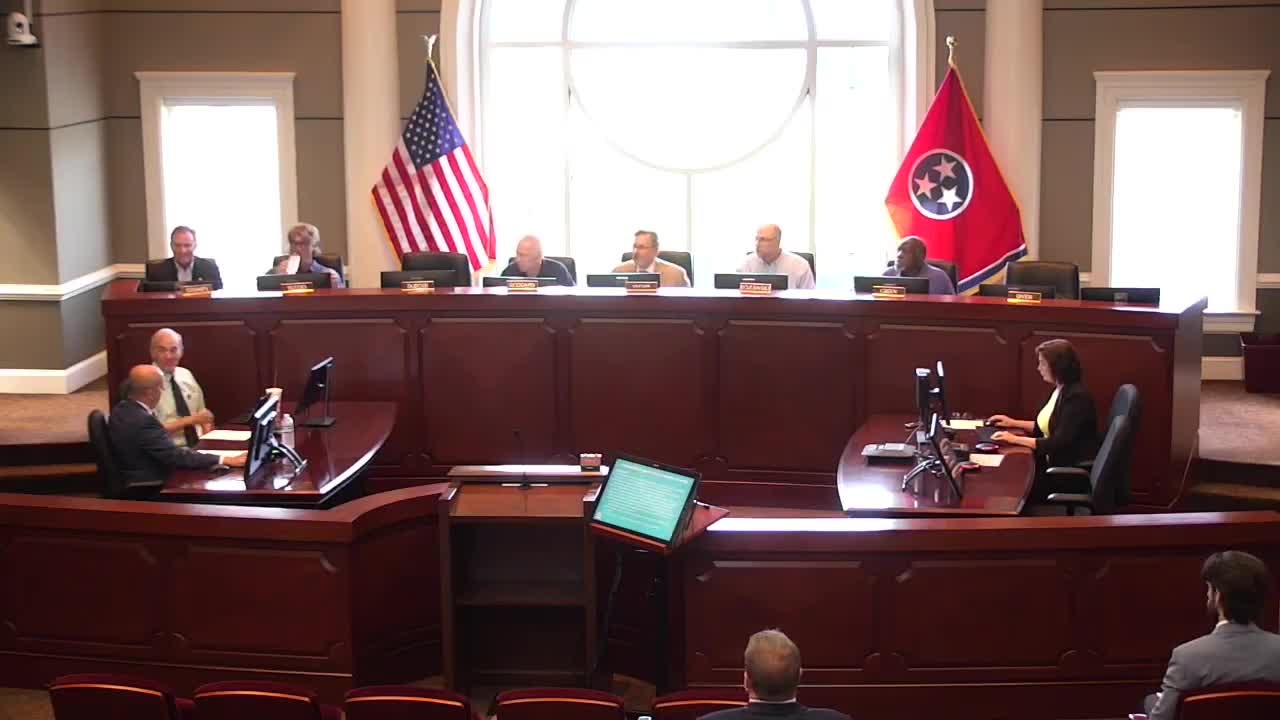
Planning commission recommends zoning changes to Collierville alcohol rules; sends ordinance to mayor and board
Summary
The Collierville Planning Commission voted 4-3 at its meeting to recommend Ordinance 2025-08, a zoning amendment that would align the zoning ordinance with proposed town-code changes governing alcohol permits and related uses, sending the measure to the Board of Mayor and Aldermen for further consideration.
The Collierville Planning Commission voted 4-3 at its meeting to recommend Ordinance 2025-08, a zoning amendment that would align the zoning ordinance with proposed town-code changes governing alcohol permits and related uses, sending the measure to the Board of Mayor and Aldermen for further consideration.
The measure would remove several zoning-specific restrictions tied to alcohol sales, including some conditional-use requirements and distance buffers between establishments and churches or schools; reclassify many alcohol-related uses so they are treated like other retail or commercial businesses; create new use categories such as nightclubs, microdistilleries and micro-wineries; allow temporary alcohol service at permitted special events on the town square; and replace a fixed cap on liquor stores with a population-based metric (proposed at one liquor store per 10,000 residents). The ordinance is paired with separate town-code changes (referred to in materials as Ordinance 2025-09) that adjust beer-permit classifications and other licensing rules.
Jamie (planning staff) presented the draft ordinance and said the zoning changes are a staff-initiated effort to “sync up” the zoning ordinance with the town-code revisions. Adam Hamrick (administration) explained how the zoning changes relate to the town code and enforcement: “The town regulates beer; the state regulates wine and, hard liquor,” Hamrick said, noting that the town was trying to remove certain zoning provisions so the code and zoning sections match. Mike Clark, Collierville’s economic development director, framed the changes as an economic-development tool, saying the proposal is intended to “have a positive impact on the local economy and enable business models that either don't currently exist or already exist that could operate differently.”
Public and commission discussion focused on safety, proximity to schools and churches, and enforcement. An unidentified resident said, “You might call me ultra conservative but I've got several concerns about relaxing the alcohol standards in our city,” raising questions about crime and whether loosening rules could attract problem venues. Commissioners and staff discussed specific technical details: currently the town code imposes a hard cap of three liquor stores; the draft would change that to a ratio tied to the federal census (one per 10,000 people in the draft). Staff said distance requirements vary by location now (150–200 feet on the town square; 500 feet elsewhere) and the zoning proposal would remove those distance restrictions to treat alcohol sales the same as other retail products. Adam Hamrick said the 150–200/500-foot buffers are proposed to be removed so alcohol would be regulated similarly to other products (for example tobacco or CBD) with site-specific scrutiny handled through zoning, site-plan review, and other administrative checks.
Commissioners pressed how enforcement would work if problems arose. Clark and staff said municipal oversight remains substantial: municipalities regulate beer permits in Tennessee and the town's beer board and police compliance operations (including undercover compliance checks) can revoke beer-permit privileges. Staff also noted the mayor’s signature on a state-required certificate of compliance remains part of the process for state-issued permits; staff said that certificate can be withheld if the mayor finds the location or proposed operation inappropriate.
Supporters in staff presentations cited local planning documents. Staff said the proposals align with the town’s 2040 plan and an earlier downtown “live-work-play” initiative that encouraged mixed-use and entertainment venues as part of economic revitalization; staff pointed to examples where microbreweries and microdistilleries became catalysts for downtown redevelopment in other communities.
After extended discussion the commission moved to recommend approval. The vote, taken by roll call, produced four votes in favor and three opposed; the motion passed and the ordinance was forwarded to the Board of Mayor and Aldermen. Staff advised that, if recommended by the board, the ordinance would proceed through three readings; the second reading and public hearing were scheduled by staff materials for Aug. 11, at which point the town-code companion (Ordinance 2025-09) would be considered with a concurrent public hearing.
The commission’s action was a recommendation only; final adoption requires Board of Mayor and Aldermen approval and, where applicable, state licensing for wine or spirit permits.
Votes at a glance: motion to recommend Ordinance 2025-08 to the Board of Mayor and Aldermen — Passed, vote tally 4–3.