Get Full Government Meeting Transcripts, Videos, & Alerts Forever!
Get email alerts on the Creek Cleanup Contract 3b topic
No spam. Unsubscribe anytime.
Volunteers, environmental groups urge SAFeco to support creek cleanups and reconsider Corpsrock-trench design
Summary
At the Sacramento Area Flood Control Agency July meeting, volunteers and local advocacy groups urged SAFeco to help clean debris from creeks and questioned the U.S. Army Corps of Engineers' proposed "launchable rock trench" approach in Contract 3B, pressing for bioengineered alternatives and a pause in approvals.
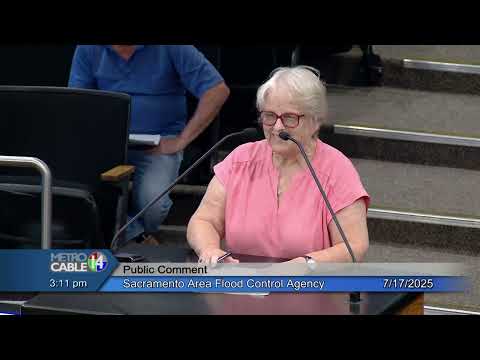
Speakers at the Sacramento Area Flood Control Agency meeting on July 17 urged the agency to join local efforts to clear decades of debris from creeks that feed the American River and to press the U.S. Army Corps of Engineers for alternatives to a rock-lined bank-protection design in Contract 3B.
Community volunteers and nonprofit advocates said the creek channels near SAFeco property are clogged with trash and illegal-encampment debris that volunteers are removing by hand. Lisa Sanchez, a volunteer with River City Waterway Alliance, told the board, "We need a partnership of all of these agencies working together to include SAFeco to help us with that." Sanchez described removing an estimated 800-pound mattress and other heavy debris during a recent cleanup.
The public comments also focused on the Corps' planned bank-protection technique for the Lower American River, referred to in meeting remarks as "launchable rock trenches". Nancy Niskerin, a resident of College Greens East, cautioned against the approach, saying the design risks removing riparian trees and soil that form habitat on the riverbank and could create large maintenance needs if the rock "launches." Pete Spalding, representing American River Trees, said his group has submitted a 22-page technical memorandum illustrating bioengineering alternatives and asked SAFeco and partner agencies to consider surgical, targeted approaches that minimize tree removal.
Why this matters: The American River Parkway and its tributary creeks are widely used and considered an environmental and recreational asset in the region. Board members present for the meeting include representatives who also sit on related regional bodies; speakers urged the agency to use its property and influence to coordinate a multi-agency cleanup and to press the Corps for less-destructive erosion-control alternatives.
Discussion details: Lisa Sanchez said volunteers have contacted multiple agencies, including the city and county, the American River Flood Control District, the Central Valley Regional Water Quality Control Board and Fish and Game, but described the responses as finger-pointing over responsibility. "Everybody just says it's not their responsibility to clean the debris that lands in the creek channels," Sanchez said.
Nancy Niskerin described engineering tests and environmental tradeoffs for trench-filled revetments and warned that excavation to install those trenches can disturb top-bank vegetation. "This trench that's 23 by 27 feet filled with quarry rock... If it never launches, hallelujah. But it's taken away the biome, the trees, the soil, the habitat," she said.
Pete Spalding said American River Trees supports targeted alternatives and has shared its technical memo with the Corps, the Central Valley Flood Protection Board and Department of Water Resources. "The American River Parkway is the greatest asset that this region has," Spalding said, urging the board to "take the time to do this right." He said his group will push at a separate meeting to remove Contract 3B from approval documents until alternatives are fully considered.
Board response: Board members did not take formal action on the public comments during the meeting. Several directors present also serve on related flood-control bodies; Pete Spalding noted Directors Holloway and Johns are members of the American River Flood Control District. Agency staff did not announce a new course of action during the public-comment item.
What remains unsettled: Speakers asked SAFeco to help coordinate cleanup work and to press for alternative engineering approaches for Contract 3B; the Corps' planned design and any formal approvals or contract schedules were not altered at the meeting. Requests for targeted preservation of heritage trees and reduced parkway impacts remain open as public advocates seek additional review and potential changes in project documents.
Ending: Public commenters urged SAFeco to use its convening role with partner agencies to resolve responsibility for creek debris and to ask the Corps to revisit bank-protection alternatives. The board moved on to other agenda items without adopting new policy or directing a specific next step on the Contract 3B concerns.