Get Full Government Meeting Transcripts, Videos, & Alerts Forever!
Get email alerts on the Missing And Murdered Indigenous Relatives topic
No spam. Unsubscribe anytime.
Organizers behind Sing Our Rivers Red urge stronger cross‑jurisdiction response to Missing and Murdered Indigenous Relatives
Summary
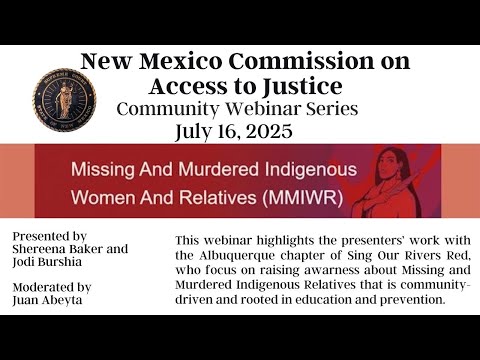
At a New Mexico Courts webinar, organizers and researchers behind Albuquerque’s Sing Our Rivers Red described grassroots outreach, student-focused prevention work and persistent gaps in prosecution, data and services for Missing and Murdered Indigenous Relatives.
Jody Bershey, an assistant professor at New Mexico Highlands University, and Shareena Baker, a University of New Mexico Ph.D. student, told a New Mexico Courts Access to Justice webinar that community organizers and campus groups in Albuquerque are working to fill gaps left by law enforcement, public agencies and interrupted statewide efforts to address Missing and Murdered Indigenous Women and Relatives (MMIWR).
The pair — who represent the Albuquerque chapter of Sing Our Rivers Red — summarized years of local events, student projects, collaborations with advocacy groups and outreach intended to raise awareness, provide culturally rooted victim supports and press for clearer cross‑jurisdictional investigations. “Justice delayed is justice denied. The time for empty promises is over,” Baker said, reading a slogan the organizers use at events.
Why it matters: presenters said MMIWR cases too often fall into jurisdictional and administrative gaps that leave families waiting years for investigations or with no federal involvement. The presenters cited federal and local obstacles — from which authorities prosecute to how evidence and paperwork move between offices — and urged stronger coordination and funding for culturally appropriate victim services.
Bershey summarized prosecution gaps she had seen in research and community reporting: “The FBI data shows U.S. attorneys declined to prosecute 46%,” she said, and she added that “less than 1 percent” of MMIWR cases receive federal attention, as reported by community researchers. She and Baker described how the complex mix of tribal, federal and state jurisdiction and uneven tribal adoption of changes in the Violence Against Women Act has contributed to inconsistent outcomes for victims and survivors.
The presenters described practical community responses they have organized: campus film projects and short films by students demonstrating safe‑dating and buddy systems; panel discussions and film screenings that connect students with counselors; self‑defense classes (including sessions with a former UFC champion); fundraising to help families with travel costs for hearings; and collaboration with groups including the Coalition to Stop Violence Against Native Women, Seventh Generation Fund, Sovereign Bodies Institute and local university CARES teams.
They also raised operational problems that slow investigations: an unnamed local law enforcement officer told the presenters that paperwork and evidence sometimes remain in paper form at tribal offices and must be hand‑delivered and scanned before being forwarded, creating delays and lost files. Bershey and Baker described community efforts to help families navigate the system and to point grieving relatives toward checklists and resources compiled by advocates.
The webinar noted a recent policy change in New Mexico: the state has established a turquoise alert system to broadcast missing Indigenous individuals, and webinar hosts said the first state turquoise alert had been issued days earlier. The presenters also recalled that a New Mexico Missing, Murdered and Indigenous Relatives task force had been disbanded, removing one statewide avenue families had used for coordination and information.
On data and evidence: the presenters and an officer who spoke with them described a backlog of unprocessed evidence kits in some jurisdictions. They cautioned that counts vary and some figures are compiled from community databases rather than official tallies; Baker and Bershey encouraged use of community resources such as the Sovereign Bodies Institute’s database and tribal missing‑persons reporting where available.
Cultural considerations were a recurring theme. Presenters said some families and tribal traditions discourage publicly repeating the names of people who are missing or deceased; organizers said they defer to family wishes and leave name‑use to relatives rather than standardize a single public practice. They also cautioned against commercialized or performative awareness efforts that do not contribute funds or services to families and frontline organizations.
The New Mexico Courts host said webinar recordings and presenter handouts would be posted on the New Mexico Courts YouTube channel and sent to registrants. Bershey and Baker offered to share contact details and to pass along vetted lists of culturally rooted shelters and legal service providers; they also identified DNA Legal Services (serving parts of the Navajo Nation and surrounding areas) as one existing legal option for tribal communities.
The presenters concluded by stressing community roles in sustaining attention and assistance: organizing campus events, coordinating local resources, connecting families to advocacy groups, and pressing for consistent cross‑jurisdictional investigation and funding for culturally rooted victim services.