Get Full Government Meeting Transcripts, Videos, & Alerts Forever!
Get email alerts on the Tax Increment Financing topic
No spam. Unsubscribe anytime.
Debate over county guidance on tax-increment financing surfaces at Marathon County meeting
Summary
County supervisors discussed a resolution (Res. 36-25) that would direct Marathon County's representative on tax-increment district joint review boards; public comment and several supervisors pressed for stricter controls on TIF payback periods and adherence to Department of Revenue guidance, while others defended TIF as essential to development.
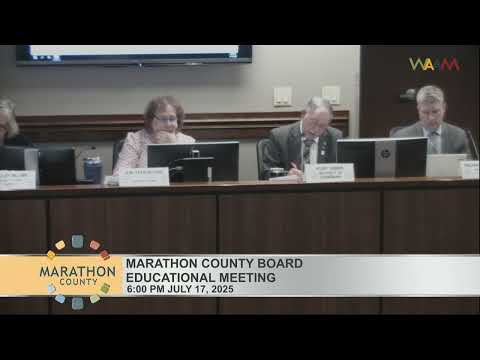
Peter Weinshank, a resident of Edgar, asked the Marathon County Board of Supervisors on July 17 to reject a committee-backed resolution on tax-increment financing and instead send the measure to the Human Resources, Finance and Property Committee or amend it to require stricter limits and mandatory Department of Revenue practices.
Weinshank told the board, “TIF in Marathon County is out of control. There's $1,400,000,000 worth of county TIF property in 2024,” and urged supervisors to require joint review boards to follow Department of Revenue recommended best practices and to mandate taxpayer repayment within 38 years for new tax-increment districts.
The item under discussion was Resolution 36-25, “a resolution providing direction to Marathon County's representative on tax incremental district joint review boards and Marathon County administration regarding Marathon County's evaluation of future proposed tax incremental districts.” The resolution was on the agenda for discussion; no formal vote was recorded during the meeting.
Supervisor Fiffrick argued against the criticisms of TIFs presented by some speakers, saying the joint review board reviews whether “this development would not happen but for the financial support of TIF.” Fiffrick said TIF can enable otherwise-unviable projects, avoid general-fund expenditures for infrastructure and help municipalities remain competitive.
By contrast, Supervisor Rosenberg said the resolution “does nothing” and no longer reflected the task force’s earlier objectives to shorten TID lifespans and require stricter acceptance criteria; Rosenberg said he would introduce amendments requiring 38-year payback periods and mandatory adherence to the Department of Revenue’s 10 standards.
Supervisor Sandalski asked county administration whether tax bills would automatically fall when TIDs close; Administrator Leonard replied, “The short answer is I don't get to decide what happens with, after a TID closure. That's driven by state statute,” and explained that when a TID closes the added taxable value is similar to net new construction and can reduce the overall tax rate as it spreads across the tax base.
The discussion included statistics and competing views about taxpayer cost and local development policy but did not produce a recorded motion or vote on Resolution 36-25 during the July 17 meeting. Supervisors discussed potential amendments and whether to refer the resolution to another committee for further work.
What happens next: supervisors said the resolution (Res. 36-25) would remain part of committee and board review; no formal board action was recorded at the meeting.